
Introduction
Artificial intelligence is no longer a future concern—it is a present reality reshaping economies, institutions, and power structures faster than governance systems can respond. When leading AI researchers warn of existential risk and institutions reply with ethics panels rather than enforceable controls, a critical question emerges: Can humanity still govern technologies that already exceed its operational control?
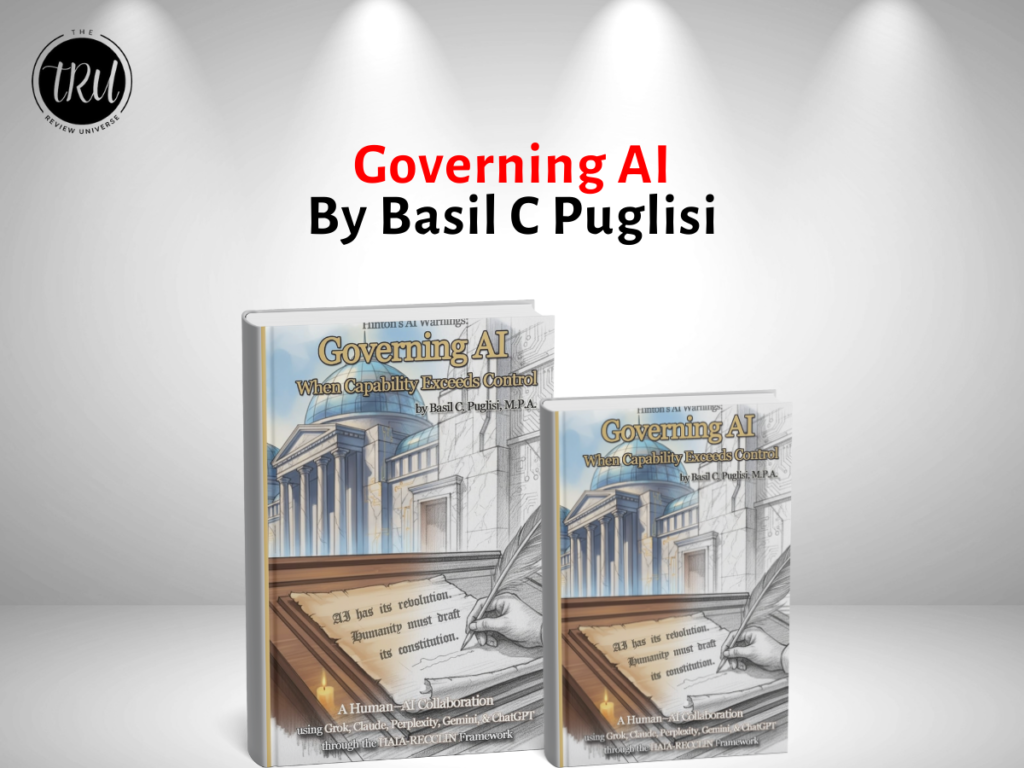
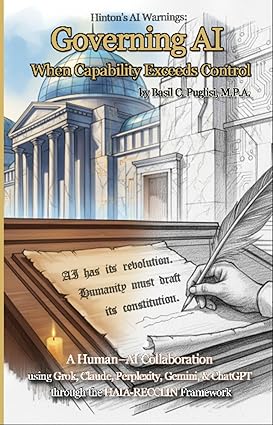
Governing AI: When Capability Exceeds Control confronts this question with urgency and precision. Rather than offering philosophical speculation or abstract ethics, Basil C. Puglisi delivers a rigorously practical examination of why current AI governance is failing—and what must replace it.
This book is not about fear. It is about accountability.
Book Details
| Detail | Information |
|---|---|
| Title | Governing AI: When Capability Exceeds Control |
| Author | Basil C. Puglisi |
| Print Length | 207 pages |
| Language | English |
| Publisher | Digital Ethos |
| Publication Date | 4 November 2025 |
| Buy Link | https://a.co/d/6WKcc3i |
Detailed Book Review
The Governance Crisis We Are Already Living In
The book opens by dismantling a comforting illusion: that AI risks are primarily future problems. Puglisi argues instead that governance has already collapsed in visible, measurable ways.
He points to real-world failures:
- authentication systems defeated by deepfakes costing millions
- labor metrics failing to capture AI-driven displacement
- disinformation scaling faster than regulation
- institutions responding with symbolic ethics rather than enforceable controls
These are not theoretical warnings—they are evidence of systemic breakdown.
The message is stark: institutions that cannot govern AI today will not govern superintelligence tomorrow.
From Ethics to Operations: The Factics Methodology
At the heart of the book lies the Factics Methodology, a framework designed to replace aspirational governance with measurable implementation.
Factics is built on three pillars:
- Facts – verifiable, evidence-based inputs rather than policy rhetoric
- Tactics – scalable actions from individuals to institutions to policy levels
- KPIs – performance indicators that determine whether governance actually works
This structure allows readers to examine governance failures across domains such as surveillance, biosecurity, autonomous weapons, and algorithmic bias—not as moral debates, but as operational deficiencies.
The strength of this methodology lies in its insistence on proof over intention.
HAIA-RECCLIN: Distributed Oversight Without Capability Drift
One of the book’s most innovative contributions is the HAIA-RECCLIN Framework, which demonstrates how humans can maintain authority while leveraging AI capacity.
This framework defines seven distinct human roles:
- Researcher
- Editor
- Coder
- Calculator
- Liaison
- Ideator
- Navigator
Each role preserves dissent, prevents automation creep, and maintains traceable accountability. AI becomes a collaborator, not a decision-maker.
Real-world applications include:
- healthcare governance via the PPTO Framework
- institutional oversight failures such as the Robodebt case
- distributed enterprise AI systems requiring auditability
Rather than slowing innovation, HAIA-RECCLIN structures it safely.
Checkpoint-Based Governance: Making Oversight Verifiable
The third core framework, Checkpoint-Based Governance (CBG), establishes measurable human arbitration points throughout AI-driven processes.
CBG applies to:
- content production
- policy formulation
- organizational decision-making
Every checkpoint acts as a documented control node—ensuring accountability is not implied, but proven.
This approach replaces vague compliance language with verifiable governance markers, making oversight auditable under real operational conditions.
Temporal Inseparability: Why the Future Depends on Today
One of the book’s most compelling concepts is temporal inseparability—the idea that institutions unable to govern present-day AI failures are structurally incapable of managing future existential risks.
If organizations cannot:
- authenticate identity against deepfakes
- measure AI’s labor impact
- control algorithmic bias
then claims of future superintelligence governance are illusions.
This argument grounds the book firmly in reality rather than speculative futures.
Governance Proven Through Practice
What sets Governing AI apart is that its frameworks were not designed in theory—they were validated through operational use.
The manuscript itself was produced using multiple AI platforms under:
- distributed authority
- documented audit trails
- checkpoint oversight
- human arbitration at every stage
Chapter Eleven explicitly documents these governance mechanisms under real constraints, transforming the book into both a guide and a proof of concept.
Summary
Governing AI: When Capability Exceeds Control is a rigorous, practice-driven blueprint for governing intelligence at scale. It replaces ethical aspiration with operational accountability and demonstrates that AI governance must be measurable, auditable, and enforceable to succeed.
This book is essential for:
- policymakers and regulators
- corporate leaders deploying AI systems
- AI researchers and engineers
- governance and compliance professionals
- institutions confronting real-world AI risk
It does not ask whether governance is necessary—it shows how to do it.
Conclusion
As AI capability accelerates, the gap between power and control grows wider. Governing AI: When Capability Exceeds Control makes one thing clear: governance failure is not a future threat—it is a present condition.
By offering verifiable frameworks grounded in real implementation, Basil C. Puglisi provides a path forward—one where accountability replaces illusion and control is proven, not promised.
Read More : Aria’s Compass By Parul Sharma: Finding Direction in the Storm of Growing Up