
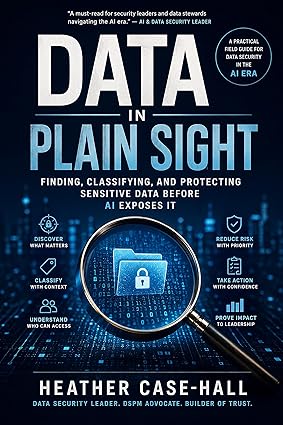
As artificial intelligence becomes deeply integrated into modern workplaces, organizations face a new challenge: protecting sensitive data that has long been overlooked. Traditional cybersecurity strategies focused primarily on securing systems, but today’s AI-powered tools can quickly surface forgotten, overexposed, or poorly governed information. In Data in Plain Sight: Finding, Classifying, and Protecting Sensitive Data Before AI Exposes It, Heather Case-Hall provides a practical roadmap for organizations seeking to strengthen data security before hidden risks become costly breaches.
Drawing on more than two decades of experience in cybersecurity, IT, and enterprise security architecture, the author presents an implementation-focused guide that helps readers understand how modern data security extends beyond technology to include governance, identity management, privacy, and organizational accountability.
Book Details
| Detail | Information |
|---|---|
| Title | Data in Plain Sight: Finding, Classifying, and Protecting Sensitive Data Before AI Exposes It |
| Author | Heather Case-Hall |
| Print Length | 411 Pages |
| Language | English |
| Publication Date | July 7, 2026 |
| Genre | Cybersecurity, Data Security, Artificial Intelligence, Information Technology |
| Book Link | https://a.co/d/0cglvk8k |
Review
One of the book’s greatest strengths is its timely focus on the relationship between artificial intelligence and data security. Heather Case-Hall argues that organizations can no longer rely solely on traditional perimeter defenses because AI systems, automation platforms, and collaborative technologies increasingly interact with data spread across cloud environments, SaaS applications, developer repositories, databases, backups, and shared file systems. This shift makes data governance itself a primary security concern.
Rather than presenting AI as the problem, the book emphasizes that the real risk lies in unmanaged and poorly governed data environments. The author explains how sensitive information often remains hidden in places organizations no longer actively monitor, creating significant exposure once AI-powered tools gain access to those environments. This practical perspective encourages proactive preparation rather than reactive incident response.
A major highlight of the book is its detailed explanation of Data Security Posture Management (DSPM) and its role within a broader security strategy. Instead of treating DSPM as an isolated technology, Heather Case-Hall demonstrates how it connects with identity and access management, data loss prevention (DLP), governance, privacy operations, retention policies, remediation workflows, executive reporting, and AI readiness. This integrated approach helps readers understand how different security disciplines work together to reduce organizational risk.
The implementation-oriented nature of the guide also sets it apart. Rather than focusing on theoretical frameworks or vendor-specific recommendations, the author provides practical guidance on identifying and classifying sensitive data, prioritizing remediation based on exposure and business context, reducing excessive permissions, addressing stale or orphaned data, and building structured security programs. The inclusion of a practical 30-, 60-, and 90-day roadmap gives readers actionable direction for initiating or improving their own data security initiatives.
Another notable strength is the book’s ability to communicate complex cybersecurity concepts in accessible language. Technical topics such as governance, identity management, AI integration, privacy operations, and executive risk reporting are explained with clarity, making the material valuable for both experienced security professionals and business leaders responsible for organizational risk management.
The author’s emphasis on business communication is equally important. Beyond technical implementation, the book highlights the importance of translating cybersecurity efforts into meaningful outcomes for executives and boards. This broader leadership perspective reinforces the idea that effective data security is not solely an IT responsibility but an organizational priority that supports trust, compliance, and responsible AI adoption.
Why This Book Matters
As organizations rapidly adopt AI technologies, many are discovering that their data governance practices have not evolved at the same pace. Data in Plain Sight addresses one of today’s most pressing cybersecurity challenges by encouraging organizations to understand, classify, secure, and govern their data before connecting it to AI-driven systems.
Its focus on practical implementation, cross-functional collaboration, and long-term governance makes the book especially valuable for cybersecurity professionals, CISOs, security architects, IT leaders, compliance teams, privacy officers, and executives responsible for digital transformation.
Rather than advocating for more security tools alone, the book emphasizes that sustainable cybersecurity begins with understanding where sensitive data exists, who has access to it, and how it should be governed in an increasingly AI-enabled world.
Final Thoughts
Data in Plain Sight: Finding, Classifying, and Protecting Sensitive Data Before AI Exposes It is a comprehensive and highly practical guide to modern data security. Heather Case-Hall successfully bridges cybersecurity, governance, privacy, identity management, and AI readiness into a clear operational framework that organizations can implement regardless of their current maturity level.
For professionals seeking to strengthen data governance, reduce cyber risk, and prepare their organizations for responsible AI adoption, this book offers timely insights and actionable guidance that extend well beyond traditional cybersecurity practices.