
Artificial intelligence is changing the relationship between knowledge, decision-making, institutions, and leadership. As intelligence becomes increasingly accessible through AI systems, the challenge is no longer simply about producing information. It is also about how that intelligence is organized, governed, directed, and used.
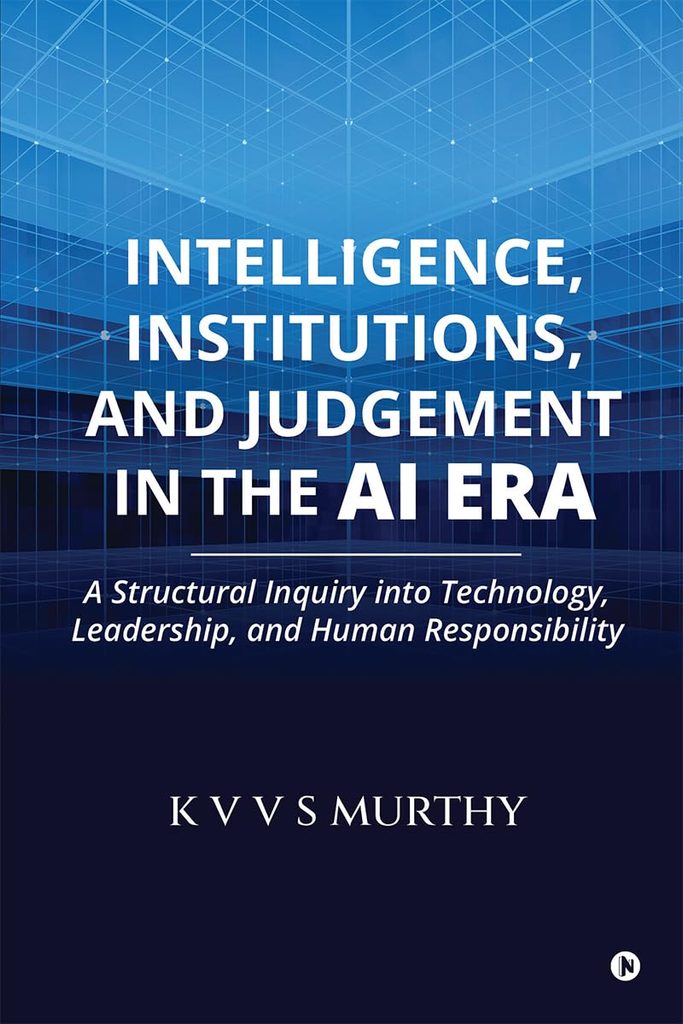
Intelligence, Institutions, and Judgement in the AI Era by K V V S Murthy examines this transition through a structural perspective, focusing on the changing role of institutions and the continuing importance of human judgement and responsibility.
Book Details
| Detail | Information |
|---|---|
| Book Title | Intelligence, Institutions, and Judgement in the AI Era: A Structural Inquiry into Technology, Leadership, and Human Responsibility |
| Author | K V V S Murthy |
| Genre | Artificial Intelligence / Leadership / Technology / Philosophy |
| Language | English |
| Pages | 184 |
| Publication Date | August 14, 2026 |
| Book Link | https://www.amazon.in/dp/B0HF85NKQM |
Review
At the center of the book is a significant shift brought about by artificial intelligence: intelligence is becoming less scarce and more accessible. This changes the nature of the challenge facing individuals and institutions. The question becomes not simply how to create knowledge, but how to structure and apply it effectively.
K V V S Murthy examines intelligence as something that must operate within systems. Knowledge and intelligence alone do not automatically produce outcomes. They require direction, coordination, institutions, and decision-making structures that can turn available intelligence into meaningful action.
The book places particular emphasis on institutions and their ability to evolve alongside technological change. As AI becomes increasingly integrated into organizational and decision-making processes, institutions must consider how intelligence is organized, governed, and controlled.
Judgement forms another central theme. While AI can make intelligence more abundant and accessible, the book explores what remains important in human decision-making. This creates a broader discussion around responsibility and the role humans continue to play when increasingly capable technological systems participate in complex decisions.
The question of control also adds another dimension to the discussion. Who controls the systems that shape and organize intelligence? How should leaders navigate environments where information and analytical capabilities are increasingly available? These questions connect technology with leadership, institutional design, and responsibility.
Final Thoughts
Intelligence, Institutions, and Judgement in the AI Era presents a structural exploration of how AI may reshape intelligence, institutions, leadership, and decision-making. K V V S Murthy focuses on the transition from intelligence scarcity to intelligence abundance while emphasizing the continuing importance of judgement and human responsibility.