
Book Details
| Detail | Information |
|---|---|
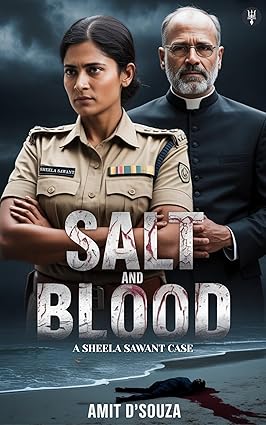
| Title | SALT AND BLOOD: A Sheela Sawant Case |
| Author | Amit D’Souza |
| Publisher | Tridev Publishers |
| Language | English |
| Print Length | 210 pages |
| Publication Date | 14 December 2025 |
| Genre | Crime Thriller, Psychological Fiction |
| Buy Link | https://amzn.in/d/czR4kYe |
Introduction
Crime fiction often relies on fast pacing and shocking twists, but SALT AND BLOOD: A Sheela Sawant Case takes a more measured and introspective route. This novel begins with what appears to be a solvable crime, yet quickly unfolds into a layered investigation where certainty is elusive and truth resists easy answers. It is a story less about spectacle and more about the quiet tension that builds when human behavior, fear, and secrecy collide.
Story Overview
Inspector Sheela Sawant is assigned a case involving a body discovered under disturbing and unfamiliar circumstances. From the outset, the evidence feels fragmented and unreliable. Clues contradict each other, witnesses reveal only partial truths, and every logical assumption seems to dissolve under closer scrutiny.
As Sheela digs deeper, the investigation shifts from a search for facts to an exploration of motives, silences, and emotional undercurrents. Each lead forces her to reassess not only the case, but her own instincts as an investigator. The story unfolds gradually, allowing uncertainty to take center stage rather than offering immediate resolution.
Psychological Depth and Human Complexity
What sets Salt and Blood apart is its strong focus on psychological realism. The novel examines how people behave when trapped by fear, guilt, or desire. Characters are not defined by clear moral boundaries but by hesitation, panic, and vulnerability. This ambiguity becomes the emotional core of the narrative.
Inspector Sheela Sawant is portrayed not as an infallible authority figure, but as a thinking, questioning individual. As professional responsibility begins to blur with personal reflection, her internal conflicts add a quiet but persistent tension to the investigation. The crime is not just something to be solved; it is something that leaves a mark.
Themes of Ambiguity and Accountability
At its heart, Salt and Blood is a meditation on ambiguity and accountability. The novel resists neat conclusions, instead asking readers to consider how truth is shaped by perspective, timing, and human weakness. Choices made in moments of panic or emotional exposure echo long after the event itself, and the consequences are rarely clean or contained.
This approach makes the book especially appealing to readers who appreciate crime fiction grounded in realism rather than formula. The story does not rush to judgment, allowing space for reflection on how easily certainty can collapse.
Writing Style and Atmosphere
The writing style is restrained and atmospheric, relying on mood rather than dramatic excess. The pacing mirrors the investigative process, slow and deliberate, drawing readers deeper into the psychological landscape of the case. The setting and emotional tone reinforce the sense of unease, making the novel immersive without relying on sensationalism.
The narrative voice maintains a steady balance between external investigation and internal observation, giving equal weight to action and introspection.
About the Author
Amit D’Souza is an Indian author, songwriter, and IT professional known for blending fiction with deep emotional insight. Raised in Mumbai and Goa, he spent more than two decades in the corporate world before turning to writing, a background that informs his nuanced understanding of human behavior.
His previous works include Unhinged, a corporate drama exploring ambition and loyalty; An Evening Full of Glow Worms, a short story collection rooted in survival and resilience; Handful, a set of emotionally driven stories; and Unorthodox Leadership & Animalism, which challenges traditional management thinking through metaphor and observation.
Beyond writing, D’Souza is also a songwriter, composer, practicing martial artist, and aspiring rifle shooter. He has earned praise from readers and bloggers for his evocative storytelling and is recognized as a distinctive voice in contemporary Indian literature, with upcoming projects spanning crime, military thrillers, and fantasy.
Conclusion
Salt and Blood: A Sheela Sawant Case is a thoughtful and character driven crime thriller that prioritizes psychological depth over spectacle. By focusing on ambiguity, human behavior, and the fragile nature of truth, the novel offers a reflective reading experience that lingers beyond the final page.
For readers who value crime fiction rooted in realism, introspection, and moral complexity, this book delivers a quietly powerful narrative that challenges assumptions and invites deeper engagement.