
In many workplaces today, talented and hardworking people often find themselves asking a frustrating question: Why does effort no longer seem connected to results? Promotions go to the politically skilled rather than the competent. Institutions miss obvious failures despite layers of oversight. Metrics improve while outcomes deteriorate. For many professionals, these experiences feel familiar but difficult to explain.
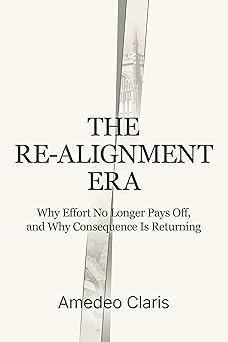
In The Re-Alignment Era: Why Effort No Longer Pays Off, And Why Consequence Is Returning, Amedeo Claris attempts to provide that explanation. Rather than offering motivational advice or productivity hacks, the book delivers a structural analysis of how accountability has gradually eroded across institutions and why the relationship between effort and outcome has weakened in many modern systems.
This is not a comfort-driven business book. It is a serious examination of incentives, governance, accountability, and institutional failure.
Book Details
| Detail | Information |
|---|---|
| Title | The Re-Alignment Era: Why Effort No Longer Pays Off, And Why Consequence Is Returning |
| Author | Amedeo Claris |
| Series | The Re-Alignment Series (Book 1) |
| Print Length | 329 Pages |
| Language | English |
| Genre | Business, Leadership, Organizational Behavior, Economics, Social Analysis |
| Amazon Link | https://www.amazon.co.uk/dp/B0GWRWT5N4 |
Review
The central argument of The Re-Alignment Era is both provocative and highly relevant. Claris suggests that modern institutions have gradually disconnected effort from outcome through a combination of expanding bureaucracy, diluted accountability, credential inflation, governance complexity, and performance metrics that prioritize appearances over results.
According to the author, this breakdown did not happen overnight. It emerged slowly through systems that increasingly rewarded compliance with processes rather than achievement of outcomes. As accountability became distributed across layers of committees, regulations, frameworks, and reporting structures, responsibility became harder to trace and failures became easier to excuse.
What makes the book particularly compelling is its reliance on real-world case studies rather than abstract theory. The analysis draws on major institutional failures such as the Boeing 737 MAX crisis, the Post Office Horizon scandal, the Wells Fargo incentive structure, Carillion’s collapse, NHS performance target failures, and the financial crisis linked to weaknesses in the Basel capital framework. These examples serve as evidence for the author’s broader claim that consequence-free systems eventually generate predictable dysfunction.
One of the book’s strengths is its willingness to challenge popular assumptions. Many contemporary management books focus on personal productivity, mindset shifts, or leadership habits. Claris takes a different approach. He argues that individual excellence alone cannot overcome systems that are structurally misaligned. In such environments, even capable people may struggle to produce meaningful results because incentives reward the wrong behaviors.
The writing is analytical, direct, and unapologetically critical. Readers looking for inspirational anecdotes or optimistic corporate messaging may find the tone challenging. However, readers interested in understanding how institutions function and fail will likely appreciate the depth of the analysis.
Why This Book Feels Timely
The themes explored in this book resonate strongly with current debates surrounding education, corporate governance, public administration, and organizational accountability.
Across many sectors, there is growing concern about credential inflation, declining trust in institutions, ineffective oversight, and performance metrics that fail to reflect real outcomes. Employees often feel trapped in systems where effort and competence are not consistently rewarded, while organizations struggle to understand why increasing layers of management and reporting have not improved performance.
The Re-Alignment Era enters this conversation with a framework that seeks to explain these frustrations at a structural level rather than a personal one.
Whether readers agree with every conclusion or not, the questions raised are difficult to ignore.
Final Thoughts
The Re-Alignment Era is a thought-provoking and intellectually rigorous examination of accountability, incentives, and institutional performance. Amedeo Claris challenges readers to reconsider widely accepted assumptions about success, governance, and organizational effectiveness.
Rather than offering simple solutions, the book provides a framework for understanding why systems fail when consequences disappear and why reconnecting effort with outcomes may be one of the defining challenges of the coming decade.
For leaders, policymakers, business professionals, academics, and anyone interested in how modern institutions actually function, this book offers a compelling and often uncomfortable perspective.