
Building Secure Systems in an Age of Constant Change
Introduction
Security is no longer a layer added at the end of a project. It has become inseparable from how modern technology is designed, built, and operated. Cloud platforms, mobile ecosystems, distributed architectures, and always connected services have reshaped not only innovation but also the nature of risk itself. In this environment, security engineering is not a niche skill. It is a core discipline.
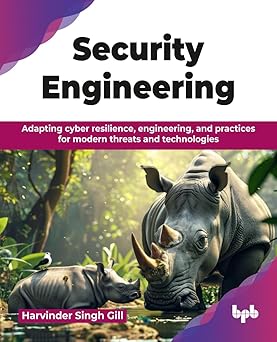
Security Engineering: Adapting Cyber Resilience, Engineering, and Practices for Modern Threats and Technologies addresses this shift with clarity and realism. Rather than relying on abstract theory or checklist driven compliance, the book explores how security actually functions inside modern organizations facing real constraints, evolving threats, and complex trade-offs.
Book Details
| Attribute | Details |
|---|---|
| Title | Security Engineering: Adapting Cyber Resilience, Engineering, and Practices for Modern Threats and Technologies |
| Language | English |
| Print Length | 440 pages |
| ISBN 10 | 9365891655 |
| ISBN 13 | 978-9365891652 |
| Publication Date | 24 December 2025 |
| Format | Paperback and Digital |
| Buy Link | https://amzn.in/d/6T7QsEa |
A Practical View of Modern Security Engineering
This book presents security as an engineering problem rather than a purely defensive one. Each chapter builds on the idea that secure systems emerge from thoughtful design decisions made early and reinforced consistently throughout development and operations.
The content spans essential foundations such as cryptography, access control, and authentication, while also addressing how those fundamentals must adapt in cloud native and distributed environments. The discussion remains grounded, reflecting the realities of legacy systems, rapid deployments, and imperfect tooling that most teams encounter.
Understanding the Adversary and the Human Factor
Modern attackers are adaptive, patient, and strategic. The book dedicates significant attention to how adversaries evolve their tactics and how defenders must respond with resilience rather than reactive controls. Security is framed as an ongoing contest shaped by behavior, incentives, and opportunity.
Equally important is the human element. Security failures are often the result of decision making under pressure, misaligned incentives, or misunderstood risk. By examining human behavior alongside technical controls, the book encourages readers to design systems that anticipate mistakes instead of assuming perfect execution.
Security in Cloud and DevOps Environments
As organizations move toward agile delivery models, the integration of security into engineering workflows becomes critical. The book explores practical approaches for embedding security into DevOps pipelines, cloud configurations, and infrastructure design without slowing innovation.
Readers gain insight into designing cloud native architectures that can withstand attacks, recover quickly, and maintain compliance. Topics such as identity management, access control models, and end to end encryption are explained with both theoretical grounding and practical application in mind.
The Economics Behind Security Decisions
One of the distinguishing features of this book is its exploration of the economic forces that shape security outcomes. Budget constraints, business priorities, and risk tolerance all influence how security is implemented in practice. By addressing these realities directly, the book helps readers understand why certain decisions are made and how to advocate for better security outcomes within organizational limits.
Who Should Read This Book
Security Engineering is well suited for cybersecurity professionals, cloud engineers, architects, and SOC analysts who want to deepen their understanding of how modern security systems are built and maintained. Readers are expected to have a basic foundation in networking and system operations, but the book provides the structure needed to connect foundational knowledge with real world application.
It is particularly valuable for practitioners who want to move beyond tool focused security and develop an engineering mindset that treats security as a system property rather than a checklist.
Conclusion
Security Engineering: Adapting Cyber Resilience, Engineering, and Practices for Modern Threats and Technologies offers a comprehensive and thoughtful examination of security as it exists today. It balances theory with application, technical depth with organizational reality, and defensive thinking with proactive design.
For anyone responsible for building, securing, or maintaining modern digital systems, this book provides the perspective and practical insight needed to approach security as an integral and enduring part of technology.
Read More : 15 books that mix fitness, mindset and storytelling