
Where Sacred Legacy Meets Political Reality
Introduction
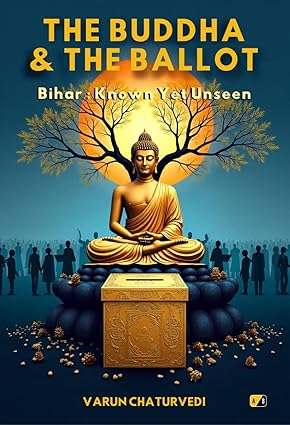
Bihar holds one of the most powerful spiritual legacies in human history. It is the land where Prince Siddhartha attained enlightenment under the Bodhi Tree and became the Buddha. Yet, despite being the cradle of a global faith followed by over 520 million people, Bihar remains locked in cycles of political stagnation and underdevelopment. The Buddha & The Ballot confronts this contradiction head-on, asking why a region with unmatched cultural and spiritual capital continues to lag behind in vision, infrastructure, and global influence.
Written as both analysis and manifesto, this book challenges readers to rethink politics not as an exercise in vote counting, but as a long-term strategy for reclaiming civilizational leadership.
Book Details
| Attribute | Details |
|---|---|
| Title | The Buddha & The Ballot |
| Author | Varun Chaturvedi |
| Publisher | Adhyyan Books |
| Language | English |
| Print Length | 230 pages |
| Publication Date | 1 January 2026 |
| Reading Age | 13 years and up |
| Buy Link | https://amzn.in/d/fZm1WJe |
The Bihar Paradox Explained
At the heart of the book lies what the author terms the Bihar Trap. Despite holding forty strategically important Lok Sabha seats, political discourse in the state remains centered on short-term welfare calculations rather than long-term development. Infrastructure, heritage management, and global engagement are repeatedly sidelined in favor of caste arithmetic and electoral survival.
This approach, the book argues, has led to brain drain, weakened institutions, and the gradual loss of Bihar’s rightful place in Buddhist Asia. While nations like Japan, South Korea, Thailand, and China actively invest in Buddhist diplomacy, Indian presence at Bodh Gaya often appears fragmented and under-resourced.
Untapped Soft Power and the Global Diaspora
One of the book’s strongest contributions is its exploration of Bihar’s forgotten global networks. Through colonial indenture, Bihari communities spread across Mauritius, Trinidad, Fiji, and Southeast Asia. Today, these diasporas retain emotional, cultural, and spiritual ties that remain largely unacknowledged in Indian policy.
Varun Chaturvedi draws from personal journeys across Yangon, Mauritius, and Southeast Asia, uncovering everyday evidence of Bihar’s influence. Taxi shrines, Bhojpuri conversations abroad, Hindu deities inside Buddhist temples, and Thai kings bearing the name Rama all point to a shared civilizational memory that traces back to Bihar. These connections, if activated, could unlock tourism revenue, diaspora investment, and cultural diplomacy on a scale comparable to China’s ASEAN engagement.
Politics Versus Vision
The Buddha & The Ballot does not romanticize history. Instead, it delivers a sharp critique of how political incentives discourage long-term thinking. Heritage sites are left underdeveloped, while foreign-funded temples often outshine domestic efforts. The result is a paradox where enlightenment is globally celebrated, yet locally neglected.
The book calls for a shift from ballot-box politics to ballot-backed vision. Drawing inspiration from demonstration models such as Gujarat’s development cycle, it argues that visible success can create momentum, trust, and sustained reform.
A Blueprint for Renewal
Rather than ending in despair, the book offers a roadmap. Professional heritage management, structured diaspora engagement, infrastructure-led tourism, and strategic cultural diplomacy form the pillars of escape from the Bihar Trap. The message is clear. Bihar is not doomed. It is dormant.
The question is not whether Bihar has the assets to lead Buddhist Asia again, but whether its political imagination is willing to rise to the scale of its inheritance.
Conclusion
The Buddha & The Ballot is both a wake-up call and a declaration of possibility. It reframes Bihar not as a problem to be managed, but as a sleeping giant whose spiritual and geopolitical relevance remains unmatched. For readers interested in Indian politics, cultural diplomacy, development economics, and civilizational strategy, this book offers a compelling and urgent perspective. The throne of enlightenment will not remain vacant forever. Either Bihar claims it with vision, or others will continue to do so in its place.