
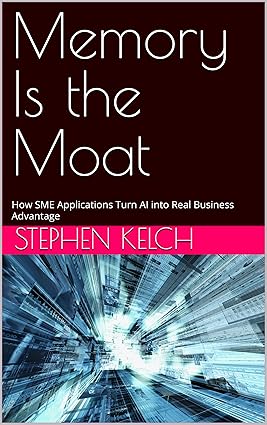
Memory Is the Moat by Stephen Kelch is a sharp and forward thinking book that challenges one of the biggest assumptions in modern AI and enterprise software. Instead of focusing on intelligence alone, the book argues that true competitive advantage lies in memory, the ability to capture, retain, and apply real world decision making knowledge.
It presents a practical framework for building AI systems that actually work in real business environments.
Book Details
| Detail | Information |
|---|---|
| Book Title | Memory Is the Moat How SME Applications Turn AI into Real Business Advantage |
| Author | Stephen Kelch |
| Genre | Business, Technology, Artificial Intelligence |
| Pages | 201 |
| Language | English |
| Publication Date | March 20, 2026 |
| Theme | AI systems, knowledge management, business strategy |
| Ideal Readers | Business leaders, tech professionals, AI practitioners, entrepreneurs |
| Book Link | https://www.amazon.com/dp/B0GTB66226 |
A New Perspective on AI and Business Systems
The book challenges the idea that AI alone can solve business problems. It highlights a critical gap, most systems can process data but fail to capture the reasoning behind decisions.
This shift in perspective makes the book highly relevant in today’s AI driven world.
The Concept of Memory as Advantage
At the core of the book is the idea that memory is the true moat in business systems. Organizations often lose valuable knowledge when it is not documented or structured properly.
By focusing on capturing decision making processes, the book shows how businesses can create lasting advantages.
Introducing SME Applications
The book introduces SME Applications as a new category of systems. These are not generic AI tools but domain specific systems designed to capture knowledge, enforce structured reasoning, and improve over time.
This concept provides a practical alternative to traditional AI implementations.
From Data to Decision Intelligence
The book emphasizes that recording what happened is not enough. Understanding why decisions were made is what creates value.
It explains how systems can be designed to retain context, constraints, and reasoning, making outputs more reliable and trustworthy.
A Practical and Structured Approach
Rather than being purely theoretical, the book provides clear frameworks and architectures. It outlines how to build systems that accumulate knowledge and improve with every use.
This makes it useful for both technical and strategic audiences.
Addressing Real World AI Challenges
The book directly tackles why many AI systems fail in production environments. It explains issues such as lack of context, inconsistency, and inability to scale decision making.
These insights make it highly practical for organizations implementing AI.
Building Long Term Competitive Advantage
A key takeaway from the book is that sustainable advantage comes from systems that learn and improve continuously. By preserving institutional knowledge, organizations can reduce dependency on individuals and create more stable operations.
This long term view adds strategic value to the book.
Final Thoughts
Memory Is the Moat is a powerful and practical guide that redefines how businesses should think about AI. It shifts the focus from intelligence to memory and provides a clear path for building systems that deliver real value.
For leaders and professionals looking to implement AI effectively, this book offers both insight and actionable direction.