
Artificial Intelligence has transformed cybersecurity at an unprecedented pace. Organizations can now detect threats faster, automate investigations, and process massive amounts of security data in ways that were unimaginable just a few years ago. Yet despite these advancements, cyber breaches continue to make headlines. Why? According to Ashutosh Mastud, the answer is surprisingly simple: organizations are focusing on tools while neglecting governance.
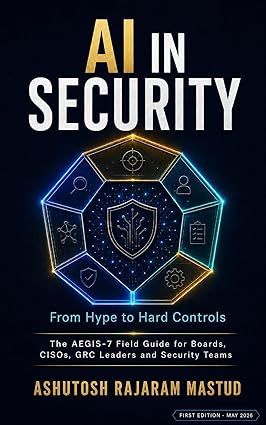
In AI in Security: From Hype to Hard Controls, Mastud moves beyond marketing claims and technology buzzwords to address a far more important challenge: how organizations can build accountability, governance, and operational discipline around AI-powered security systems. Rather than presenting AI as a magical solution, the book argues that AI amplifies whatever processes already exist, whether they are strong or weak.
Book Details
| Detail | Information |
|---|---|
| Title | AI in Security: From Hype to Hard Controls |
| Author | Ashutosh Mastud |
| Language | English |
| Publication Date | 26 May 2026 |
| Reading Age | 6–17 Years |
| Genre | Cybersecurity, Artificial Intelligence, Risk Management, Governance |
| Amazon Link | https://www.amazon.in/dp/B0H2YF3TR1 |
Review
One of the strongest aspects of this book is its practicality. Instead of focusing solely on technical discussions about machine learning algorithms or security platforms, Mastud focuses on organizational readiness. The central argument is compelling: AI does not solve security problems by itself. It magnifies existing strengths and weaknesses within an organization.
The author highlights a reality many security professionals have witnessed firsthand. Companies invest heavily in sophisticated AI-driven security tools yet remain vulnerable because ownership, governance, and accountability are unclear. This perspective immediately separates the book from many AI security publications that focus exclusively on technology.
A particularly valuable contribution is the introduction of the AEGIS-7 Framework, a seven-layer governance model designed specifically for AI security oversight. The framework asks organizations critical questions about visibility, accountability, incident response, vendor governance, control validation, and Zero Trust implementation. Rather than offering theoretical concepts, the framework provides a structured approach that boards, CISOs, governance teams, and security leaders can apply directly within their organizations.
The discussion around AI-powered threats is equally relevant. The book explores modern attack scenarios such as AI-generated phishing campaigns, voice cloning, social engineering, and automated attack techniques that have become increasingly realistic with advances in generative AI. These examples help readers understand that AI is transforming both defense and offense in cybersecurity.
What makes the book especially effective is its focus on governance language. Security professionals often struggle to communicate cyber risk to executives and board members. Mastud bridges this gap by framing AI security as a business risk and governance challenge rather than merely a technical issue. This approach makes the book valuable not only for practitioners but also for decision-makers responsible for overseeing organizational risk.
Why This Book Matters
Many organizations are currently experiencing what could be called the “AI adoption rush.” New AI-powered platforms are being deployed rapidly, often without corresponding policies, accountability structures, or governance mechanisms.
This creates a dangerous gap.
As AI systems become embedded in security operations, customer service platforms, cloud environments, and third-party vendor products, organizations must understand where responsibility begins and ends. AI in Security: From Hype to Hard Controls addresses this challenge directly and offers a framework for moving from reactive security practices toward disciplined governance.
Final Thoughts
AI in Security: From Hype to Hard Controls is not a book about chasing the latest AI trend. It is a practical guide for organizations seeking to use AI responsibly, securely, and effectively. Ashutosh Mastud delivers a clear message throughout the book: tools alone do not create security. Governance, accountability, and operational discipline do.
For CISOs, risk managers, board members, governance professionals, and cybersecurity practitioners, this book provides valuable insights into the realities of AI security in a rapidly evolving threat landscape.