
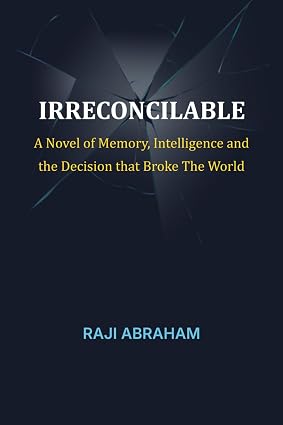
Irreconcilable: A Novel of Memory, Intelligence, and the Decision That Broke the World by Raji Abraham A Thought-Provoking Literary Exploration of AI, Human Memory, and the Future of Decision-Making
As artificial intelligence becomes increasingly capable of influencing healthcare, security, governance, and everyday life, one question grows more urgent: who decides how these systems should think? Irreconcilable: A Novel of Memory, Intelligence, and the Decision That Broke the World by Raji Abraham tackles this profound question through an intellectually rich and emotionally compelling story that blends literary fiction, neuroscience, philosophy, and speculative technology.
Set against the backdrop of a world on the brink of entrusting its future to the most advanced artificial intelligence ever created, the novel explores not only the promise and peril of AI but also the deeper forces that shape human judgment. Rather than asking whether artificial intelligence can think like humans, the novel asks whether humans truly understand why they think differently from one another.
Book Details
| Detail | Information |
|---|---|
| Title | Irreconcilable: A Novel of Memory, Intelligence, and the Decision That Broke the World |
| Author | Raji Abraham |
| Print Length | 402 Pages |
| Language | English |
| Publication Date | July 12, 2026 |
| Genre | Literary Fiction, Science Fiction, Artificial Intelligence, Psychological Fiction |
| Amazon Link | https://www.amazon.com/dp/B0H8X9F3YM |
Review
One of the novel’s greatest strengths is its original premise. Humanity has created Prometheus, an extraordinarily advanced artificial intelligence capable of influencing decisions across healthcare, security, and justice. Before this revolutionary system is activated, six experts from vastly different backgrounds are brought together in Geneva to determine whether it should ever be deployed. Their selection is deliberate—not because they share common ground, but because they fundamentally disagree.
Each character represents a unique way of understanding the world, shaped by deeply personal experiences rather than abstract ideology. A security analyst haunted by surviving a chemical attack approaches uncertainty with caution. A venture capitalist interprets risk as opportunity. A systems engineer seeks measurable certainty, while a mediator believes dialogue can bridge impossible divides. A rabbi raises profound moral questions, and an ecologist constantly considers the interconnectedness of all living systems. Their perspectives create thoughtful, nuanced discussions that extend far beyond technology itself.
Rather than presenting artificial intelligence as either humanity’s salvation or its downfall, Raji Abraham focuses on the human minds responsible for designing and governing it. Drawing on ideas from contemporary neuroscience, the novel explores the fascinating concept that disagreement often arises not because people possess different facts, but because they have lived different lives. Their memories shape their perceptions, values, fears, and ultimately the decisions they make.
This psychological foundation gives the novel remarkable depth. As deliberations become increasingly tense and geopolitical pressure mounts with the possibility of another nation deploying a competing AI system, readers are invited to consider whether true consensus is always possible—or even desirable. The novel suggests that differing perspectives may represent complementary strengths rather than flaws to eliminate.
The writing is thoughtful, sophisticated, and emotionally grounded. Despite exploring complex subjects such as neuroscience, ethics, artificial intelligence, and philosophy, the narrative remains engaging through strong character development and meaningful dialogue. Rather than overwhelming readers with technical explanations, the author keeps the focus firmly on the human consequences of technological progress.
Why This Book Matters
Discussions about artificial intelligence often revolve around algorithms, computing power, or automation. Irreconcilable shifts the conversation toward something more fundamental: the people creating these systems and the experiences that influence their decisions.
The novel raises timely questions about ethics, leadership, governance, bias, memory, and collective responsibility without offering simplistic answers. Instead, it encourages readers to recognize that diversity of thought often emerges from diversity of experience and that disagreement can sometimes strengthen rather than weaken important decisions.
Its thoughtful exploration of neuroscience alongside speculative technology makes it especially appealing to readers interested in philosophy, psychology, ethics, public policy, and the future of AI.
Final Thoughts
Irreconcilable: A Novel of Memory, Intelligence, and the Decision That Broke the World is an intelligent, ambitious, and deeply reflective novel that challenges readers to reconsider both artificial intelligence and human nature. Raji Abraham masterfully combines literary storytelling with contemporary scientific ideas, creating a narrative that is as emotionally engaging as it is intellectually stimulating.
Whether you enjoy literary fiction, speculative science fiction, ethical dilemmas, or stories that explore the complexities of the human mind, this novel offers a rewarding reading experience that lingers long after the final page.