
What if some of the most important ideas shaping the future of artificial intelligence have already been running quietly in nature for billions of years?
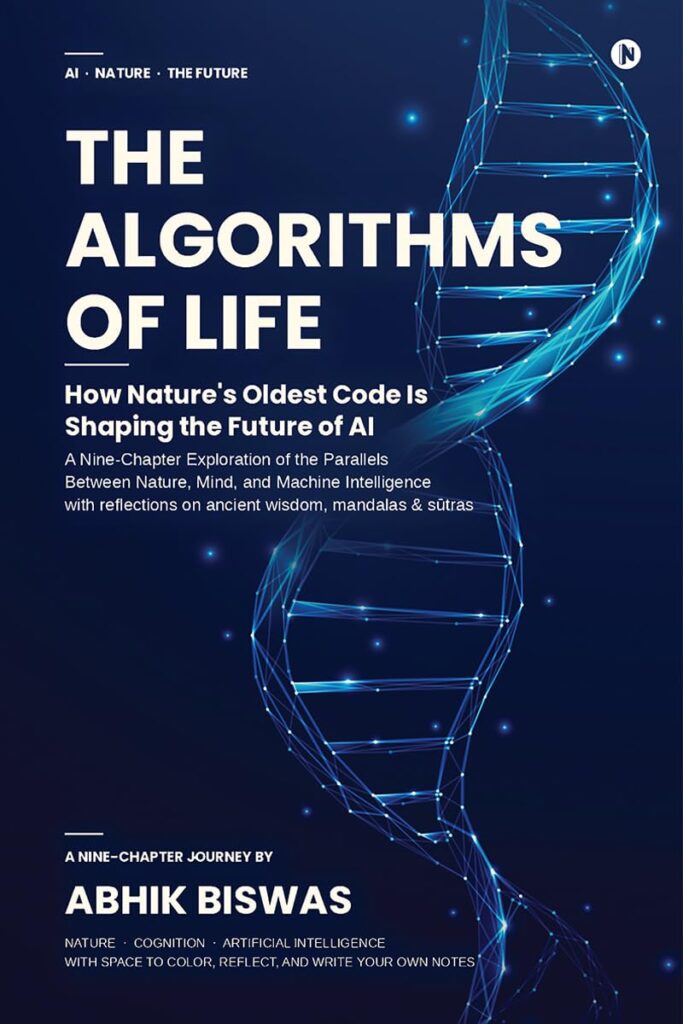
From evolution and ant colonies to the human brain and immune system, nature has developed extraordinary ways of processing information, adapting to change, coordinating complex systems, and responding to threats. The Algorithms of Life: How Nature’s Oldest Code Is Shaping the Future of AI by Abhik Biswas explores these connections and asks what artificial intelligence can learn from the living world.
Blending AI, nature, science, and Eastern wisdom, the book offers readers a different way of thinking about the future of intelligent systems.
Introduction
Artificial intelligence is developing at an extraordinary pace. Machine learning, multi-agent systems, adaptive cybersecurity, and other emerging technologies are changing how we understand computation and intelligence.
But artificial intelligence is not the first form of intelligence to emerge.
Nature has been experimenting with adaptation, coordination, memory, defense, and survival for billions of years.
In The Algorithms of Life, Abhik Biswas explores this idea through a nine-chapter journey that examines the hidden patterns found throughout the natural world and connects them with concepts shaping modern AI.
The result is an interdisciplinary exploration of what technology might learn by looking beyond computers and studying the systems that already exist around us.
Book Details
| Book Details | Information |
|---|---|
| Book Title | The Algorithms of Life: How Nature’s Oldest Code Is Shaping the Future of AI |
| Author | Abhik Biswas |
| Genre | Artificial Intelligence / Technology / Nature / Eastern Philosophy |
| Language | English |
| Print Length | 140 pages |
| Publication Date | July 6, 2026 |
| Book Link | Amazon.com |
Nature as the Original Intelligence Lab
The central question of The Algorithms of Life is compelling: what if nature itself provides a blueprint for artificial intelligence?
For approximately four billion years, living systems have adapted to changing environments, processed information, coordinated with one another, developed defenses, and evolved increasingly complex forms of behavior.
The book uses these natural processes as a starting point for understanding modern AI.
Instead of treating nature and technology as completely separate subjects, Biswas explores the possibility that many principles found in biological systems can offer useful ways of understanding the next generation of intelligent machines.
Evolution as Computation
Evolution is one of the major ideas explored in the book.
Through countless generations, living organisms have adapted to their environments. Traits that help survival and reproduction can persist, while others disappear.
The Algorithms of Life examines this process through the lens of computation and digital intelligence.
This perspective encourages readers to think about evolution not only as a biological phenomenon but also as a system capable of producing adaptation and complexity over enormous periods of time.
The connection raises an intriguing question for AI: what can artificial systems learn from the way nature searches for solutions?
Swarm Intelligence and Multi-Agent AI
Another fascinating connection explored in the book is between swarm behavior and multi-agent artificial intelligence.
Ant colonies provide a striking example. Individual ants follow relatively simple behaviors, yet together they can create highly organized systems for finding food, navigating environments, and responding to changing conditions.
This is an example of how complex behavior can emerge from the interaction of many individual agents.
The book connects these ideas with the growing development of multi-agent AI, where multiple intelligent systems can interact, coordinate, and contribute toward larger objectives.
The Brain, Memory, and Machine Learning
The human brain offers another natural model for understanding intelligence.
The book examines brain plasticity and memory and considers their relationship with machine learning.
The brain is not a static system. It changes through experience and interaction with the environment.
This idea of adaptability is particularly relevant to artificial intelligence, where researchers continue to explore how machines can learn more effectively, retain useful information, and adapt to new circumstances.
By placing neuroscience alongside AI, The Algorithms of Life encourages readers to consider how biological intelligence can inspire technological development.
Immunity and Cybersecurity
One of the book’s more interesting parallels connects the human immune system with cybersecurity.
The immune system is designed to identify threats, respond to unfamiliar dangers, and protect the larger organism.
Modern cybersecurity faces a similar challenge. Digital systems must identify potential threats and respond to attacks that can constantly change.
The book explores how the adaptive defense mechanisms of biological systems can provide inspiration for thinking about cybersecurity and AI-driven protection.
This comparison demonstrates the broader theme running throughout the book: nature often solves complex problems through systems that are distributed, adaptive, and constantly responding to their environments.
Ecosystems and Emergent Intelligence
Nature rarely operates through isolated components.
Ecosystems are made up of countless organisms interacting with one another and with their environment. From these interactions, larger patterns can emerge.
The Algorithms of Life connects this concept of emergence with agentic AI.
As AI systems become increasingly capable of acting with greater independence and interacting with other systems, understanding how complex behavior emerges from interconnected agents may become increasingly important.
The book therefore looks beyond individual AI models and considers intelligence as something that can arise through relationships between multiple components.
Eastern Wisdom and Artificial Intelligence
The book also takes its exploration beyond biology and technology.
Eastern philosophical traditions, including sutras, the Dao, koans, Sanskrit, and classical wisdom, form another part of its framework.
The inclusion of these traditions adds a philosophical dimension to the discussion of intelligence.
Rather than treating AI solely as an engineering problem, the book asks readers to consider broader questions about intelligence, consciousness, interconnectedness, and the way humans understand knowledge.
This combination of technology and philosophy gives the book an interdisciplinary character.
The I Ching, Sanskrit, and Patterns of Knowledge
Another distinctive aspect of the book is its exploration of patterns found in traditional systems of knowledge.
The book examines the grammar of Sanskrit and the binary patterns associated with the I Ching, considering their relationship with ideas of structure, information, and computation.
These connections contribute to the book’s larger argument that patterns of intelligence and organization can be found in unexpected places.
The discussion invites readers to look at ancient systems not simply as historical artifacts but as sources of ideas that may offer new perspectives on modern technology.
A More Reflective Approach to AI
While much of the conversation surrounding artificial intelligence focuses on speed, capability, automation, and economic impact, The Algorithms of Life takes a broader approach.
It asks readers to pause and look at the systems that inspired some of our ideas about intelligence in the first place.
The book combines technical concepts with reflective elements, including Buddhist mandalas to color and space for chapter notes.
These additions create a more contemplative reading experience and reinforce the idea that understanding intelligence may require both analytical and reflective thinking.
Why Readers May Find This Book Interesting
The Algorithms of Life may appeal to readers who enjoy the intersection of technology, science, nature, and philosophy.
It can be particularly interesting for:
- AI and technology professionals
- Business and technology leaders
- Researchers and students
- Readers interested in machine learning
- Readers fascinated by natural intelligence
- People interested in Eastern philosophy
- Readers exploring the future of AI
- Anyone curious about the relationship between nature and technology
The book’s interdisciplinary approach makes it accessible to readers who may not necessarily have a technical background but are curious about how AI is evolving.
About the Author
Abhik Biswas is the author of The Algorithms of Life: How Nature’s Oldest Code Is Shaping the Future of AI.
Through the book, Biswas brings together ideas from artificial intelligence, biology, neuroscience, cybersecurity, Eastern wisdom traditions, and natural systems.
His approach encourages readers to look at AI through a wider lens and consider the possibility that some of the most valuable lessons for future technology may already exist in nature.
Conclusion
The Algorithms of Life: How Nature’s Oldest Code Is Shaping the Future of AI offers a thought-provoking perspective on one of the defining technologies of our time.
By connecting evolution with computation, ant colonies with multi-agent AI, brain plasticity with machine learning, immunity with cybersecurity, and ecosystems with emergent intelligence, Abhik Biswas presents nature as an extraordinary source of ideas for technological development.
At the same time, the book reaches beyond technology through its exploration of Eastern wisdom and contemplative practices.
Its central question remains both simple and profound: what if nature has already written some of the algorithms we are now trying to build?
For readers interested in where artificial intelligence may go next, looking backward toward the oldest systems of intelligence on Earth could offer an unexpected way forward.