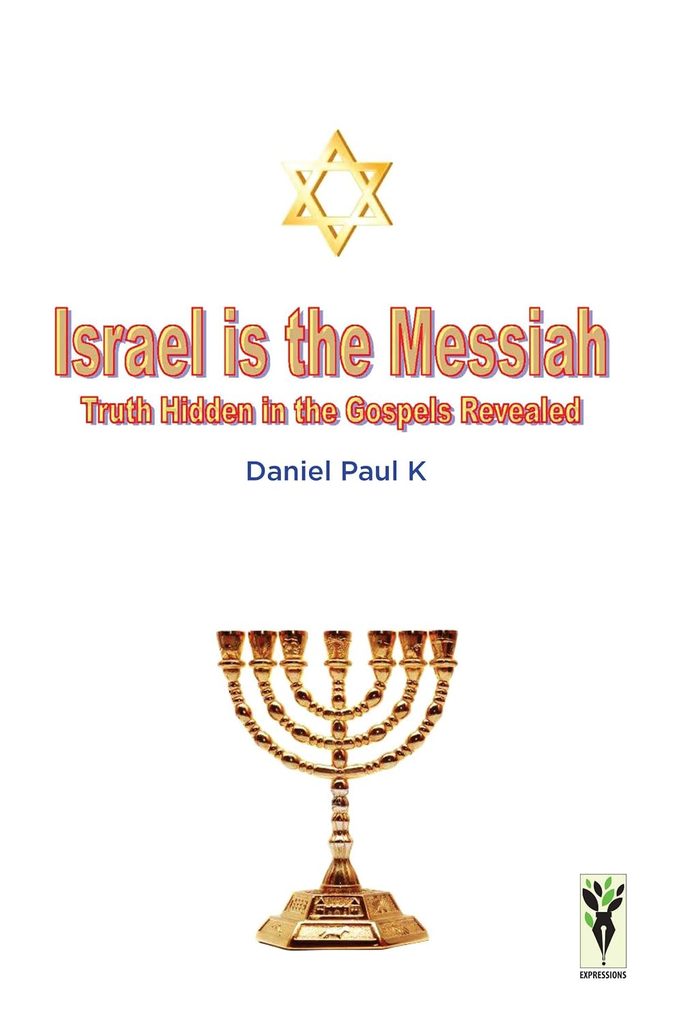
Explore Daniel Paul K’s Israel Is the Messiah, a provocative theological re-reading of biblical prophecy that identifies Israel with key messianic titles and explores judgment, exile, suffering, and restoration.
What if some of the Bible’s most familiar messianic passages have been pointing not primarily to an individual, but to a people?
That is the provocative question at the heart of Israel Is the Messiah by Daniel Paul K. First published in 2016 and presented through an extensive scriptural argument, the book challenges conventional interpretations of messianic prophecy by proposing that many titles traditionally associated with an individual Messiah can instead be understood as corporate descriptions of Israel. The accompanying manuscript analysis describes this as the book’s central thesis, identifying the “Son of Man,” “Suffering Servant,” “Lamb of God,” and other messianic figures as names associated with Israel’s national story.
This is not a small adjustment to traditional theology. It is a fundamental re-reading of how prophecy, Jesus’ teachings, Israel’s history, exile, suffering, and restoration fit together.
Reading Jesus Through the Story of Israel
One of the book’s foundational arguments is that Jesus should be read within the tradition of Israel’s prophets rather than primarily as the founder of a new religious system.
The book begins with the pattern of warning, judgment, and restoration. Its argument asks whether, just as earlier prophets warned Israel before national catastrophe, Jesus likewise came as a prophetic voice warning about destruction, scattering, and eventual restoration. The manuscript analysis describes this opening as foundational to the book’s larger framework.
This approach becomes particularly significant when the book examines Jesus’ statement that he came not to bring peace but a sword. Rather than interpreting the statement in isolation, the argument places it alongside covenant warnings found in Leviticus, Ezekiel, Jeremiah, Amos, and Zechariah. Within the book’s framework, the “sword” represents the judgment already anticipated in the Hebrew Scriptures and ultimately connected with the destruction of Jerusalem.
The result is an interpretation of Jesus that is deliberately rooted in the prophetic history of Israel.
The Central Question: Who Is the Messiah?
The book’s most distinctive contribution is its challenge to the assumption that every major messianic reference must point to one individual.
The argument develops through a series of biblical images and titles.
Israel is presented as the shepherd, the tree, the vine, the Son of Man, the Suffering Servant, the Son of David, and ultimately the Messiah.
The tree and vine imagery is especially important. The book uses prophetic references to Israel as a tree that can be cut down but not destroyed, and as the vineyard of God. These images establish a recurring pattern of judgment, survival, and restoration.
The argument then moves to the “Son of Man.” Here, Daniel 7, the sayings of Jesus, and the imagery of Israel as God’s people are brought together. The book argues that the “Son of Man” can be understood corporately rather than exclusively as an individual figure.
This becomes one of the book’s pivotal interpretive moves.
If Israel is the entity handed over to the nations, mocked, scattered, suffers, and eventually restored, the book asks whether these descriptions can be read as the prophetic story of Israel itself.
From Scattering to Restoration
A major strength of the book’s structure is that it does not stop with judgment.
Its argument follows a larger cycle:
blessing → covenant failure → judgment → scattering → suffering → restoration.
The analysis identifies the Mosaic covenant framework, particularly Deuteronomy 28, Leviticus 26, and Deuteronomy 30, as a foundational structure for understanding the book’s interpretation.
This allows the author to interpret Israel’s historical suffering not as an isolated tragedy but as part of a larger prophetic narrative.
The destruction of Jerusalem and the scattering of the Jewish people therefore become central to the book’s interpretation of Jesus’ words about the Son of Man. The book connects the Gospel predictions concerning Jerusalem, captivity, scattering, and the Gentiles with earlier prophetic warnings.
But the story does not end there.
The book turns toward the possibility of Israel’s restoration, reading resurrection language and promises of renewed life through a national and historical lens. Hosea’s reference to revival on the third day becomes particularly significant within this interpretation.
The movement from death to restoration becomes essential to the overall thesis.
A Different Understanding of Salvation
Another important stage in the book’s argument is its distinction between Savior and salvation.
The book emphasizes Yahovah as the ultimate source of salvation and interprets Israel’s restoration as a visible historical expression of that salvation. In this framework, the restored people of Israel are not presented as replacing God, but as the people through whom God’s promised salvation becomes visible in history.
This prepares the reader for the book’s ultimate claim.
If salvation belongs to God, and if Israel is repeatedly portrayed as God’s servant, witness, kingdom, vine, son, and restored people, then the author argues that the messianic identity itself can be understood corporately.
The Modern History of Israel Enters the Argument
The book’s interpretation eventually moves beyond ancient Scripture and into modern history.
The modern restoration of Israel becomes an important part of the author’s reading of prophecy. The analysis describes chapters dealing with Zionism, the Holocaust, the Balfour Declaration, the United Nations vote, the establishment of Israel, wars, and the imagery of restoration found in Ezekiel and other prophetic books.
Particularly striking is the author’s treatment of the rebirth of Israel as a fulfillment of the larger prophetic pattern.
One chapter even reinterprets the “virgin birth” concept corporately, connecting Isaiah 7:14 with the national “birth” of Israel in 1948 rather than treating it as a biological description of Jesus.
Another section focuses on Galilee, connecting its biblical significance, Jesus’ ministry, Jewish settlement, and modern developments into a broader prophetic interpretation. The analysis describes this as one of the book’s attempts to complete its corporate Messiah argument through geography and modern history.
These are among the book’s most unconventional interpretations.
A Book Designed to Challenge Traditional Readings
Israel Is the Messiah is not presented as a neutral survey of competing theological positions. It makes a strong case for its own interpretation and repeatedly asks readers to reconsider assumptions that have become familiar through traditional Christian readings.
The manuscript analysis describes the concluding chapter as the doctrinal and rhetorical climax of the work. It brings together titles including Son of Man, Son of David, Suffering Servant, Branch, Kingdom of God, and Son of God, arguing that these can all be understood in relation to Israel.
The final synthesis is therefore straightforward within the author’s framework:
Israel is the Messiah, the anointed one of Yahovah.
The argument also draws on passages describing Yahovah as saving His anointed, reversing the familiar expectation that the Messiah is primarily the one who saves others. Instead, Israel’s suffering, survival, and restoration become part of the messianic story.
A Controversial Book That Invites Examination
The book’s greatest distinguishing feature is also likely to be its most controversial.
Its interpretation challenges traditional Christian understandings of Jesus, Messiah, salvation, and several central New Testament passages. The manuscript analysis explicitly notes that some readers may find the interpretation compelling while others may consider it challenging or offensive to their established beliefs. It frames the purpose as inviting readers to engage with the argument and determine where they stand.
Several later chapters make particularly strong claims about the development of Christianity and its relationship with Judaism. The manuscript analysis notes that these sections are likely to provoke significant disagreement, particularly where the author interprets the early Christian movement as part of a divine testing of Israel.
For that reason, this is best approached as a provocative theological interpretation, rather than as a conventional introduction to Christianity or biblical prophecy.
Readers who approach it with an open mind may find themselves repeatedly returning to familiar passages and asking whether they have always been interpreted in the only possible way.
Final Assessment
Israel Is the Messiah is an ambitious theological work built around a single radical proposition: that the messianic story found throughout Scripture may be understood primarily through the history and destiny of Israel.
Its argument progresses from the prophets to Jesus, from covenant judgment to exile, from the destruction of Jerusalem to centuries of suffering, and finally toward restoration. Along the way, familiar biblical images are given a corporate interpretation, with Israel presented as the tree, vine, shepherd, Son of Man, suffering servant, kingdom, Son of David, and ultimately Messiah. The book’s final chapter brings these strands together into its defining conclusion.
Whether readers accept that conclusion or reject it, the book succeeds in doing something valuable for theological discussion: it makes familiar Scriptures unfamiliar again.
That may be the most interesting reason to read Israel Is the Messiah.
It asks readers to look again at the language of prophecy, examine the relationship between Jesus and the Hebrew Scriptures, reconsider the meaning of messianic titles, and explore whether the story of Israel itself could be at the centre of passages traditionally understood as referring to an individual Messiah.
For readers interested in biblical prophecy, messianic interpretation, Israel’s history, Hebrew Scripture, Christian theology, Jewish-Christian relations, and alternative readings of the Bible, Daniel Paul K’s book offers a distinctive and deeply unconventional perspective.
It is ultimately a book that does not ask the reader simply to accept an answer.
It asks a much more difficult question:
What if the Messiah described throughout Scripture is not the person we have always assumed, but the people whose story those Scriptures have been telling all along?
Book Details
| Details | Information |
|---|---|
| Title | Israel Is the Messiah |
| Author | Daniel Paul K |
| Language | English |
| Print Length | 260 pages |
| Publisher | EXPRESSIONS, A Self Publishing Initiative of DC Books Group |
| Publication Date | 9 August 2017 |
| Book Link | Amazon India |