
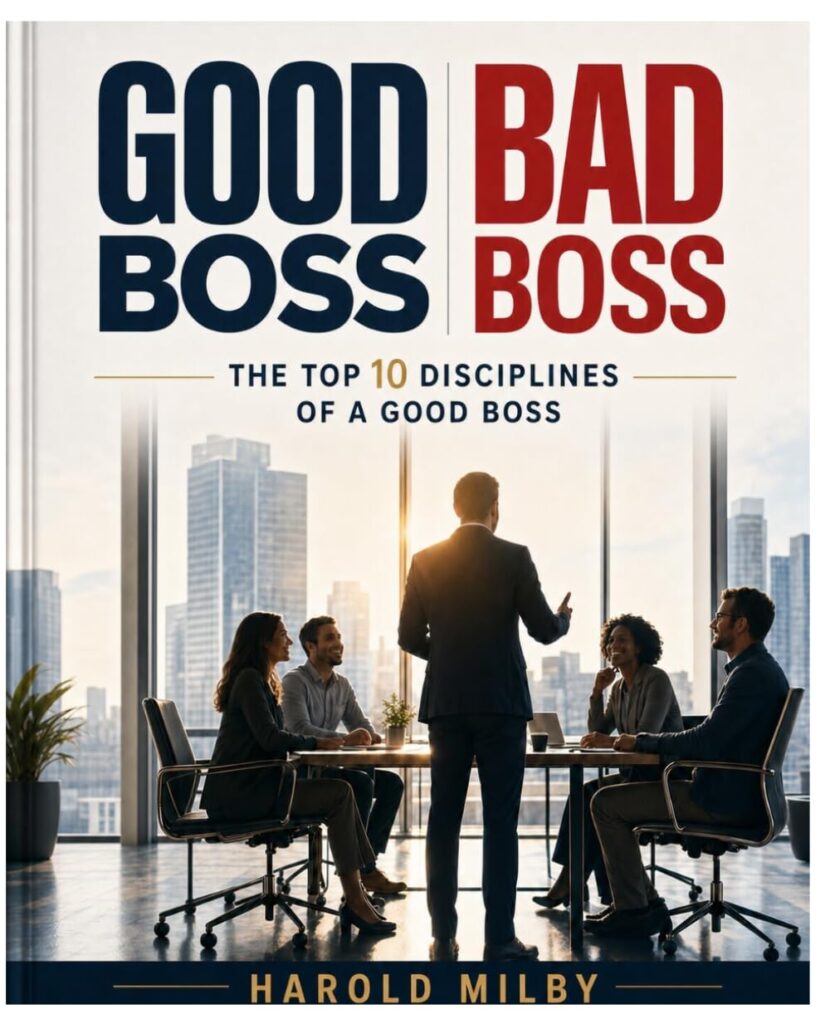
Leadership is often discussed, frequently taught, and widely misunderstood. While many books focus on strategy, productivity, and management techniques, few address the practical behaviors that truly separate effective leaders from ineffective ones. In Good Boss/Bad Boss: The Top 10 Disciplines of a Good Boss, Harold Milby presents a straightforward and experience-driven guide to becoming the kind of leader employees respect, trust, and willingly follow.
Drawing on years of management experience, real-world examples, leadership principles, and practical workplace wisdom, Milby explores the habits and disciplines that distinguish exceptional bosses from those who create disengagement, frustration, and turnover. The book serves as both a leadership handbook and a personal development guide for managers, supervisors, executives, business owners, and aspiring leaders.
Rather than relying on complex theories, the author focuses on actionable principles that can immediately improve workplace culture, employee performance, and organizational success.
Book Details
| Detail | Information |
|---|---|
| Book Title | Good Boss/Bad Boss: The Top 10 Disciplines of a Good Boss |
| Author | Harold Milby |
| Publication Date | May 19, 2026 |
| Print Length | 227 Pages |
| Language | English |
| Genre | Leadership, Management, Business, Professional Development |
| Best For | Managers, supervisors, executives, entrepreneurs, team leaders |
| Book Link | https://www.amazon.com/Good-Boss-Bad-Top-Disciplines/dp/B0H2DJ15SR/ |
Why Employees Leave Bosses, Not Companies
One of the book’s most powerful opening observations is the reality that employees often leave managers rather than organizations. Using workplace research and employee feedback, Milby highlights how poor leadership contributes to disengagement, low morale, lack of trust, and high turnover.
This foundation sets the stage for the book’s central message: leadership is not about authority or position. It is about influence, responsibility, and the ability to develop people.
The author argues that becoming a good boss is not an innate gift but a skill that can be learned, practiced, and refined over time.
Coaching Versus Managing
One of the most insightful sections of the book explores the distinction between coaching and managing. Rather than presenting them as competing philosophies, Milby explains that successful leaders must master both.
Managing focuses on direction, structure, policies, and performance, while coaching focuses on growth, development, and unlocking potential. The author uses practical examples to demonstrate when leaders should provide direct instruction and when they should step back to encourage employee ownership.
Particularly valuable is the discussion of the GROWTH coaching framework, which emphasizes goals, reality, options, action planning, timelines, and accountability. This practical model gives leaders a structured approach to employee development.
Building a Culture of Trust and Openness
Trust emerges as one of the book’s most important leadership themes.
Milby argues that trust is not created through slogans or policies but through consistent actions. Leaders build trust by communicating openly, listening actively, following through on commitments, and creating environments where employees feel safe to contribute ideas and voice concerns.
The book discusses psychological safety, transparency, vulnerability, and the importance of open communication. Readers are provided with practical guidance on creating workplace cultures where collaboration flourishes and innovation becomes possible.
The detailed discussion of trust makes this section particularly relevant for modern workplaces navigating change, uncertainty, and employee engagement challenges.
Leadership Through Example
A recurring theme throughout the book is that leaders must model the behavior they expect from others.
Milby emphasizes that credibility is earned through actions rather than titles. Employees observe how leaders behave, respond to challenges, handle mistakes, and interact with others. Leaders who fail to live by the standards they impose quickly lose respect and influence.
The examples drawn from military leaders, business executives, and historical figures effectively reinforce the importance of leading from the front rather than directing from a distance.
This principle serves as one of the strongest and most practical lessons in the book.
Practical Leadership Rather Than Theory
One of the book’s greatest strengths is its accessibility.
Instead of relying on academic jargon or abstract leadership theories, Milby focuses on real workplace situations. Stories, analogies, and personal experiences make the lessons easy to understand and apply.
Readers will find discussions on:
- Employee motivation
- Delegation
- Communication
- Accountability
- Trust building
- Coaching techniques
- Leadership attitudes
- Team development
- Workplace culture
- Performance management
The practical nature of these lessons makes the book useful for leaders at every level of experience.
A Strong Focus on People Development
Unlike management books that focus primarily on results, Good Boss/Bad Boss consistently emphasizes people development.
Milby argues that long-term organizational success depends on helping employees grow, develop skills, and realize their potential. The most effective leaders view employee development as a core responsibility rather than an optional activity.
This people-centered approach gives the book lasting relevance in an era where employee engagement and retention are increasingly important.
Writing Style and Reader Experience
Harold Milby writes in a conversational, practical, and highly approachable style.
The chapters are organized around clear leadership disciplines, making the book easy to follow and reference. The author’s extensive use of examples, leadership stories, historical references, and workplace scenarios helps readers connect theory with practice.
The tone is encouraging rather than academic, making the book accessible to both first-time managers and experienced executives.
Its straightforward presentation allows readers to immediately implement many of the lessons discussed.
Who Should Read This Book
This book is highly recommended for:
- New managers and supervisors
- Team leaders
- Business owners
- Executives
- Human resource professionals
- Entrepreneurs
- Leadership development students
- Anyone responsible for managing people
Final Review
Good Boss/Bad Boss: The Top 10 Disciplines of a Good Boss is a practical and insightful leadership guide that focuses on the behaviors and disciplines that truly matter in management.
Harold Milby successfully demonstrates that effective leadership is not about authority, status, or control. It is about trust, coaching, accountability, communication, and genuine investment in people. Through real-world examples and actionable advice, the book provides readers with a roadmap for becoming more effective leaders and creating healthier workplace cultures.
Its greatest strength lies in its practicality. Readers are not simply told what good leadership looks like; they are shown how to develop it.
For managers, business owners, and leaders seeking to improve their effectiveness while building stronger teams, Good Boss/Bad Boss offers valuable lessons that can be applied immediately.