
Introduction
Preparing for a competitive examination is often associated with completing the syllabus, solving questions, revising concepts, and improving accuracy. But what happens when a student has prepared well and still struggles to perform when the pressure is at its highest?
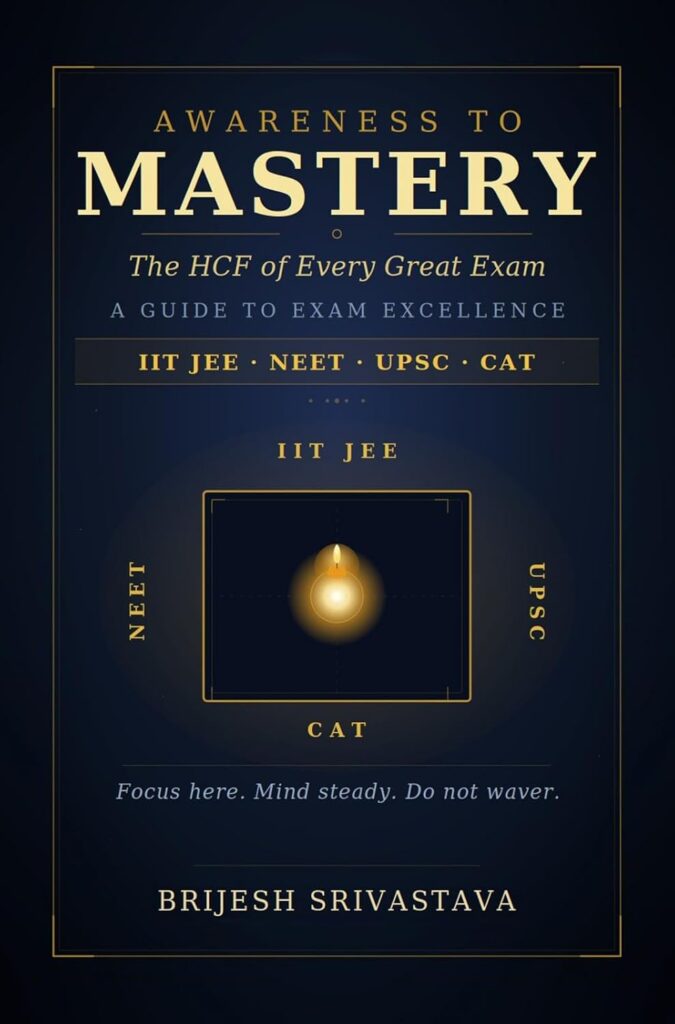
Awareness to Mastery: The HCF of Every Great Exam by Brijesh Chandra Srivastava explores the mental foundation behind examination performance. The book argues that the common factor behind great examination performance is not simply knowledge, coaching, or intelligence. It is awareness, particularly the ability to observe and manage one’s own mind.
Written for serious aspirants preparing for examinations such as JEE, NEET, UPSC, and CAT, the book combines neuroscience, ancient Indian wisdom traditions, awareness training, and examination psychology to explore how students can develop greater mental clarity and stability under pressure.
Book Details
| Detail | Information |
|---|---|
| Title | Awareness to Mastery: The HCF of Every Great Exam |
| Author | Brijesh Chandra Srivastava |
| Publisher | Astitva Prakashan |
| ISBN | 9789376868421 |
| Language | English |
| Print Length | 183 pages |
| Publication Date | May 30, 2026 |
| Edition | First Edition, 2026 |
| MRP | ₹509 |
| Book Link | Amazon India |
What Is the HCF of a Great Examination Performance?
The title uses HCF, or Highest Common Factor, as a central idea. In mathematics, the HCF is the factor shared by numbers in a set. The book applies this concept to examination performance and proposes that awareness is the common factor underlying strong performance across different examinations.
Awareness here means more than simply knowing what is happening around you. It involves observing your own mind, controlling attention, staying mentally stable during uncertainty, and maintaining clarity when pressure begins to affect performance.
For students, this can be particularly important during an examination. A candidate may know the material but struggle to access that knowledge when anxiety, self-doubt, or loss of concentration takes over.
Knowledge Is Only Part of the Equation
One of the central ideas presented in Awareness to Mastery is that the most knowledgeable student is not necessarily the student who performs best.
The book suggests that high performers are often distinguished by their ability to keep their minds calm, focused, and available when it matters most. This becomes especially relevant during lengthy and demanding examinations, where concentration and emotional stability can be tested alongside academic knowledge.
The book therefore shifts attention from preparation alone to the mental state in which preparation is ultimately used.
The Neuroscience Behind Examination Performance
The book also examines examination performance through the lens of neuroscience.
It discusses the role of the prefrontal cortex under pressure and explores how students can train the cognitive abilities that support effective performance. Rather than treating mental control as something students either naturally possess or lack, the book presents awareness as a quality that can be deliberately developed.
This perspective makes the book relevant to students who may already have substantial preparation but want to understand why their performance sometimes does not reflect their level of knowledge.
Ancient Indian Wisdom and Modern Understanding
Another distinctive feature of Awareness to Mastery is its combination of modern neuroscience with ancient Indian wisdom traditions.
The book explores practices involving focused attention and connects them with the cognitive foundation required for examination performance. According to the book, these traditions understood aspects of attention and mental discipline long before they were examined through modern scientific research.
The result is an approach that attempts to bring together two different perspectives: contemporary understanding of the brain and long-standing practices of mental awareness.
Understanding Examination Anxiety
Examination anxiety can affect even students who have prepared extensively.
Awareness to Mastery looks at the psychology behind this problem and asks why intelligent and well-prepared students can sometimes struggle or collapse under examination pressure.
Rather than treating anxiety simply as an obstacle, the book focuses on developing awareness and self-observation so that students can recognize what is happening within their minds.
This approach encourages aspirants to become students of their own mental processes, giving them another dimension of preparation beyond textbooks and mock tests.
Awareness Training Without Adding Another Burden
An important practical aspect of the book is its focus on integrating awareness training into an existing preparation schedule.
The book does not position mental training as another large subject that students need to add to an already demanding routine. Instead, it presents awareness as a foundation that can make existing preparation more effective.
For students balancing classes, self-study, revision, mock tests, and other preparation activities, this distinction can be particularly meaningful.
Who Should Read Awareness to Mastery?
The book is intended for a broad examination-focused audience, including:
- JEE aspirants preparing for highly competitive engineering examinations
- NEET aspirants dealing with intense academic and examination pressure
- UPSC aspirants managing long-term preparation
- CAT aspirants looking to improve performance under pressure
- Parents and mentors supporting examination candidates
- Educators and coaching faculty interested in the cognitive side of student performance
- Students who have the knowledge but struggle with consistency during examinations
About the Author
Brijesh Chandra Srivastava is an alumnus of the University of Roorkee, now IIT Roorkee, where he completed his B.E. and M.E. in Civil Engineering in 1985 and 1987 respectively.
He spent thirty-six years with RITES Limited, Ministry of Railways, Government of India, eventually retiring as General Manager (Civil). His professional career included work involving railways, bridges, metros, highways, and World Bank-aided infrastructure projects across India.
He is also a Fellow Member of the Chamber of Railway Industries, The Institution of Engineers (India), and the Indian Concrete Institute, and is the Founder and CEO of BridgeMind Consulting in Lucknow.
Awareness to Mastery is his third published book. His other works include The Document Fortress and The Mindful Engineer. His fourth book, Beyond the Syllabus, was also published in 2026.
Recognition and Media Coverage
The book has received coverage through several platforms. According to the author’s book material, DoRA IIT Roorkee featured the book on its official social media channels, including LinkedIn, Instagram, Facebook, and X.
The book has also received four separate features from The Literature Times, covering its book release, book review, author feature, and author interview. It is listed as available through Amazon India, Flipkart, and Classicshelf.
Conclusion
Awareness to Mastery: The HCF of Every Great Exam takes a different approach to examination preparation. Instead of focusing on another syllabus, subject, or collection of study techniques, it looks at the person sitting behind the preparation.
Its central argument is that knowledge can only reach its full potential when the mind remains capable of accessing and applying it under pressure. Through neuroscience, Indian wisdom traditions, awareness training, and examination psychology, the book explores how students can develop greater control over attention, emotional stability, and mental clarity.
For aspirants preparing for JEE, NEET, UPSC, CAT, and other demanding examinations, the book offers a perspective worth considering: preparation is not only about what you know. It is also about the state of mind in which you bring that knowledge into the examination hall.
Read More : Crypto Queen: You Are a Mark Book Review