
Every successful founder eventually faces a difficult question: how can the organisation continue to thrive when the person who built it is no longer at the centre of every decision?
In Internal Ashvamedha: The Architecture of Sovereign Succession, Jay V Pande explores the complex relationship between leadership, personal identity, and institutional independence. The book examines how a founder’s strengths, such as decisiveness, relentless oversight, and the instinct to solve every problem, can gradually become obstacles to the organisation’s growth.
Drawing from the philosophical traditions of the Vedas and Upanishads, the author presents succession not as a simple change of leadership, but as a deeper transformation of authority. It is a guide for founders who want to move beyond personal command and build an institution capable of standing on its own.
Book Details
| Detail | Information |
|---|---|
| Book Title | Internal Ashvamedha: The Architecture of Sovereign Succession |
| Author | Jay V Pande |
| Language | English |
| Print Length | 132 pages |
| Publication Date | 23 October 2026 |
| Genre | Business, Leadership, Corporate Governance, Succession Planning |
| Amazon Link | View on Amazon |
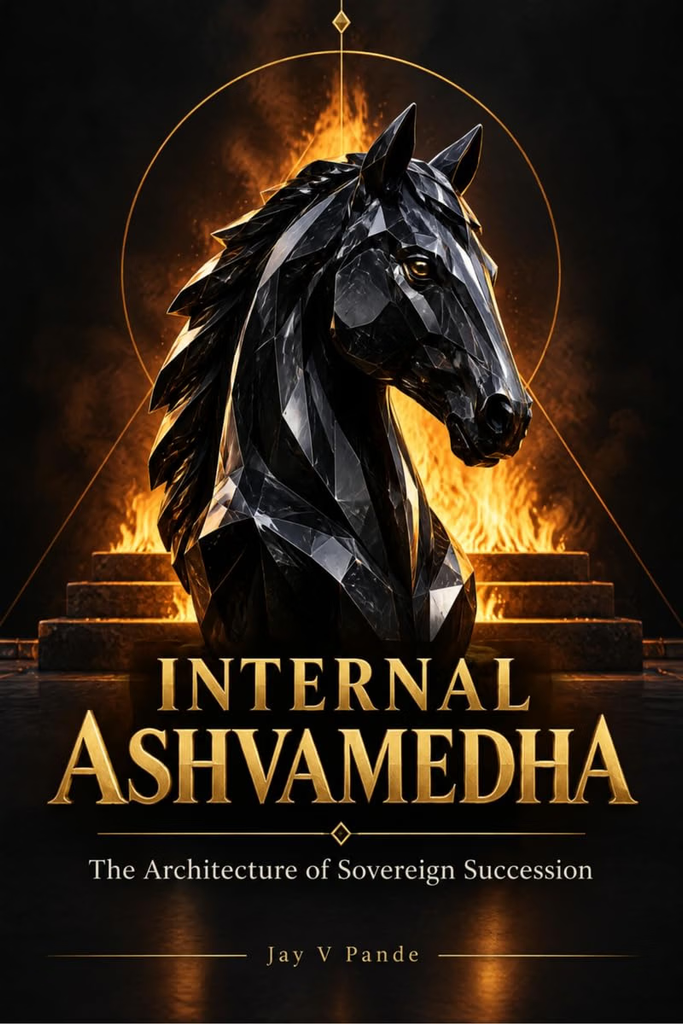
Review of Internal Ashvamedha: The Architecture of Sovereign Succession
One of the most compelling ideas in Internal Ashvamedha is that the very qualities that help a founder build an empire can eventually prevent it from becoming a mature institution. Decisiveness, close supervision, and the ability to manage crises may be essential during the early stages of a business. However, when these habits become permanent, they can create an organisation that depends too heavily on one individual.
The book challenges the common belief that succession can be solved through a new organisational chart or a formal announcement of retirement. According to its central argument, the real difficulty lies in the founder’s relationship with power. Even after appointing successors, founders may continue to influence decisions through hidden vetoes, informal control, or a constant need to remain involved.
Jay V Pande approaches this issue through the concept of the Internal Ashvamedha, using the symbolism of an ancient royal sacrifice to explore the transformation of leadership. The book connects this philosophical foundation with practical concerns of modern business, particularly legacy succession and C-suite governance.
Its emphasis on the “Sovereign Charter” offers a different way of thinking about institutional authority. Rather than allowing the organisation to remain dependent on the founder’s personal judgement, the book advocates replacing individual command with a durable structure of governance. This approach encourages founders to create systems that can guide decisions even when the original creator is no longer directly involved.
The book also addresses the psychological challenges of stepping away from leadership. For founders who have spent years solving problems, managing crises, and maintaining control, becoming less involved can feel like losing relevance. The author highlights how this attachment can quietly undermine succession and prevent new leaders from developing genuine authority.
Written in an austere and literary style, Internal Ashvamedha appears designed for experienced founders, business owners, and senior executives who are thinking seriously about the future of their organisations. Its combination of philosophical reflection and procedural guidance gives succession planning a broader meaning: it is not simply about transferring a position, but about changing the architecture of power itself.
Final Thoughts
Internal Ashvamedha: The Architecture of Sovereign Succession presents a thoughtful perspective on one of the most difficult challenges in leadership: learning when to stop being the centre of an institution.
Jay V Pande’s approach encourages founders to look beyond formal succession and examine the habits, fears, and control mechanisms that may prevent their organisations from becoming independent. For business leaders preparing for succession, strengthening governance, or building a lasting legacy, this book offers a distinctive framework for reflection.