
Starting a business is an exciting achievement, but finding customers and earning their trust can be one of the biggest challenges for any entrepreneur. Getting the first few sales is important, yet building lasting relationships with customers is what helps a business grow over time. How to Get Your First 50 Customers and Keep Them: A Practical Guide to Getting Customers and Keeping Them by Kevin K. Lutchmansingh explores both sides of this journey.
Drawing on nearly thirty years of business ownership across multiple industries, Lutchmansingh shares practical lessons about attracting customers, understanding their needs, and creating experiences that encourage them to return. The book is designed for entrepreneurs who want to move beyond simply launching a business and focus on building a reliable customer base.
Book Details
| Detail | Information |
|---|---|
| Book Title | How to Get Your First 50 Customers and Keep Them |
| Subtitle | A Practical Guide to Getting Customers and Keeping Them |
| Author | Kevin K. Lutchmansingh |
| Genre | Business, Entrepreneurship, Marketing |
| Language | English |
| Print Length | 124 pages |
| Publication Date | September 22, 2026 |
| Buy the Book | Amazon Canada |
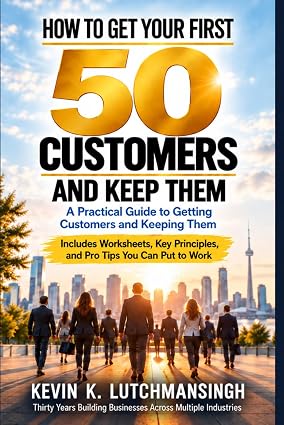
Review of How to Get Your First 50 Customers and Keep Them
One of the most valuable aspects of this book is its focus on two closely connected business goals: customer acquisition and customer retention. While many new business owners concentrate on finding their first buyers, keeping those customers satisfied and encouraging repeat purchases can be equally important. This book addresses both challenges, making its approach relevant to entrepreneurs who want to build sustainable businesses.
The emphasis on identifying the right customers is particularly useful. Rather than trying to appeal to everyone, business owners need to understand who their potential customers are, what problems they face, and whether their products or services meet a genuine need. This customer-focused perspective can help entrepreneurs make better decisions about their offerings and how they communicate their value.
Another important theme is making a business easier to find. Even a useful product or service may struggle to attract attention if potential customers do not know it exists. By addressing visibility alongside customer needs and service quality, the book highlights several interconnected factors that influence business growth.
Customer experience and genuine value also play central roles. Attracting a customer is only the beginning. The quality of service, the value delivered, and the way customers are treated can influence whether they return or recommend a business to others. These principles are relevant to small businesses, independent professionals, service providers, and early-stage startups alike.
The book’s practical format adds to its appeal. Worksheets, key principles, and exercises are intended to help readers apply the lessons to their own businesses. Instead of treating customer acquisition as an abstract marketing concept, the guide encourages entrepreneurs to think about concrete actions they can take to find customers, improve their service, and build stronger relationships.
Lutchmansingh’s experience across multiple industries provides the foundation for the book’s practical perspective. Readers looking for straightforward guidance may appreciate its focus on essential business fundamentals rather than complicated theories or unnecessary jargon.
Although no single approach can guarantee that a business will acquire or retain a specific number of customers, the principles explored here offer a useful starting point. Success will depend on the business model, target market, execution, and willingness to learn from customer feedback.
Final Thoughts
How to Get Your First 50 Customers and Keep Them is a practical resource for entrepreneurs who are working to establish their customer base and build lasting relationships. Its focus on understanding customer needs, improving visibility, delivering value, and encouraging repeat business makes it relevant to people at different stages of their entrepreneurial journey.
For first-time founders and small business owners, the book offers a clear reminder that sustainable growth involves more than making the first sale. It requires consistently giving customers good reasons to choose a business again.