
Artificial intelligence is changing how organizations operate, how professionals deliver value, and what businesses expect from their employees. As AI makes many routine knowledge-work tasks faster and more accessible, a deeper question emerges: what truly distinguishes an effective organization from one that merely appears productive?
In Centrifuge: Inside the Emerging AI Organization, Mitch Kelly explores this question through the lens of organizational transformation, human judgment, and technological independence. Drawing on his experience building a fully AI-enabled advisory firm, Kelly examines how AI can expose weaknesses that traditional business structures have allowed to remain hidden.
Rather than presenting AI as simply another productivity tool, the book invites readers to reconsider how organizations are designed, how people respond to change, and who ultimately controls the tools shaping their work.
Book Details
| Detail | Information |
|---|---|
| Book Title | Centrifuge: Inside the Emerging AI Organization |
| Author | Mitch Kelly |
| Genre | Artificial Intelligence, Business, Leadership, Organizational Transformation |
| Language | English |
| Print Length | 244 pages |
| Publication Date | September 30, 2026 |
| Buy the Book | Amazon |
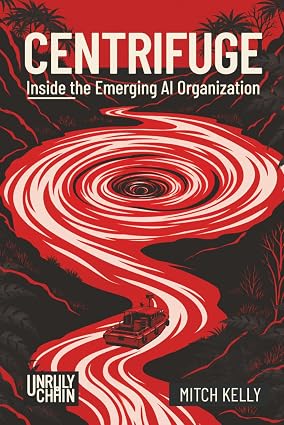
Review of Centrifuge: Inside the Emerging AI Organization
One of the book’s most compelling ideas is its central metaphor: AI acts like a centrifuge, separating what is genuinely valuable within an organization from what has merely been maintained through established routines and appearances. As AI accelerates work, the difference between real expertise and the performance of expertise becomes harder to ignore.
This perspective moves the discussion beyond the familiar promise of automation and efficiency. Instead of asking only how AI can help employees complete tasks faster, Kelly encourages readers to consider what remains valuable when the mechanical parts of knowledge work become widely accessible. Judgment, independent thinking, and the ability to make meaningful decisions become central to this discussion.
The book also explores why AI transformation often fails. Its description frames this challenge as a problem of organizational design rather than simply a matter of adopting new technology. This is an important distinction for business leaders. Introducing AI tools does not automatically create an AI-ready organization. Existing processes, responsibilities, decision-making structures, and workplace habits may need deeper reconsideration.
Kelly’s experience building a fully AI-enabled advisory firm provides the foundation for these ideas. The book follows patterns in how people react to AI, examines the difficulties of organizational transformation, and considers what a redesigned organization might look like. This progression gives the subject a broader scope than a conventional guide focused exclusively on software, prompts, or productivity techniques.
Another notable theme is the relationship between AI and human judgment. When routine work becomes easier to automate, organizations must reconsider how they recognize expertise, assign responsibility, and evaluate meaningful contributions. The book encourages readers to think about the qualities that cannot be reduced to the simple execution of tasks.
The final theme, sovereignty, adds a philosophical dimension to the discussion. AI tools can expand individual capabilities, but dependence on those tools may also create new forms of control. Kelly raises an important question about whether people and organizations can preserve their ability to think independently when the technologies they rely on are controlled by others.
These themes make the book particularly relevant to business leaders, consultants, entrepreneurs, and professionals preparing for AI-driven change. Readers seeking a step-by-step technical implementation manual may need additional resources, but those interested in the deeper organizational and human implications of AI may find its perspective valuable.
Final Thoughts
Centrifuge: Inside the Emerging AI Organization by Mitch Kelly offers a thought-provoking perspective on how artificial intelligence may reshape organizational structures, professional value, and independent judgment.
Its central argument encourages leaders to look beyond adopting new tools and examine the foundations of their organizations. By connecting AI transformation with organizational design and technological sovereignty, the book raises questions that extend beyond efficiency to the future of meaningful work and human autonomy.
For readers who want to understand not only what AI can do, but also what its adoption reveals about the organizations using it, this book offers an interesting perspective to explore.
Read More : Book Review : From the Margins: A Caribbean Man’s Ode to Small Business and Life by Javette Nixon