
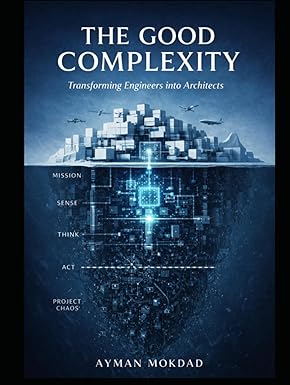
The Good Complexity by Ayman Mokdad is a sharp, experience-driven guide for engineering leaders who are struggling with increasing system complexity, longer development cycles, and declining efficiency. Instead of treating complexity as a problem to eliminate, the book reframes it as something that—when governed properly—can become a powerful strategic advantage.
This is not theory. It is a field manual built from decades of real industrial experience.
Book Details
| Detail | Information |
|---|---|
| Book Title | The Good Complexity Transforming Engineers into Architects |
| Author | Ayman Mokdad |
| Genre | Engineering, Industrial Strategy, Leadership |
| Pages | 83 |
| Language | English |
| Publication Date | April 14, 2026 |
| Theme | Engineering complexity, architecture, innovation, systems thinking |
| Ideal Readers | Engineers, architects, product leaders, industrial managers |
| Book Link | https://www.amazon.fr/dp/B0GXFH7J24 |
The Core Problem Engineering Faces Today
The book starts with a critical observation—despite better tools, engineering teams are slower, overloaded, and less efficient. The issue is not effort but lack of architectural control.
This reframing is crucial.
Complexity Is Not the Enemy
Rather than simplifying everything, the book argues that complexity can be valuable when managed correctly. It can enable product variety, innovation, and scalability.
This challenges conventional thinking.
The PACT Doctrine A Governance Framework
At the heart of the book is the PACT Doctrine, which structures engineering into four key phases
FRAME, FORGE, ASSEMBLE, and DELIVER
This model helps decouple external variety from internal inefficiency.
It provides a clear system for control.
The Leap Left Strategy
Going beyond the traditional shift left approach, the book introduces Leap Left—validating system behavior early through virtual methods before hardware decisions are locked.
This reduces costly late-stage errors.
The STA Paradigm Simplifying Complexity
The Sense Think Act model breaks systems into their core functional logic. This ensures clarity in interfaces and scalability in design.
It simplifies without oversimplifying.
The Digital Engine and System Integration
The book emphasizes the importance of connecting ALM and PLM through a digital thread. This allows faster decision making and better impact analysis.
This is highly relevant for modern engineering teams.
AI as a Force Multiplier Not a Replacement
AI is positioned as a tool that enhances clarity and consistency, not something that replaces human decision making. Strategic thinking remains with the architect.
This is a balanced view.
From Engineers to Architects
A key theme is the transformation of engineers into architects—professionals who think in systems, not just components. This shift is essential for managing complexity at scale.
This is where leadership comes in.
A Practical and Concise Guide
Despite covering complex topics, the book remains concise and focused. It delivers actionable insights without unnecessary detail.
This makes it efficient to read.
Final Thoughts
The Good Complexity is a powerful and practical guide for modern engineering leaders. It redefines how complexity should be viewed and managed, offering structured frameworks that can improve performance, reduce waste, and drive innovation.
For professionals working in engineering, product development, and industrial systems, this book provides valuable and immediately applicable insights.