
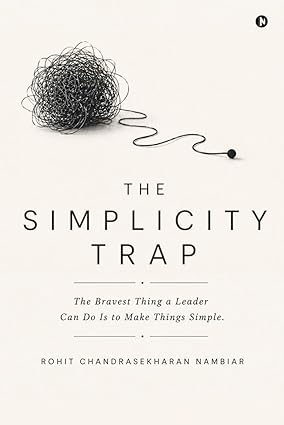
Modern organizations are often praised for sophistication, scale, and complexity. Yet beneath many layers of processes, systems, meetings, approvals, and strategies lies a hidden problem that few leaders are willing to confront. Complexity has become a substitute for clarity. In The Simplicity Trap: The Bravest Thing a Leader Can Do Is to Make Things Simple, Rohit Chandrasekharan Nambiar delivers a compelling argument that simplicity is not a weakness or a lack of sophistication. Rather, it is one of the most difficult and courageous leadership choices an organization can make.
This thought-provoking book challenges conventional management thinking and explores why businesses often become trapped in unnecessary complexity. Through practical observations, leadership insights, and strategic reflections, the author demonstrates how simplicity can become a powerful competitive advantage in an increasingly complicated world.
For leaders, entrepreneurs, managers, and innovators seeking greater clarity, efficiency, and impact, The Simplicity Trap offers a refreshing and highly relevant perspective.
Book Details
| Detail | Information |
|---|---|
| Book Title | The Simplicity Trap: The Bravest Thing a Leader Can Do Is to Make Things Simple |
| Author | Rohit Chandrasekharan Nambiar |
| Genre | Leadership, Business Strategy, Management, Organizational Development |
| Language | English |
| Print Length | 206 Pages |
| Publication Date | April 30, 2026 |
| Format | Paperback / Kindle Edition |
| Best For | Leaders, executives, entrepreneurs, managers, innovators, business strategists |
| Book Link | https://www.amazon.com/dp/B0GZ4XPXJL |
Why Complexity Becomes a Problem
One of the book’s most important observations is that organizational complexity rarely appears overnight.
Instead, complexity accumulates gradually through countless decisions, compromises, habits, and assumptions. New processes are added but old ones are rarely removed. Products remain in portfolios long after they stop creating value. Systems continue to operate because questioning them feels risky.
Nambiar argues that complexity survives not because it is useful, but because removing it often requires difficult decisions and uncomfortable conversations.
This insight immediately resonates with anyone who has worked within large organizations where inefficiency becomes accepted as normal.
Simplicity Requires Courage
A central message throughout the book is that simplicity is fundamentally a leadership challenge.
Many leaders recognize unnecessary complexity but hesitate to act because simplification often carries personal and professional risks. Eliminating processes, questioning established systems, and challenging long-standing assumptions can create resistance.
The author makes a convincing case that true leadership involves accepting these risks in pursuit of greater clarity and effectiveness.
Rather than viewing simplicity as an operational improvement, the book presents it as a strategic act of courage.
This perspective gives the book both its originality and its practical relevance.
Simplicity Is Not the Opposite of Sophistication
A common misconception addressed throughout the book is the belief that simplicity means reducing quality, capability, or sophistication.
Nambiar argues the opposite.
The most effective organizations, products, and leaders often achieve simplicity through deep understanding and disciplined decision-making. Simplicity is not achieved by removing value. It is achieved by removing distractions.
This distinction is particularly important in an era where businesses frequently mistake complexity for innovation.
The book challenges readers to reconsider what truly creates value and what merely creates noise.
Innovation Through Elimination
One of the book’s most memorable ideas is that innovation often comes not from adding more but from removing what no longer serves a purpose.
Organizations frequently focus on creating new products, processes, and initiatives while neglecting the equally important task of eliminating outdated ones.
The author’s statement, “If you want to innovate, you must never be afraid of being fired,” captures the courage required to challenge organizational norms and advocate for meaningful simplification.
This philosophy encourages leaders to prioritize effectiveness over popularity and long-term value over short-term comfort.
Leadership, Decision-Making, and Clarity
Beyond operational efficiency, the book explores how simplicity influences leadership effectiveness.
Complex environments often produce:
- Slow decision-making
- Conflicting priorities
- Reduced accountability
- Communication breakdowns
- Employee frustration
- Strategic confusion
By simplifying systems, structures, and priorities, leaders create greater alignment and enable teams to focus on meaningful work.
The book repeatedly demonstrates that clarity is one of the most powerful leadership tools available.
This emphasis on decision-making and organizational focus makes the lessons applicable across industries and business functions.
A Strategic Perspective on Organizational Growth
Many companies assume growth inevitably requires greater complexity. The Simplicity Trap challenges this assumption.
The author suggests that sustainable growth depends on maintaining simplicity even as organizations expand. Businesses that fail to manage complexity often experience declining agility, slower execution, and weaker customer experiences.
Through this lens, simplicity becomes not just an operational objective but a strategic capability.
Organizations that master simplification position themselves to adapt more effectively in rapidly changing markets.
Writing Style and Reader Experience
Rohit Chandrasekharan Nambiar writes with clarity, conviction, and practical insight.
The book avoids unnecessary jargon and communicates its ideas in a direct and engaging manner. Complex organizational concepts are presented through relatable examples and thoughtful observations, making the content accessible to readers across different professional backgrounds.
The writing reflects the very principle it advocates: simplicity.
At 206 pages, the book remains focused and concise while delivering substantial value and actionable insights.
Who Should Read This Book
This book is highly recommended for:
- Business leaders and executives
- Entrepreneurs and startup founders
- Product managers
- Organizational development professionals
- Strategy consultants
- Team leaders and managers
- Innovation professionals
- Anyone seeking greater clarity and effectiveness in their work
Final Review
The Simplicity Trap: The Bravest Thing a Leader Can Do Is to Make Things Simple is a timely and insightful examination of one of the most overlooked challenges in modern organizations.
Rohit Chandrasekharan Nambiar successfully demonstrates that complexity is often a symptom of leadership avoidance rather than necessity. Through thoughtful analysis and practical wisdom, he shows that simplicity requires courage, discipline, and a willingness to challenge established assumptions.
The book’s greatest strength lies in its ability to transform simplicity from a vague ideal into a strategic leadership principle. Readers are encouraged not merely to reduce complexity but to rethink how value, innovation, and organizational effectiveness are created.
For leaders seeking to build more focused, agile, and impactful organizations, The Simplicity Trap offers valuable insights and a compelling call to action.