
In today’s business environment, uncertainty is no longer an occasional challenge. Markets shift, technology changes established practices, customer expectations evolve, and strategies that once seemed reliable can quickly lose their relevance. For managers, the challenge is not simply to make plans but to make sound decisions when the available information is incomplete and circumstances keep changing.
Thinking in the Fog: A Manager’s Guide to Strategic Thought in Uncertain Times by Amiit Deep Kumarr explores this reality. Rather than promising a formula for predicting the future, the book focuses on developing the ability to think clearly, recognise emerging changes, and take thoughtful action without waiting for perfect clarity. Across 14 chapters, it offers practical guidance for managers navigating ambiguity, competing signals, and difficult decisions.
Book Details
| Detail | Information |
|---|---|
| Book Title | Thinking in the Fog: A Manager’s Guide to Strategic Thought in Uncertain Times |
| Author | Amiit Deep Kumarr |
| Language | English |
| Print Length | 108 pages |
| Publication Date | 15 October 2026 |
| Genre | Business, Management, Strategic Thinking |
| Amazon Link | View on Amazon |
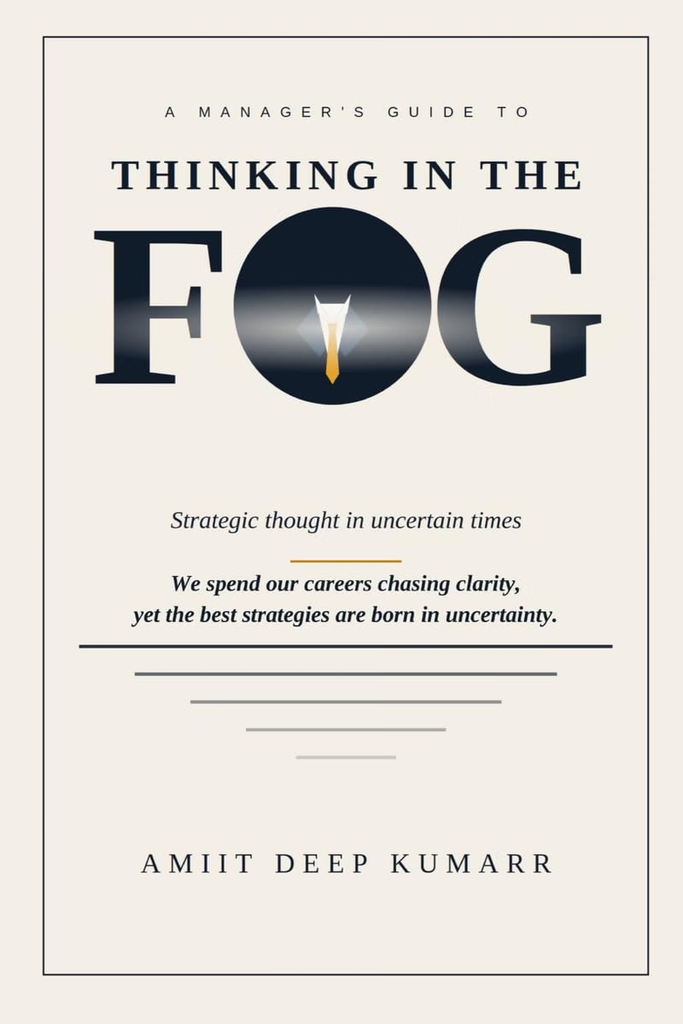
Review of Thinking in the Fog: A Manager’s Guide to Strategic Thought in Uncertain Times
One of the book’s strongest ideas is that working harder does not always lead to better results. In changing business environments, effort can become counterproductive when it is directed towards outdated priorities. The opening chapter, Why Hard Work Alone Fails, makes an important distinction between being busy and making meaningful progress. It encourages managers to step back regularly and question whether their current approach still fits the situation.
The book also explores the limits of managerial control. Managers can influence their preparation, communication, team standards, and responses, but they cannot control every market movement, competitor decision, or external disruption. The discussion draws on ideas from Stoic philosophy and psychological research to explain why recognising this distinction can reduce unnecessary anxiety and help managers focus on what they can actually change.
Another valuable theme is the importance of noticing weak signals before they become visible trends. Through business situations and historical examples, the author highlights how small changes in customer behaviour, competitor activity, technology, and market conditions can offer early indications of larger shifts. Instead of waiting for complete confirmation, managers are encouraged to observe carefully and make small, appropriately sized decisions.
The discussion of timing adds another useful perspective. A good idea may fail not because it lacks potential, but because the market is not ready for it. By considering infrastructure, customer behaviour, costs, and regulatory conditions, managers can evaluate whether an initiative is genuinely flawed or simply too early.
Across its chapters, the book also addresses decision-making with incomplete information, cognitive biases, employee loyalty, leadership during uncertainty, organisational change, scenario planning, and personal resilience. Its use of composite business cases, historical examples, practical exercises, and visual explanations helps connect strategic concepts with everyday management situations. The final playbook brings these ideas together into guidance that managers can revisit when facing difficult choices.
What makes the book particularly relevant is its central message: uncertainty cannot always be removed, but the way we think and respond to it can improve. It does not encourage managers to pretend they have all the answers. Instead, it asks them to remain observant, question their assumptions, stay flexible, and move forward with measured confidence.
Final Thoughts
Thinking in the Fog is a practical read for managers, team leaders, business owners, and professionals responsible for making decisions in changing environments. Its value lies in shifting the focus from predicting every possible outcome to developing better judgement when prediction is difficult.
Amiit Deep Kumarr presents strategic thinking as an ongoing discipline rather than a fixed framework. For readers who want to become more adaptable, recognise emerging opportunities, and lead teams without relying on false certainty, this book offers useful ideas to consider and apply.