What if mythology was never meant to replace science but to remember what science is only now rediscovering?
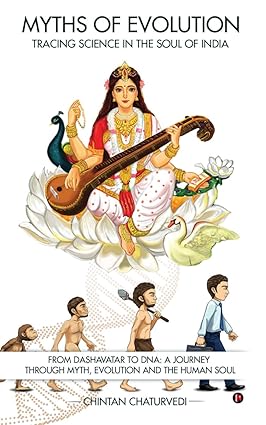
That is the audacious and deeply intellectual question at the heart of Myths of Evolution: Tracing Science in the Soul of India by philosopher and writer Chintan Chaturvedi. This book does not attempt to mythologize science, nor does it reduce mythology to metaphor alone. Instead, it opens a third space where ancient symbolic memory and modern analytical reasoning coexist.
Core Idea: When Myth Becomes Memory
Myths of Evolution proposes a radical yet carefully reasoned thesis. Indian myths, often dismissed as poetic or religious allegory, may encode proto scientific insights about evolution, cosmology, consciousness, and time.
Drawing from the Rigveda, the Upanishads, the Bhagavad Gita, the Dashavatara, and the Yuga cycles, the author explores whether these ancient narratives reflect intuitive understandings of reality that modern science is only now beginning to articulate through quantum physics, evolutionary biology, and consciousness studies.
This book is not about proving myths scientifically correct. It is about asking why the patterns align at all.
Key Explorations Inside the Book
Dashavatara and Evolutionary Memory
The book revisits the famous sequence of Vishnu’s avatars, moving from aquatic life to amphibian, mammal, early human, and evolved human forms. It examines whether this mythic progression mirrors biological evolution in a symbolic and non literal way, suggesting cultural memory rather than coincidence.
Upanishadic Self and Consciousness Studies
Is the concept of Atman compatible with modern debates on consciousness? The book explores whether ancient Indian philosophy anticipated ideas such as non local awareness, observer dependent reality, and the limitations of strict materialism.
Cosmic Time and Yuga Cycles
Instead of linear progress, Indian cosmology speaks in cycles. The author compares this worldview with modern cosmology, entropy theory, and cyclic universe models, raising questions about progress, decay, repetition, and renewal.
Ritual, Symbolism, and Information
Fire altars, chants, and mythic narratives are examined not as superstition but as symbolic technologies. These were systems for encoding and transmitting complex ideas across generations long before formal scientific language or data storage existed.
Why This Book Feels Timely
In an age shaped by artificial intelligence, reductionist science, and overwhelming data without meaning, Myths of Evolution argues for mythic intelligence. It presents a way of knowing that integrates story, symbol, intuition, and reason.
The book positions mythology not as the enemy of science but as its forgotten ancestor. It resonates with readers questioning whether science alone can explain consciousness, whether spirituality must reject rational inquiry, and whether ancient cultures were more sophisticated than modern assumptions allow.
Writing Style and Approach
The tone of the book is reflective rather than dogmatic, philosophical yet accessible, speculative but intellectually disciplined. It is neither a devotional text nor a scientific manual. Instead, it functions as a conversation starter that respects skepticism and reverence equally.
Book Details
| Detail | Information |
|---|---|
| Title | Myths of Evolution: Tracing Science in the Soul of India |
| Author | Chintan Chaturvedi |
| Genre | Philosophy, Mythology, Science |
| Language | English |
| Print Length | 232 pages |
| Publisher | Notion Press |
| Publication Date | 5 September 2025 |
| Buy Link | https://amzn.in/d/3nYIz8S |
Who Should Read This Book
This book is ideal for readers interested in Indian philosophy beyond religion, scientists curious about symbolic and cultural cognition, spiritual thinkers who value reason, AI and consciousness researchers, and anyone intrigued by the meeting point of DNA and Dashavatara.
Final Verdict
Myths of Evolution does not aim to provide definitive answers. Instead, it reframes the questions. It challenges rigid boundaries between myth and science and suggests that truth may not belong exclusively to either domain.
This is a book for thinkers comfortable standing at the edge of certainty, where fossils whisper, scriptures think, and evolution remembers.
Read More : Review : The Legend of Khandoba By Arnav Mukherjee