
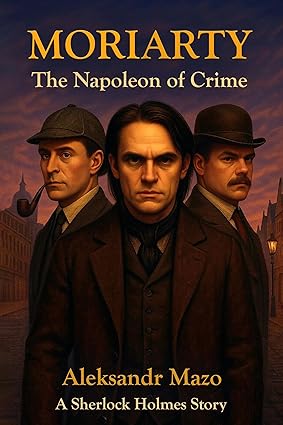
MORIARTY: The Napoleon of Crime by Aleksandr Mazo is a Victorian noir mystery that reimagines Sherlock Holmes’ greatest enemy through a psychological and atmospheric lens.
A Sherlock Holmes Story
Book Details
| Detail | Information |
|---|---|
| Title | MORIARTY: The Napoleon of Crime |
| Author | Aleksandr Mazo |
| Series | Moriarty Saga |
| Genre | Mystery Fiction, Victorian Noir, Psychological Thriller |
| Language | English |
| Print Length | 172 pages |
| Publication Date | October 16, 2025 |
| Amazon Link | https://a.co/d/03NnMK2E |
Introduction
Few villains in literary history command as much fascination as Professor James Moriarty. Known to Sherlock Holmes readers as the shadow behind London’s criminal underworld, Moriarty has long existed as a brilliant but distant figure. MORIARTY: The Napoleon of Crime dares to step into that shadow and ask the question readers have quietly carried for generations. What if the greatest criminal mind of Victorian London was not simply evil, but understandable.
Aleksandr Mazo reimagines the Reichenbach Falls not as an ending, but as a beginning. When Holmes discovers Moriarty’s private journal, the familiar world of deduction and pursuit shifts into something darker and more intimate. This novel invites the reader to sit inside the mind Holmes feared most.
A Confession That Changes Everything
The core of the novel rests on Moriarty’s journal. It is not a confession seeking forgiveness, nor a memoir asking for sympathy. It is a manifesto. Through its pages, Moriarty explains his logic, his discipline, and the intellectual structure that governed his criminal empire.
The most compelling revelation is not what Moriarty did, but why. The book explores the infamous decision at Reichenbach Falls, questioning why a strategist of Moriarty’s calibre would choose close quarters combat over calculated escape. The answer reshapes the reader’s understanding of both adversaries.
This is not an attempt to excuse evil, but to explain the machinery that makes it possible.
Victorian London as a Psychological Landscape
Mazo’s London is richly atmospheric. Fog-laden streets, discreet gentlemen’s clubs, and shadowed alleys become extensions of Moriarty’s mind. Crime is not chaos here. It is geometry. Every move has intent, every risk a calculation.
The city is portrayed not merely as a setting, but as a system Moriarty understands better than anyone. Crime becomes higher mathematics, and London itself becomes a chessboard where order and disorder are carefully balanced.
The result is a Victorian noir tone that feels both classic and unsettlingly modern.
Faithful to Canon Yet Boldly Original
One of the novel’s greatest strengths is its respect for Arthur Conan Doyle’s original canon. The voice, atmosphere, and moral tension remain unmistakably Victorian. At the same time, Mazo expands the narrative without rewriting history.
Sherlock Holmes remains formidable, brilliant, and dangerous. Moriarty does not diminish him. Instead, he reframes their rivalry as a clash of philosophies rather than mere intellects.
The book stands confidently as a standalone story while quietly opening the door to a larger reckoning within the Moriarty Saga.
The Psychology of a Monster
What makes MORIARTY: The Napoleon of Crime unsettling is its restraint. The novel does not glorify violence or revel in cruelty. Instead, it explores how discipline, intelligence, and belief can become tools of domination.
Readers may find themselves disturbed not by Moriarty’s crimes, but by how coherent his reasoning feels. This is the dangerous confession promised by the book. The moment when understanding brushes uncomfortably close to empathy.
And that discomfort lingers long after the final page.
Who This Book Is For
This novel is ideal for readers who love Sherlock Holmes stories but have always been drawn to the darker corners of the canon. It will resonate with fans of British mystery fiction, Victorian noir, and psychological crime novels that challenge simple notions of good and evil.
It is especially compelling for readers who enjoy seeing familiar legends reexamined through a morally complex lens.
Conclusion
MORIARTY: The Napoleon of Crime is not a retelling of a classic mystery. It is a reframing. Aleksandr Mazo delivers a sharp, atmospheric, and intellectually daring novel that dares readers to look behind the villain’s eyes.
This is a story about control, belief, and the thin line between genius and monstrosity. Once you enter Moriarty’s mind, you may understand him. Whether you wish you had is another matter entirely.
Read More : Aria’s Compass By Parul Sharma: Finding Direction in the Storm of Growing Up