
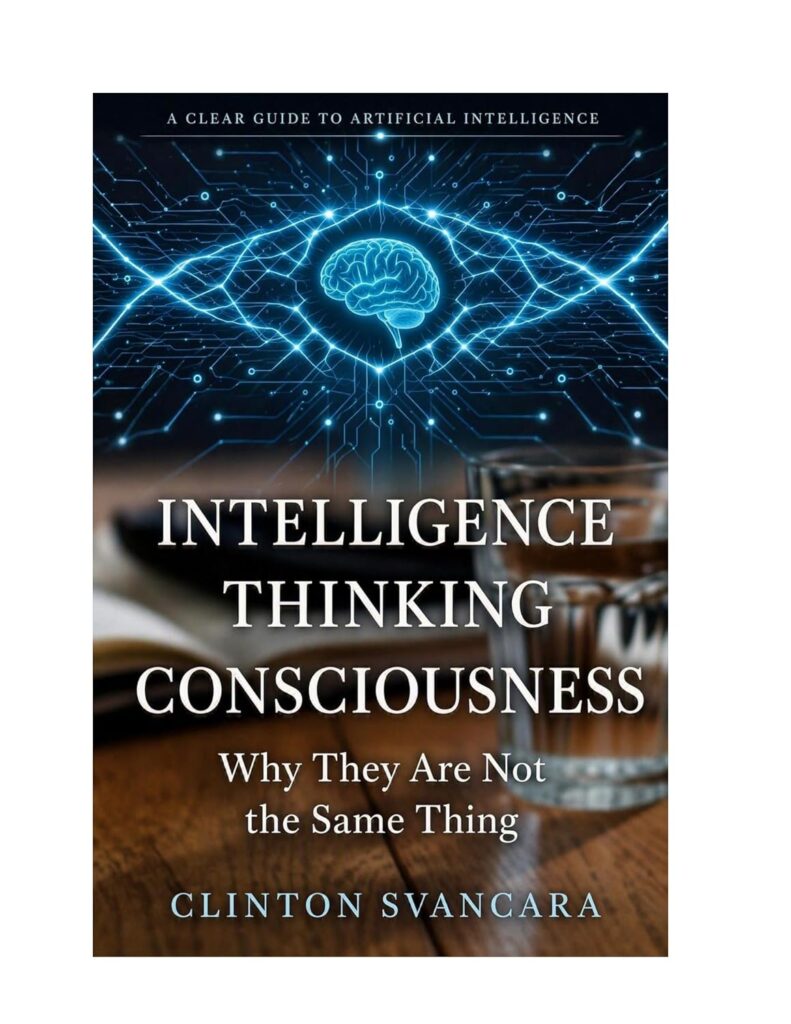
Understanding Intelligence, Thinking, and Consciousness: Why Modern AI Is Powerful Without Being Conscious by Clinton Svancara explores one of the most fascinating questions surrounding modern artificial intelligence: Does intelligent behavior mean that an AI system is actually conscious?
As AI becomes increasingly capable of writing, communicating, solving problems, and performing complex tasks, it is easy to assume that these abilities indicate some form of human-like awareness. This book challenges that assumption by asking readers to distinguish between three concepts that are often treated as interchangeable: intelligence, thinking, and consciousness.
Book Details
| Detail | Information |
|---|---|
| Title | Understanding Intelligence, Thinking, and Consciousness: Why Modern AI Is Powerful Without Being Conscious |
| Author | Clinton Svancara |
| Print Length | 91 Pages |
| Language | English |
| Publication Date | 17 July 2026 |
| Genre | Artificial Intelligence, Consciousness, Philosophy, Technology |
| Book Link | Amazon |
Book Review
The central idea of Understanding Intelligence, Thinking, and Consciousness is straightforward but important: capability is not necessarily consciousness.
Clinton Svancara separates intelligence into three different concepts. Intelligence concerns capability—what a system can accomplish. Thinking relates to processing information. Consciousness, however, concerns subjective experience. While these ideas may overlap in some contexts, the book argues that they should not automatically be treated as the same thing.
This distinction becomes increasingly relevant as modern AI systems demonstrate impressive abilities. AI can write articles, carry conversations, analyze information, generate ideas, and solve increasingly complicated problems. Such capabilities can make AI appear remarkably human-like, but appearance and subjective experience are not necessarily equivalent.
The book takes an accessible approach to this complicated subject, drawing on examples from everyday life, biology, and modern artificial intelligence. Rather than overwhelming readers with technical terminology, it focuses on building a framework for thinking more carefully about what intelligence actually means.
One of the book’s strengths is that it avoids taking an unnecessarily extreme position. It does not claim that AI is conscious, but it also does not attempt to prove that AI could never become conscious. Instead, it encourages readers to recognize the difference between what we can observe intelligent behavior and what we cannot automatically conclude from that behavior subjective awareness.
This approach makes the discussion particularly relevant at a time when conversations about AI frequently move between two extremes: portraying artificial intelligence as almost human or dismissing its capabilities entirely. The book attempts to move beyond both positions by encouraging clearer definitions and more careful reasoning.
The distinction between intelligence, thinking, and consciousness also has implications beyond AI. Understanding these concepts can change how readers think about intelligence in humans, animals, biological systems, and machines. By examining the concepts separately, the book invites readers to reconsider assumptions that often go unnoticed.
At just 91 pages, the book is also relatively concise. Its focus appears to be less about providing an exhaustive technical examination of AI consciousness and more about giving readers a conceptual framework they can use when thinking about the subject.
Why This Book Matters
As artificial intelligence becomes more capable, questions about whether machines understand, think, or experience the world are likely to become increasingly common.
Understanding Intelligence, Thinking, and Consciousness provides readers with a useful starting point for separating these questions. Rather than asking simply, “Is AI conscious?”, the book encourages a more fundamental examination of what we mean when we use words such as intelligence, thinking, understanding, and consciousness.
This makes it suitable for curious readers, technology enthusiasts, AI professionals, students, and anyone interested in the philosophical questions emerging alongside modern AI.
Final Thoughts
Understanding Intelligence, Thinking, and Consciousness offers a concise and accessible exploration of a complicated subject.
Its central message is that intelligent behavior should not automatically be interpreted as evidence of consciousness. By separating capability, information processing, and subjective experience, Clinton Svancara encourages readers to think more precisely about what modern AI can do—and what its abilities actually tell us.
Rather than providing an exaggerated prediction about the future of conscious machines, the book focuses on a more valuable skill: thinking carefully before reaching a conclusion