
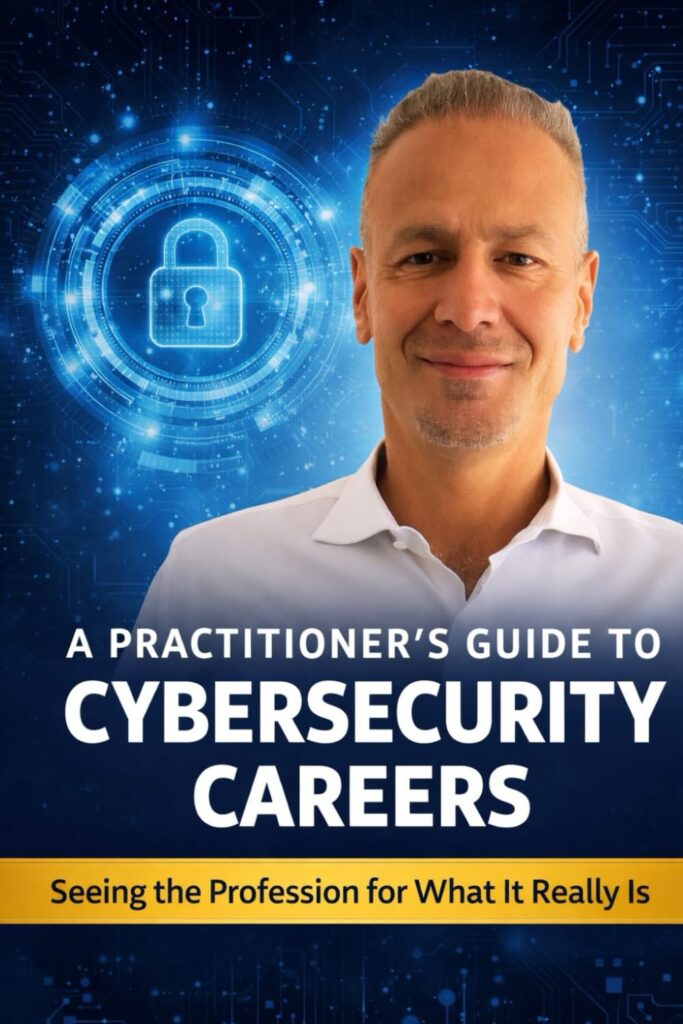
Cybersecurity is often presented as a field where the right certification, a few technical skills, and a willingness to learn can quickly lead to a new career. A Practitioner’s Guide to Cybersecurity Careers: Seeing the Profession for What It Really Is takes a more grounded approach. Written by Tony Manzoni, the book focuses on what cybersecurity careers actually look like and how professionals can transition into the industry without necessarily starting their careers from scratch.
Drawing on 22 years of experience across global technology and cybersecurity organizations, Manzoni approaches cybersecurity as a profession with multiple career paths rather than a single technical destination. The book is particularly relevant for professionals coming from sales, IT, cloud, and other technology backgrounds who want to understand where their existing experience can fit within cybersecurity.
Book Details
| Detail | Information |
|---|---|
| Title | A Practitioner’s Guide to Cybersecurity Careers: Seeing the Profession for What It Really Is |
| Author | Tony Manzoni |
| Print Length | 101 Pages |
| Language | English |
| Publication Date | 15 January 2026 |
| Genre | Cybersecurity, Career Development, Technology, Professional Development |
| Book Link | Amazon UK |
Book Review
The most valuable aspect of A Practitioner’s Guide to Cybersecurity Careers is its realistic approach to entering the cybersecurity profession. Instead of presenting cybersecurity as a field that requires everyone to follow the same technical route, Tony Manzoni highlights the variety of roles that exist within the industry.
The book explores both sales and go-to-market positions and technical and security engineering paths, helping readers understand that cybersecurity organizations need a broad range of professional capabilities. This is particularly useful for people who may already have years of experience in another area of technology but assume that changing careers means starting again at an entry-level position.
The idea of transitioning without starting over is central to the book. Many mid-career professionals have valuable experience in areas such as IT, cloud technologies, sales, customer relationships, or business operations. The challenge is understanding how those existing capabilities translate into cybersecurity. Manzoni’s approach encourages readers to look at their professional background as a foundation rather than something they need to discard.
Another important theme is the distinction between cybersecurity knowledge and cybersecurity employability. The book moves away from the idea that collecting certifications automatically creates a successful career. Instead, it focuses on understanding what employers and hiring managers actually value and how candidates can demonstrate relevant experience and credibility.
This makes the book especially timely for people who have encountered the overwhelming number of cybersecurity certifications available today. Rather than treating certification as the destination, the book places greater emphasis on choosing an appropriate career direction and understanding the expectations of the role.
The discussion of how organizations buy and manage cybersecurity also adds an important professional perspective. Cybersecurity is not simply about technology. Security decisions are influenced by risk, business priorities, budgets, organizational structures, and the people responsible for making those decisions. Understanding this environment can help professionals see cybersecurity from the perspective of an organization rather than only from the perspective of a technical practitioner.
The inclusion of frameworks such as MEDDIC, MEDDPICC, and STAR gives the book an additional practical dimension. These frameworks can help professionals structure how they communicate their experience, demonstrate value, and approach career positioning. For someone changing fields, being able to explain existing experience in a way that connects with cybersecurity employers can be just as important as acquiring new knowledge.
For example, an IT professional who has spent years working with cloud infrastructure may already possess experience relevant to cloud security. The challenge is not necessarily to erase that history and begin again, but to understand how existing experience connects with the security responsibilities and business outcomes employers are looking for. This is the kind of career reframing that makes the book particularly useful for mid-career professionals.
Why This Book Matters
The cybersecurity industry continues to attract professionals because of its importance across technology and business. However, the sheer amount of career advice, certification content, and online training can make it difficult for newcomers to determine what actually matters.
A Practitioner’s Guide to Cybersecurity Careers addresses this problem by taking a practitioner-led approach. Its emphasis is on understanding the profession, identifying the right career path, positioning existing experience, and building credibility rather than simply following a certification checklist.
The book is particularly suited to sales professionals, IT and cloud practitioners, and mid-career technology professionals who are considering a transition into cybersecurity. It can also be useful for anyone who wants a clearer understanding of the different professional paths available within the cybersecurity ecosystem.
Final Thoughts
A Practitioner’s Guide to Cybersecurity Careers: Seeing the Profession for What It Really Is is a concise and practical career guide that challenges the idea that entering cybersecurity necessarily means starting from zero.
Tony Manzoni’s experience-driven perspective gives the book a grounded quality. Instead of promising shortcuts into a rapidly growing industry, it encourages readers to understand cybersecurity as a profession, identify where their existing experience fits, and deliberately build credibility for the direction they choose.
For professionals considering a move into cybersecurity, the book’s central message is particularly valuable: your previous career is not necessarily baggage. With the right positioning, it can become part of your cybersecurity advantage.