
Introduction
What if the biggest strategic advantage is not competing better, but changing the competition itself?
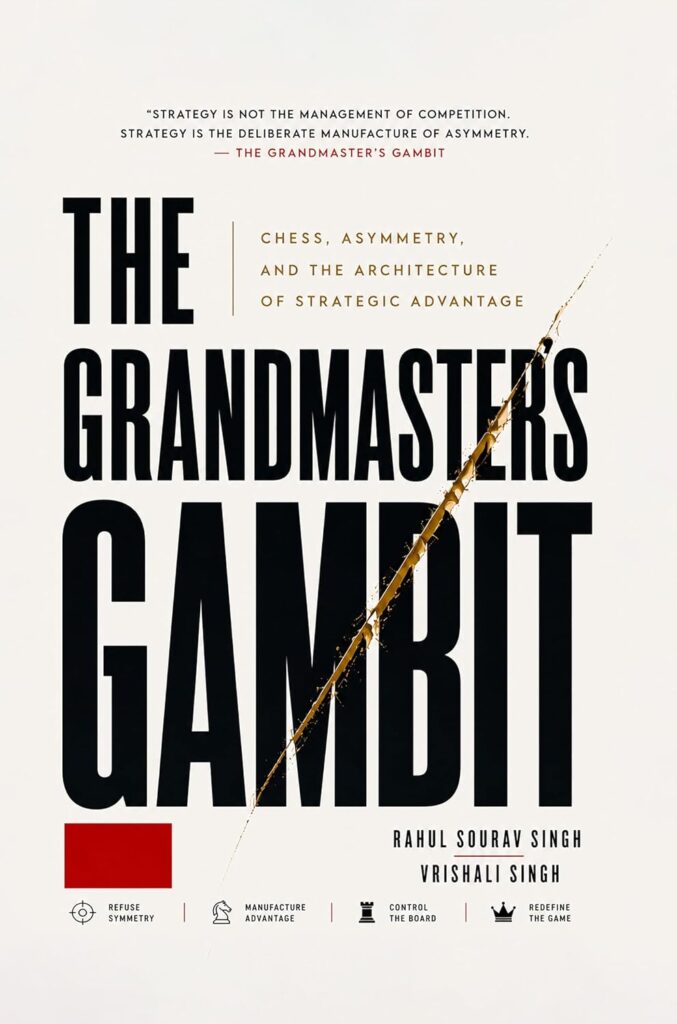
The Grandmaster’s Gambit by Rahul Sourav Singh and Vrishali Singh explores this question through the architecture of chess, using familiar concepts from the game to examine strategy across business, geopolitics, and artificial intelligence.
The book argues that great strategists do not simply try to outperform competitors within an existing system. Instead, they look for ways to restructure the contest, create asymmetry, and place themselves in positions where the competition becomes difficult to answer.
Drawing on examples such as Reliance Jio, Apple, Nvidia, SpaceX, and Bobby Fischer, the authors present a strategic framework built around ideas such as Fork, Tempo, and Zugzwang. The result is a book that uses chess as its language while focusing on a much broader question: how can leaders create advantages before the real contest begins?
Book Details
| Detail | Information |
|---|---|
| Title | The Grandmaster’s Gambit |
| Authors | Rahul Sourav Singh and Vrishali Singh |
| Publisher | Crown Publishing |
| Genre | Strategy, Business, Leadership |
| Language | English |
| Print Length | 351 pages |
| Publication Date | July 13, 2026 |
| Book Link | Amazon India |
Strategy Begins Before the Contest
A central idea in The Grandmaster’s Gambit is that strategy should not be limited to competing more effectively within an established game.
According to the book’s premise, great strategists recognize that the strongest victories can be created before the competition fully begins. Instead of simply playing the game better, they find ways to redesign the game itself.
This changes the way competitive advantage can be understood. Rather than asking only how to beat competitors, leaders can ask a more fundamental question: Can the structure of the competition be changed?
What Do Jio, Apple, Nvidia, SpaceX, and Bobby Fischer Have in Common?
The book connects seemingly different names and industries through a common strategic principle.
Reliance Jio, Apple, Nvidia, SpaceX, and chess grandmaster Bobby Fischer operated in very different environments. Yet the book argues that they share an important characteristic: they refused to simply fight the game everyone else had prepared to play.
This concept of challenging the existing competitive structure becomes one of the book’s foundations.
For business leaders, this can mean changing how a market operates. In technology, it can involve creating a new competitive advantage. In geopolitics, it can mean approaching strategic situations through a different structure of power.
The underlying principle remains the same: sometimes the best way to win is to make the old rules less relevant.
Learning Strategy Through Chess
Chess provides the central framework through which the authors explain their strategic ideas.
The game is built around positioning, timing, anticipation, sacrifice, pressure, and the ability to recognize possibilities before they become obvious. These qualities can also be applied to leadership and competitive decision-making.
The Grandmaster’s Gambit takes concepts from chess and gives them broader strategic applications. Instead of treating chess simply as a game of moves, it presents the architecture of chess as a way of understanding complex competition.
The Power of Asymmetry
One of the book’s key concepts is asymmetry.
In a competitive environment, organizations do not always need to become stronger in every area. A more powerful approach can be to restructure the contest so that existing strengths and weaknesses matter differently.
This idea encourages leaders to look beyond conventional competition.
Rather than asking how to match a competitor feature for feature, a strategist can look for an entirely different position. The objective is to create an advantage that is difficult for others to respond to using conventional methods.
Fork, Tempo, and Zugzwang
The book introduces chess principles such as Fork, Tempo, and Zugzwang as part of its strategic vocabulary.
A fork represents a position where multiple targets can be threatened simultaneously. In a broader strategic context, this can represent creating several pressures or opportunities at once.
Tempo relates to timing and initiative. Strategic decisions are not only about what action is taken, but also about when it is taken.
Zugzwang describes a situation in which a player is forced to make a move even though moving may worsen their position. Applied strategically, the concept illustrates how positioning can create circumstances where the opposing side has limited or undesirable choices.
Together, these concepts provide a distinctive vocabulary for thinking about competitive advantage.
Strategy Across Business, Geopolitics, and AI
The scope of The Grandmaster’s Gambit extends beyond traditional business strategy.
The authors apply their framework across business, geopolitics, and artificial intelligence, suggesting that the principles of positioning and asymmetry can operate across very different competitive environments.
This broader perspective makes the book relevant to readers who want to think about strategy beyond a single industry.
Whether the contest involves companies competing for markets, nations navigating geopolitical interests, or organizations developing AI capabilities, the fundamental strategic question remains similar: Who controls the structure of the game?
A New Vocabulary for Competitive Dominance
One of the book’s distinctive contributions is its attempt to create a vocabulary for strategic thinking using familiar chess concepts.
Terms such as Fork, Tempo, and Zugzwang become more than chess terminology. They are presented as ways to identify strategic situations, understand competitive positioning, and recognize opportunities to reshape the contest.
For leaders, having such a framework can make complex competitive situations easier to analyze and discuss.
Who Should Read The Grandmaster’s Gambit?
The book may be particularly relevant to:
- Business leaders interested in competitive strategy
- Entrepreneurs looking for unconventional approaches to market competition
- Strategists studying asymmetry and positioning
- Technology leaders navigating AI and rapidly changing markets
- Executives dealing with complex competitive environments
- Students of geopolitics interested in strategic decision-making
- Chess enthusiasts interested in applying chess principles beyond the board
- Readers interested in leadership, innovation, and competitive advantage
About the Authors
Rahul Sourav Singh and Vrishali Singh are the authors of The Grandmaster’s Gambit, a strategy-focused work that uses chess architecture to explore competitive advantage across business, geopolitics, and AI.
Their framework brings together chess concepts and strategic thinking to examine how leaders can move beyond conventional competition and create positions that fundamentally alter the contest.
Conclusion
The Grandmaster’s Gambit presents strategy as something deeper than simply being better than the competition.
Its central message is that some of the most powerful victories come from changing the conditions under which competition takes place. Through chess concepts such as Fork, Tempo, and Zugzwang, the book explores how leaders can recognize asymmetries, create difficult positions for competitors, and potentially redefine the game itself.
For entrepreneurs, executives, strategists, technology leaders, and anyone interested in competitive thinking, the book offers a different way to approach strategy.
The question is no longer simply how do you win the game?
It is whether you can redesign the game before everyone else realizes what has changed.