
Artificial intelligence is transforming the way organizations operate, but adopting AI is only the beginning. The real challenge is turning ambitious ideas, pilot projects, and technology investments into measurable business outcomes.
In The AI Execution Advantage: How Leaders Turn Artificial Intelligence Strategy into Governed, Adopted, and Measurable Business Results, Dr. Kolawole O. Akinbaleye explores this important gap between AI strategy and successful execution.
This practical guide focuses on the leadership, governance, organizational readiness, and execution capabilities needed to make AI work in real business environments. It offers a structured approach for organizations seeking to move beyond experimentation and build sustainable AI capabilities.
Book Details
| Details | Information |
|---|---|
| Book Title | The AI Execution Advantage |
| Author | Dr. Kolawole O. Akinbaleye |
| Genre | Artificial Intelligence, Business, Leadership, Technology |
| Print Length | 111 pages |
| Language | English |
| Publication Date | November 17, 2026 |
| Book Link | Buy on Amazon |
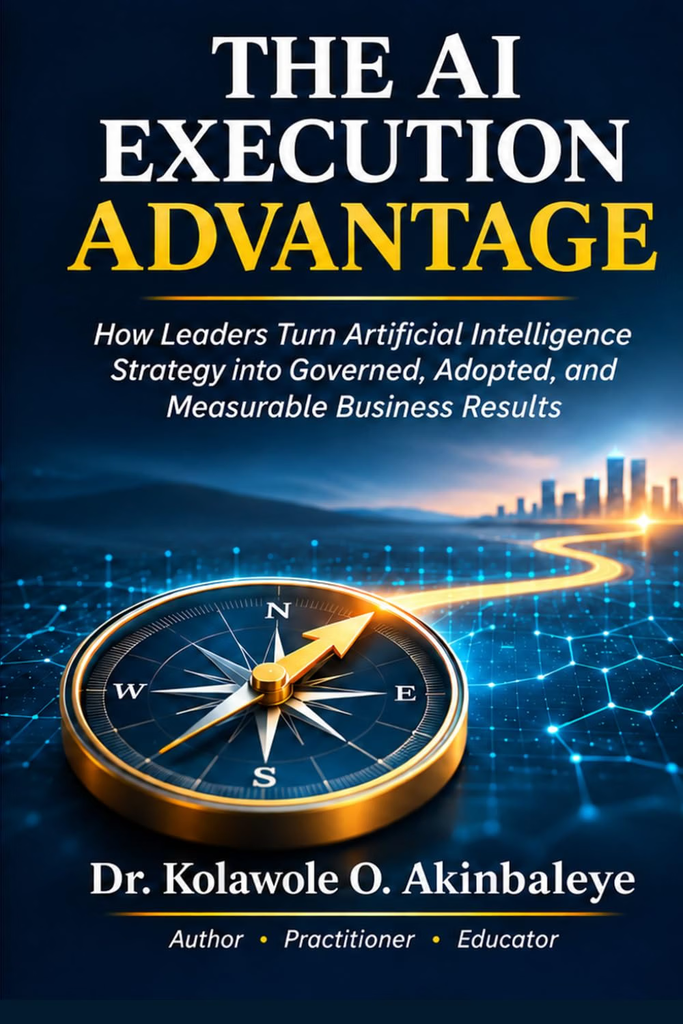
Review of The AI Execution Advantage
One of the strongest aspects of The AI Execution Advantage is its focus on execution rather than simply explaining the potential of artificial intelligence. Many organizations understand that AI can improve productivity, decision-making, and business performance, yet struggle to convert that promise into lasting value.
Dr. Akinbaleye addresses this challenge through the eight-stage AI Strategy-to-Value Framework. The framework guides leaders from defining the right business problem to assessing readiness, building a business case, establishing governance, testing solutions, managing implementation, encouraging adoption, and measuring results.
This structured approach highlights an important lesson: successful AI implementation requires more than technology. It depends on clear objectives, reliable data, accountable leadership, effective risk management, and the ability to bring people along through organizational change.
The book also explores practical concerns such as data readiness, vendor management, enterprise dependencies, AI governance, and responsible scaling. These topics are especially relevant for organizations that are moving beyond small experiments and beginning to integrate AI into their core operations.
Another valuable element is the emphasis on adoption and measurable outcomes. An AI solution may perform well in a demonstration, but its real value depends on whether people use it, whether it improves business processes, and whether those improvements can be sustained over time.
Drawing on more than eighteen years of experience across technology, transformation, enterprise systems, governance, consulting, and project management, the author brings a broad organizational perspective to the subject.
The book is well suited to executives, transformation leaders, technology professionals, consultants, and students who want to understand how AI initiatives can be planned and delivered with greater discipline.
Final Thoughts
The AI Execution Advantage offers a practical perspective on one of the most important challenges facing modern organizations: turning AI ambition into real business performance.
Its eight-stage framework provides a clear structure for thinking about AI initiatives, while its focus on governance, adoption, accountability, and value measurement reinforces the importance of responsible execution.
For leaders who want to move beyond AI experimentation and build capabilities that deliver lasting results, this book presents a useful and timely guide.
Read Another : Behind Those Eyes: Through Muddy Paws, Silent Language, and Unspoken Devotion – The Story of Us by Tushar Chatterji