
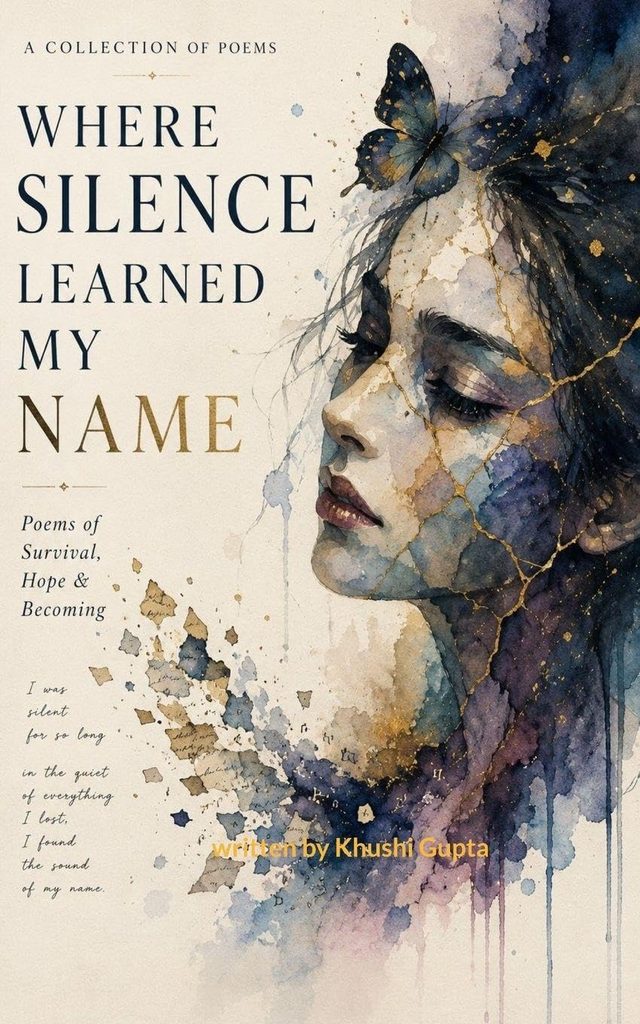
Where Silence Learned My Name is an intimate and deeply reflective collection of poetry about what it means to survive something that changes you—and then slowly discover that survival does not have to be the end of the story.
Khushi Gupta’s collection is not simply a book about pain. It is a book about what happens after pain becomes part of your identity: learning to live inside a body you once feared, questioning the stories other people have written about you, remembering the child you once were, finding people who stay without demanding explanations, and eventually learning to speak in your own voice.
The preface establishes this intention beautifully. The author describes silence as something she once believed was the safest place for her feelings, but gradually comes to understand that silence is not where our stories are meant to remain. The poems are presented not merely as expressions of suffering but as reflections on survival, hope, resilience, and becoming.
A Journey from Diagnosis to Identity
One of the strongest threads running through the collection is the experience of living with a medical condition and the way illness can become something other people use to define a person.
The opening poem, “Before I Knew My Own Name,” immediately establishes this tension. The speaker’s childhood is intertwined with insulin, a glucometer, numbers, and the fear of what the body might do next. What should have been ordinary childhood experiences become measured against medical realities.
This develops further in “The Weight of Numbers.” Here, numbers are not merely measurements. They become a second language—one capable of communicating fear, relief, patience, uncertainty, and hope. The speaker ultimately recognizes that although numbers can measure the blood, they cannot measure everything a person is.
That distinction is important to the entire collection:
A diagnosis may describe part of someone’s life, but it cannot describe the whole person.
When Home Does Not Feel Like Home
The emotional landscape then expands beyond illness.
In “Home Was Never Home,” Gupta explores the complicated idea of safety. A house can have four walls and still fail to feel like home. The poem captures how childhood experiences can teach someone to associate raised voices and fear with ordinary domestic spaces.
What makes this section particularly affecting is that the speaker does not remain trapped in the idea of returning to the place she came from. Instead, she begins imagining a different kind of home one where silence means rest rather than fear, where love does not leave bruises, and where closing a door feels like protection rather than a warning.
The idea of redefining home becomes one of the collection’s important forms of healing.
The Stories Other People Write About Us
Another powerful theme appears in “The Things They Decided About Me.”
The poem examines how easily people can construct an identity around someone without actually asking who that person wants to become. A diagnosis, an insulin pen, other people’s assumptions, and even their expectations can become a substitute for knowing the individual.
The speaker eventually reaches a crucial realization: not every opinion deserves a permanent home inside her.
This is where the collection begins moving from being defined toward self-definition.
That transition continues in “The Child Who Grew Up Too Soon.” The poem looks back at a childhood in which responsibility arrived before childhood had properly finished. Its most touching quality is its compassion toward the younger self. Instead of telling that child to become stronger, the poem recognizes that she had already learned how to survive.
That distinction gives the collection emotional maturity.
Silence Is Not the Same as Peace
The title becomes particularly meaningful when we reach “A Voice That Wasn’t Shaking.”
For years, silence has functioned as protection. The speaker has swallowed words, carried unfinished apologies, and learned to make herself smaller. But eventually something changes: she speaks.
The significance is not simply that she finally says something.
It is that her voice no longer shakes.
The poem suggests that healing does not necessarily mean forgetting what happened. Sometimes it means being able to remember without allowing the memory to control whether you speak.
This idea reaches an important stage in “The First Time I Spoke First.” The speaker realizes that the hardest part was not speaking itself—it was believing that her voice deserved to arrive before permission did.
That is one of the collection’s most compelling ideas: finding your voice begins with believing that you are entitled to have one.
The Quiet Importance of People Who Stay
The collection also gives considerable space to relationships that do not demand explanations.
“The Friend Who Stayed” is particularly gentle in this respect. The friend does not need a dramatic speech or a perfect solution. She simply stays. She notices small things, makes room, listens, and provides the kind of companionship that does not require the speaker to perform being okay.
This poem offers an important counterpoint to many of the earlier poems. Where some people have tried to define, judge, diagnose, or speak for the narrator, this friend simply makes room beside her.
The book therefore recognizes that healing can sometimes happen through very ordinary acts of presence.
Learning to Want a Future
A particularly meaningful shift occurs in “The Future I Was Afraid to Want.”
Earlier in the collection, the future is largely organized around medical appointments and immediate survival. Eventually, however, the speaker begins imagining something beyond the next hospital visit.
A job. A city.
A different version of herself.
The future initially feels almost dangerous because imagining it means allowing herself to want something again.
The poem captures a subtle but important stage of recovery: hope can be frightening when disappointment has taught you not to expect anything.
Yet the speaker eventually carries that imagined future with her.
Making Peace with the Body
“The Body That Stayed” continues this movement inward.
The body, which earlier appeared as something that generated numbers, warnings, fear, and uncertainty, is reconsidered with greater tenderness.
Instead of treating the body as a problem waiting to happen, the speaker begins reading its marks differently. What once looked like damage can become a language—a record of everything the body has carried.
The moment when the speaker places a hand over her heartbeat without checking or measuring anything is especially significant. For once, she is not counting.
She is simply listening.
That small change carries enormous emotional weight.
Discovering Happiness in Ordinary Things
One of the collection’s most effective developments is that its definition of happiness becomes increasingly modest.
In “An Ordinary Afternoon,” nothing extraordinary happens. There is tea, a book, sunlight, a window, and the passage of time.
Yet the speaker realizes that what she once might have called an uneventful day can actually be happiness.
This is an important departure from conventional narratives of recovery. Healing does not have to culminate in a dramatic victory. Sometimes it looks like having an ordinary afternoon without being consumed by fear.
Similarly, “The Weather Owed Me Nothing” uses changing weather as a metaphor for releasing the expectation that life must always provide perfect conditions. The speaker learns to carry an umbrella without demanding that it never rain—and eventually finds herself laughing in the rain.
From Hiding to Becoming
The final sequence is where the collection’s central transformation becomes clearest.
In “The Story I Stopped Hiding,” the speaker finally refuses to make herself smaller or choose the easier version of her story. Speaking about her life does not make the story heavier; instead, it means she no longer has to carry it alone.
Then comes “The Flower I Didn’t Expect.”
The flower growing through a crack in the pavement becomes an understated but effective image of unexpected resilience. Nobody planted it. Nobody promised it would survive. Yet it grows toward the light.
That image perfectly reflects the movement of the collection: life can continue in places where the speaker once believed nothing beautiful could grow.
The Final Poems: Survival Becomes Something More
The final poems are particularly important because they prevent the collection from ending simply with the statement that the speaker survived.
In “The Hands That Didn’t Let Go,” support is presented not as someone rescuing the speaker but as someone walking beside her until the road becomes familiar again.
Then “The Light I Carried Forward” transforms the wound itself. The pain has not magically disappeared; rather, it has learned to become something that can illuminate rather than merely hurt.
The closing poem, “The Way Home,” brings together many of the collection’s central ideas—childhood, broken promises, friendship, dreams, hope, and the possibility of becoming someone a frightened younger self would be proud to meet.
The ending is especially fitting because the book began with questions of identity and ends with a stronger sense of self. The final pages imagine a future in which the reader—or the younger self—can speak without fear, recognize that perfection was never the requirement, and continue choosing another sunrise.
What Makes the Collection Stand Out
What makes Where Silence Learned My Name compelling is its emotional progression.
It does not remain in one emotional register.
The collection moves through:
illness → fear → childhood → silence → other people’s expectations → loneliness → friendship → self-expression → acceptance → hope → becoming.
That progression gives the poems the feeling of a continuous emotional journey even though each poem can stand independently.
Gupta also frequently uses ordinary objects and experiences—an insulin pen, a birthday cake, a cup of tea, a window, rain, a flower, a hand, a heartbeat—to approach much larger ideas. This keeps the poetry intimate rather than abstract.
The language is generally simple and accessible, but the simplicity often allows individual images to carry emotional significance without excessive explanation.
Final Assessment
Where Silence Learned My Name: Poems of Survival, Hope & Becoming is ultimately a collection about reclaiming authorship of one’s own life.
Its speaker begins in a world where numbers, diagnoses, fear, family experiences, and other people’s opinions seem capable of defining who she is. Gradually, those things lose their authority.
The book does not claim that healing erases the past.
Instead, it proposes something more believable and more hopeful:
You can carry what happened to you without allowing it to become the only story you tell about yourself.
By the closing poems, survival has evolved into something broader. There is room for friendship, ordinary happiness, dreams, forgiveness, self-compassion, and a future that was once too frightening to imagine.
The title Where Silence Learned My Name therefore becomes an especially fitting description of the collection. Silence is present throughout the book—but it is no longer the final destination.
The speaker learns to name herself.
And, perhaps more importantly, she learns that her story deserves to be heard in her own voice.
Recommended for: readers of contemporary poetry, reflective poetry, healing and resilience literature, memoir-style poetry, and anyone drawn to themes of identity, chronic illness, childhood experiences, emotional recovery, self-acceptance, and finding one’s voice.
Overall impression: A deeply personal, emotionally progressive collection that turns survival into a conversation about identity, hope, and the courage to become.