
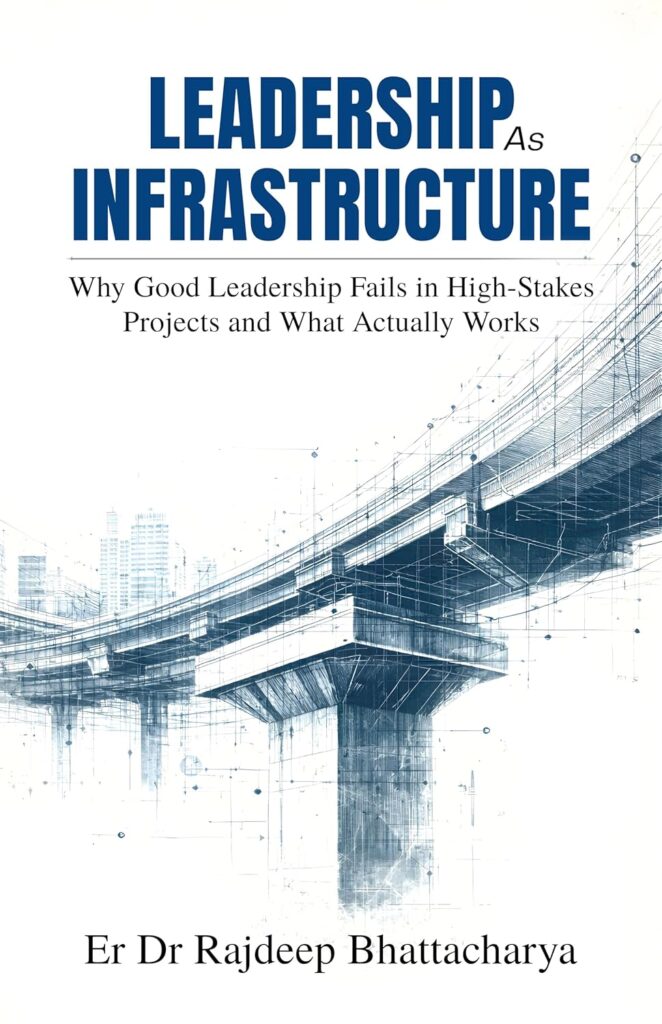
Leadership is often described as a skill, a trait, or an art. However, in complex projects where deadlines are tight, stakeholders are demanding, and the consequences of failure are significant, leadership must be much more than individual capability. In Leadership as Infrastructure: Why Good Leadership Fails in High-Stakes Projects and What Actually Works, Er. Dr. Rajdeep Bhattacharya presents a compelling and practical framework that reimagines leadership as a structured system rather than a collection of personal qualities.
Designed for engineers, project managers, infrastructure professionals, and leaders operating in high-pressure environments, the book explores why traditional leadership approaches often fail when complexity increases and offers actionable strategies for building resilient, high-performing teams.
By combining research, practical insights, and real-world project experience, the author delivers a valuable resource for professionals responsible for navigating uncertainty while delivering results.
Book Details
| Detail | Information |
|---|---|
| Book Title | Leadership as Infrastructure: Why Good Leadership Fails in High-Stakes Projects and What Actually Works |
| Author | Er. Dr. Rajdeep Bhattacharya |
| Publisher | P&P Academy |
| Publication Date | 27 January 2026 |
| Print Length | 242 Pages |
| Language | English |
| Genre | Leadership, Project Management, Engineering Management, Professional Development |
| Best For | Engineers, Project Managers, Team Leaders, Infrastructure Professionals, Executives |
| Book Link | https://www.amazon.in/dp/B0GXFLLWR8 |
Rethinking Leadership in Complex Environments
One of the book’s most significant contributions is its challenge to conventional leadership thinking.
Many leadership books focus on charisma, communication skills, or motivational techniques. While these qualities remain important, Dr. Bhattacharya argues that they are insufficient when managing large-scale projects involving uncertainty, multiple stakeholders, technical challenges, and high levels of risk.
The book proposes that leadership should function like infrastructure itself: structured, reliable, scalable, and capable of supporting consistent performance under pressure.
This perspective shifts leadership from a personality-driven concept to a system-driven discipline.
Why Good Leaders Sometimes Fail
A central question explored throughout the book is why capable and experienced leaders still struggle in high-stakes projects.
The author identifies several common causes:
- Poor stakeholder management
- Unclear accountability structures
- Weak delegation practices
- Communication breakdowns
- Emotional reactions under pressure
- Misaligned team dynamics
- Lack of leadership systems
Rather than blaming individual leaders, the book examines how organizational structures and project environments often contribute to leadership failures.
This systems-oriented approach provides readers with a deeper understanding of the challenges they face and practical ways to address them.
Emotional Intelligence as a Leadership Foundation
While the book emphasizes structure and systems, it also recognizes the importance of emotional intelligence.
Dr. Bhattacharya explains that leadership effectiveness begins with self-awareness and emotional self-mastery. High-pressure environments often expose weaknesses in decision-making, communication, and conflict management.
Readers are encouraged to develop:
- Emotional resilience
- Self-awareness
- Stress management skills
- Adaptive thinking
- Constructive communication habits
These capabilities help leaders remain effective during uncertainty and maintain stability when teams face significant challenges.
The integration of emotional intelligence with project leadership makes the book both practical and highly relevant.
Managing Stakeholders and Complex Relationships
One of the most valuable sections focuses on stakeholder management.
Large projects rarely succeed through technical expertise alone. Success often depends on managing diverse interests, expectations, and communication channels.
The book explores strategies for:
- Building stakeholder trust
- Managing competing priorities
- Improving collaboration
- Resolving conflicts
- Aligning project objectives
These insights are particularly valuable for professionals working in infrastructure, construction, engineering, technology, and large-scale transformation projects.
The emphasis on relationship management reflects the realities of modern project leadership.
Delegation, Ownership, and Accountability
Another key theme is the importance of creating systems that encourage ownership and accountability.
Many leaders struggle because they attempt to solve every problem themselves. The author argues that sustainable leadership requires empowering others while maintaining clear expectations and accountability frameworks.
The discussion covers:
- Effective delegation practices
- Responsibility allocation
- Team empowerment
- Performance ownership
- Decision-making structures
These concepts help leaders move from reactive management to proactive leadership.
By creating systems that support accountability, organizations become more resilient and adaptable.
Building High-Performing Teams
The book consistently emphasizes that project success is ultimately a team achievement.
Dr. Bhattacharya explores how leaders can create environments where teams remain stable, engaged, and productive even during periods of uncertainty and pressure.
Topics include:
- Team cohesion
- Trust building
- Psychological safety
- Communication systems
- Performance consistency
- Leadership alignment
The practical nature of these discussions makes them immediately applicable across industries and organizational contexts.
Who Should Read This Book
This book is highly recommended for:
- Engineers and technical leaders
- Project managers
- Infrastructure professionals
- Construction and development managers
- Program and portfolio managers
- Organizational leaders
- Team supervisors
- Professionals managing complex projects
Final Review
Leadership as Infrastructure: Why Good Leadership Fails in High-Stakes Projects and What Actually Works offers a fresh and practical perspective on leadership in complex environments.
Er. Dr. Rajdeep Bhattacharya successfully moves the conversation beyond traditional leadership theories and presents leadership as a structured system capable of supporting consistent performance under pressure. Through insights on emotional intelligence, stakeholder management, accountability, delegation, and team development, the book provides a comprehensive framework for leading successfully in demanding situations.
Its greatest strength lies in its practicality. Rather than focusing on idealized leadership concepts, the book addresses the real challenges professionals face every day.
For engineers, project managers, and leaders seeking a proven framework for navigating complexity and delivering results, this book is an insightful and valuable resource.