
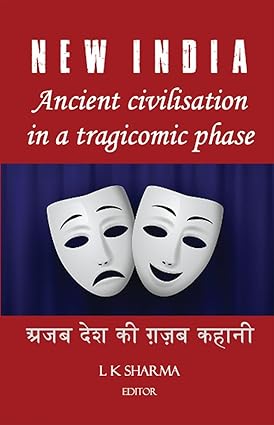
Books that attempt to interpret a nation’s political and social climate often divide readers long before the first chapter ends. NEW INDIA by L K Sharma is one such work. It is not written as neutral observation, nor does it attempt detached political commentary. Instead, it presents itself as an emotionally charged literary and ideological reflection on contemporary India, using essays, commentary, poetic references, intellectual criticism, and socio-political observations to question the direction in which the nation is moving.
At 512 pages, this is not a light political read. It is a substantial and unapologetically opinionated examination of modern India through the lens of cultural conflict, nationalism, media narratives, religion in politics, democratic anxiety, and social transformation.
Readers approaching this book should understand one thing immediately.
This is not conventional political journalism.
It is political literature with a deeply critical voice.
Book Details
| Detail | Information |
|---|---|
| Title | NEW INDIA |
| Author | L K Sharma |
| Print Length | 512 Pages |
| Language | English |
| Publication Date | 24 April 2025 |
| Genre | Political Commentary, Social Criticism, Contemporary Indian Literature |
| Amazon Link | https://www.amazon.in/dp/B0F677GWSW |
Introduction
India has always inspired contradictory narratives.
For some, it is a rising global power, a democracy navigating modern complexity with resilience and ambition.
For others, it is a nation wrestling with polarization, ideological division, media spectacle, and unresolved identity conflicts.
NEW INDIA clearly belongs to the second interpretation.
The material shared in the uploaded content makes the book’s perspective unmistakably clear. It presents modern India as emotionally fractured, politically manipulated, socially polarized, and increasingly driven by spectacle rather than substance.
The writing does not merely critique policies.
It critiques national psychology.
That distinction matters.
Because this book aims not just to challenge governance, but to question the emotional and ideological narratives shaping public consciousness.
What This Book Is About
The book appears to function as a broad political and cultural critique of present-day India, examining nationalism, governance, religious identity, media narratives, and democratic anxiety through literary framing.
The description introduces readers to what it calls “strange tales from a strange country,” suggesting a nation transformed into something emotionally unfamiliar even to its own citizens.
One of the most striking aspects of the book’s positioning is its use of metaphor.
The leadership is portrayed through symbolic characterization rather than conventional analytical language, framing political authority as spectacle, personality cult, and mass emotional persuasion.
The material also references writers, poets, journalists, and intellectual commentary, suggesting that this is not merely a personal political rant, but an aggregation of broader dissenting perspectives.
Themes that appear central include:
- Political polarization
- Religion in governance
- Democratic decline
- Media sensationalism
- National identity conflict
- Social fragmentation
- Public perception management
- Emotional nationalism
- Cultural transformation
- Civil society anxiety
This is clearly a book written for reflection, debate, and ideological engagement rather than passive consumption.
A Real-World Context That Makes This Book Relevant
Political literature becomes meaningful when it reflects conversations already happening in society.
That is exactly where NEW INDIA positions itself.
Across democracies worldwide, political narratives have increasingly become emotionally driven rather than policy-driven.
From the United States to Brazil to Turkey to India, personality-led politics, populist messaging, media amplification, ideological polarization, and identity-based public mobilization have become defining realities.
India is no exception.
This makes the themes explored in NEW INDIA relevant even for readers who may disagree with its conclusions.
For example, debates around nationalism, secularism, press independence, political rhetoric, historical identity, and religious symbolism have become central to modern Indian discourse.
Whether one agrees with the author’s interpretation or not, the emotional anxieties reflected in this work mirror real public conversations.
That gives the book contemporary significance.
Writing Style and Tone
This is not a detached academic political science book.
It reads closer to political literary activism.
The tone is emotionally expressive, symbolic, provocative, and often intentionally confrontational.
The excerpts provided reveal a blending of prose commentary, political metaphor, poetic references, and emotionally charged language.
That makes the reading experience different from traditional political nonfiction.
Readers expecting structured policy analysis may find the book more literary than statistical.
Readers who appreciate political essays, intellectual critique, and ideological reflection may find the style engaging.
The language is accessible enough for general readers, though the emotional framing means the book is clearly interpretive rather than neutral.
Themes Explored
Political Polarization
A major theme appears to be the widening emotional and ideological divide within Indian society.
The book suggests that modern politics has created deeper social fault lines.
Religion and Political Identity
One of the most explicit themes is the relationship between religion and governance.
The critique repeatedly suggests that faith-based identity politics has become a major force shaping public life.
Media Narratives and Public Perception
The work appears skeptical of televised nationalism, political spectacle, and public narrative construction.
This makes media criticism an important component.
Democratic Anxiety
Questions about institutional trust, civil society, dissent, and public discourse appear central.
National Identity Crisis
The title itself implies transformation.
The book asks whether this transformation represents progress or distortion.
What Works Well
Strong Intellectual Provocation
Even readers who disagree may find the arguments stimulating.
Books that provoke thought often have lasting relevance.
Literary Political Framing
The blending of poetry, symbolism, commentary, and critique creates a distinctive voice.
Contemporary Relevance
The themes are undeniably current.
Political polarization remains globally significant.
Emotional Honesty
The perspective is clear and unapologetic.
That gives the work authenticity.
Areas Some Readers May Notice
Balanced review requires acknowledging audience fit.
Readers seeking objective political analysis with balanced policy evaluation may find the tone strongly ideological.
Because the work appears intentionally critical, readers looking for bipartisan neutrality may not find that here.
Similarly, politically sensitive readers with opposing ideological positions may find the framing confrontational.
But that may be exactly the author’s intention.
Books like this are designed to provoke response.
Who Should Read This Book?
This book may appeal to:
- Readers interested in Indian political commentary
- Social critics and public affairs readers
- Political essay enthusiasts
- Readers interested in nationalism and democracy debates
- Contemporary Indian literature followers
- Academics exploring public discourse
- Readers who enjoy politically provocative nonfiction
Final Verdict
NEW INDIA is a politically charged, emotionally provocative reflection on modern India’s social and ideological transformation.
It does not aim for neutrality.
It aims for confrontation, questioning, and public reflection.
Whether readers agree with its conclusions or challenge them, the book clearly intends to stimulate conversation about democracy, nationalism, media narratives, and identity politics in contemporary India.
For readers comfortable engaging with strong political viewpoints and dissenting commentary, this is likely to be a thought-provoking and substantial read.