
As AI agents move from experimentation toward real-world deployment, building an intelligent system involves more than selecting a capable model. Production environments introduce questions around frameworks, architecture, security, cost, latency, and how multiple design patterns work together.
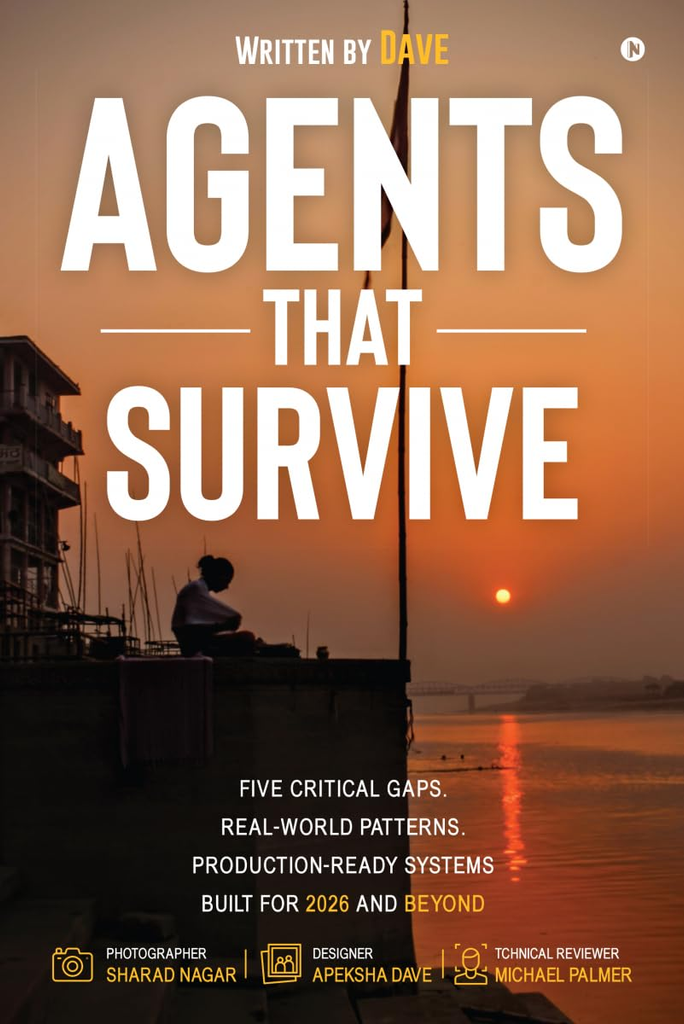
Agents That Survive: Five Critical Gaps. Real-World Patterns. Production-Ready Systems Built for 2026 and Beyond by Rajeev Dave presents itself as a companion to Antonio Gulli’s Agentic Design Patterns, focusing on areas that have become increasingly important for practitioners building agentic systems in 2026.
Book Details
| Detail | Information |
|---|---|
| Book Title | Agents That Survive: Five Critical Gaps. Real-World Patterns. Production-Ready Systems Built for 2026 and Beyond |
| Author | Rajeev Dave |
| Genre | Artificial Intelligence / AI Agents / Software Engineering |
| Language | English |
| Pages | 350 |
| Publication Date | August 26, 2026 |
| Book Link | https://www.amazon.in/dp/B0HGMRJF96 |
Review
Agents That Survive focuses on the practical challenges that emerge when agentic AI systems move beyond individual experiments and into production environments. The book identifies five areas it describes as critical gaps: the model landscape, framework selection, system isolation, safety, and cost and latency.
The first area examines the changing model landscape. As frontier models become more capable, the choice of model can influence how and when different agentic design patterns are implemented. The book focuses on understanding current capabilities in relation to practical system design.
Framework selection forms another major focus. The book compares approaches involving OpenAI Agents SDK, Google ADK, Microsoft Semantic Kernel, Amazon Bedrock Agents, and LangChain, with practical implementation guidance intended for developers navigating the growing framework ecosystem.
The discussion then moves from individual design patterns toward architectures that combine multiple patterns. This shift reflects the book’s emphasis on building complete systems rather than treating each pattern as an isolated technique.
Security is another central component. The book addresses concerns including prompt injection, tool abuse, data leakage, and risks associated with multi-agent systems. These topics are presented alongside practical security patterns for developers working with agentic architectures.
Finally, the book examines cost and latency. Model routing, caching, latency budgets, evaluation strategies, and cost-aware architectures are presented as important considerations when designing systems intended for real-world operation.
Final Thoughts
Agents That Survive presents a practitioner-focused exploration of the challenges involved in taking agentic AI systems from design concepts to production. Rajeev Dave’s approach centers on five areas that affect modern agent architectures: models, frameworks, system integration, security, and operational efficiency.