
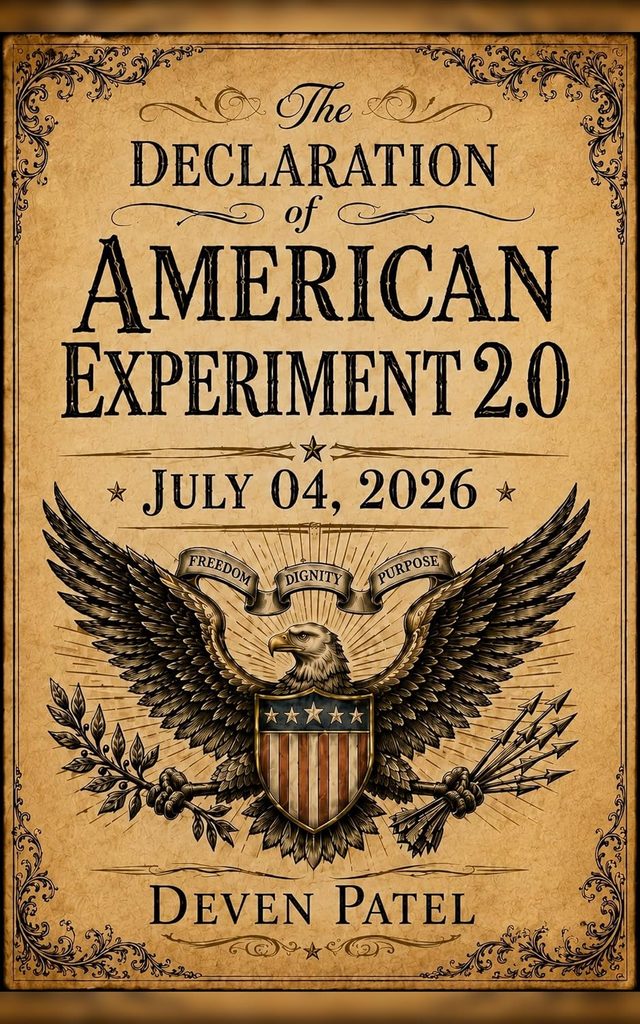
American Experiment 2.0 by Deven Patel explores the future of freedom, modern threats to human autonomy, technology, health, truth, work, and America’s unfinished promise.
What does freedom mean when the greatest threats to human autonomy no longer come from kings?
American Experiment 2.0 by Deven Patel takes this question as the starting point for a broad and deeply hopeful examination of America’s unfinished experiment with freedom. More than two centuries after the Declaration of Independence, the book asks whether political independence alone is enough, or whether freedom must be reconsidered in light of the forces shaping modern life.
From debt and illness to propaganda, addiction, surveillance, economic insecurity, digital dependency, algorithmic manipulation, and the loss of meaning, the book examines what it describes as the modern “crowns” that can limit human freedom. Its central argument is that the next chapter of American freedom must address the whole human experience rather than political freedom alone.
Book Details
| Book Details | Information |
|---|---|
| Title | American Experiment 2.0 |
| Author | Deven Patel |
| Genre | Politics, Social Philosophy, American Studies, Freedom, Social Commentary |
| Language | English |
| Print Length | 398 pages |
| Publication Date | July 4, 2026 |
| Book Link | Read on Amazon |
Review: Reimagining What It Means to Be Free
At the heart of American Experiment 2.0 is a question that reaches beyond conventional political debate: What does it mean for a human being to be truly free?
The book looks back to 1776, when America’s founding declaration challenged the idea that human beings were born to live under the authority of kings. That declaration established a powerful language of dignity, rights, liberty, and self-government.
But Deven Patel presents the first American experiment as unfinished.
The circumstances have changed. The threats to individual freedom have changed. As a result, the meaning of freedom must also be examined in the context of modern society.
From Traditional Crowns to Modern Constraints
The book’s central metaphor of the “modern crown” expands the traditional understanding of what can restrict human freedom.
Monarchs may no longer represent the primary threat to personal liberty, but the book identifies a different collection of forces that can influence how people live. Debt, disease, addiction, propaganda, surveillance, political hatred, corporate extraction, algorithmic manipulation, medical expenses, economic insecurity, and digital dependency are presented as contemporary challenges to human autonomy.
This broadens the conversation about freedom.
A person may possess political rights while still experiencing circumstances that make meaningful autonomy difficult. American Experiment 2.0 therefore asks readers to consider whether freedom should include freedom from conditions that undermine the ability to live, think, choose, work, connect, and find meaning.
The Idea of Whole-Human Freedom
One of the defining concepts in the book is whole-human freedom.
Rather than limiting liberty to political participation or legal rights, the book presents a framework that encompasses multiple dimensions of human life. These include freedom of the body, mind, health, work, ownership, truth, technology, family, community, meaning, and soul.
This approach gives the book a deliberately expansive understanding of freedom.
It suggests that the future of liberty cannot be addressed through politics alone. Health, technology, economics, information, relationships, community, and human purpose can all influence the extent to which people experience genuine freedom.
Freedom in the Age of Technology
Technology occupies an important place within this modern understanding of liberty.
The book points to algorithmic manipulation, surveillance, and technologies capable of influencing the human future without meaningful human consent. These developments raise questions about who controls technology, how individuals retain agency, and how technological progress can remain aligned with human dignity.
Rather than treating technology simply as either beneficial or harmful, the book places it within the larger question of human freedom.
As technological systems increasingly influence information, decisions, relationships, work, and everyday behavior, the question of maintaining human agency becomes increasingly significant.
Beyond the Old Political Divisions
Another central idea is the book’s call to move beyond familiar political oppositions.
Instead of framing the next revolution as left versus right, rich versus poor, or nation versus nation, Patel presents a different dividing line: humanity against dehumanization.
This framing shifts the conversation away from traditional political categories and toward the shared human experience.
It suggests that challenges to freedom can affect people across political, economic, and social boundaries. The question becomes how society can preserve human dignity and agency regardless of those divisions.
An Exploration of Health, Work, and Economic Freedom
The book also expands the concept of freedom into areas of everyday life.
Debt, economic insecurity, medical bills, sickness, and the pressures surrounding work can shape the choices available to individuals. In this framework, economic and physical wellbeing are not separate from freedom. They can directly influence a person’s ability to exercise meaningful choice.
By including the body, health, work, and ownership within its framework, American Experiment 2.0 encourages readers to think about freedom as something experienced in daily life rather than solely expressed through political institutions.
Truth and the Information Environment
The book also identifies propaganda and manipulation as contemporary challenges.
In an environment where information can be distributed rapidly and digital systems can influence what people see, believe, and engage with, the ability to distinguish truth becomes closely connected to personal autonomy.
This places truth within the book’s broader framework of freedom. A person cannot fully exercise independent judgment if their understanding of reality is continually shaped through manipulation.
Family, Community, Meaning, and the Soul
The book’s understanding of freedom extends beyond individual independence.
Family, community, meaning, and the soul are included among the dimensions of whole-human freedom. This gives the discussion a more human and philosophical character.
Freedom, within this framework, is not simply the absence of external control. It also involves the ability to maintain meaningful relationships, participate in community, pursue purpose, and preserve an inner sense of human dignity.
This creates a vision of liberty that includes both individual autonomy and the conditions necessary for a meaningful human life.
A Hopeful Vision for America’s Future
Despite addressing serious challenges, American Experiment 2.0 is presented not as an attack on America but as an expression of faith in what America can become.
The book looks toward the next 250 years rather than simply revisiting the past. Its objective is to renew the promise of 1776 by considering what that promise might mean in a world dramatically different from the eighteenth century.
This gives the work an intentionally forward-looking character.
Instead of asking readers to return to an earlier era, it asks them to consider how the principles of freedom might be carried into the future.
Completing the Promise of 1776
The book’s relationship with the American founding is central to its identity.
The first Declaration challenged political domination by a king. American Experiment 2.0 asks what a new declaration might need to address when control can emerge through very different mechanisms.
The proposed answer is not simply another political revolution. It is a broader reconsideration of human freedom.
In this vision, completing the promise of 1776 means extending the principle of human dignity into the realities of the twenty-first century and beyond.
Final Thoughts
American Experiment 2.0 by Deven Patel is an expansive exploration of freedom and what it may mean in America’s next chapter.
Beginning with the unfinished promise of 1776, the book examines modern forces such as debt, disease, propaganda, addiction, surveillance, digital dependency, algorithmic manipulation, economic insecurity, and loss of meaning. Against these challenges, it presents the idea of whole-human freedom, encompassing the body, mind, health, work, ownership, truth, technology, family, community, meaning, and soul.
Its central message is ultimately hopeful. The book does not reject America’s founding ideals. Instead, it asks readers to imagine how those ideals can be renewed for a radically different era.
For readers interested in freedom, American society, technology, human dignity, political philosophy, and the future of democracy, American Experiment 2.0 offers a wide-ranging invitation to reconsider what genuine freedom should look like.
The first American experiment declared freedom from the rule of a king. This book asks what the next experiment must do to protect human beings from the many modern forces that can diminish their freedom.