
What does it take to keep going when every reasonable option seems to suggest giving up?
Pathigam Tales: 11 Ways to Build Resilience by Ramanathan Rajamani explores this question through the lives and hymns of four Tamil poet-saints: Appar, Sambandar, Sundarar, and Manikkavasagar.
Rather than presenting their stories simply as religious history, the book focuses on eleven defining moments when faith, conviction, and resilience were tested. Each episode is connected to a real hymn, freshly translated for the book, allowing readers to encounter the poetry alongside the circumstances in which it was traditionally remembered.
The result is a narrative that combines history, devotional poetry, storytelling, and reflections on resilience.
Book Details
| Book Details | Information |
|---|---|
| Book Title | Pathigam Tales: 11 Ways to Build Resilience |
| Author | Ramanathan Rajamani |
| Genre | Spirituality, Devotional Literature, Resilience, Tamil Literary Tradition |
| Language | English |
| Print Length | 165 pages |
| Publication Date | 11 August 2026 |
| Book Link | Amazon India |
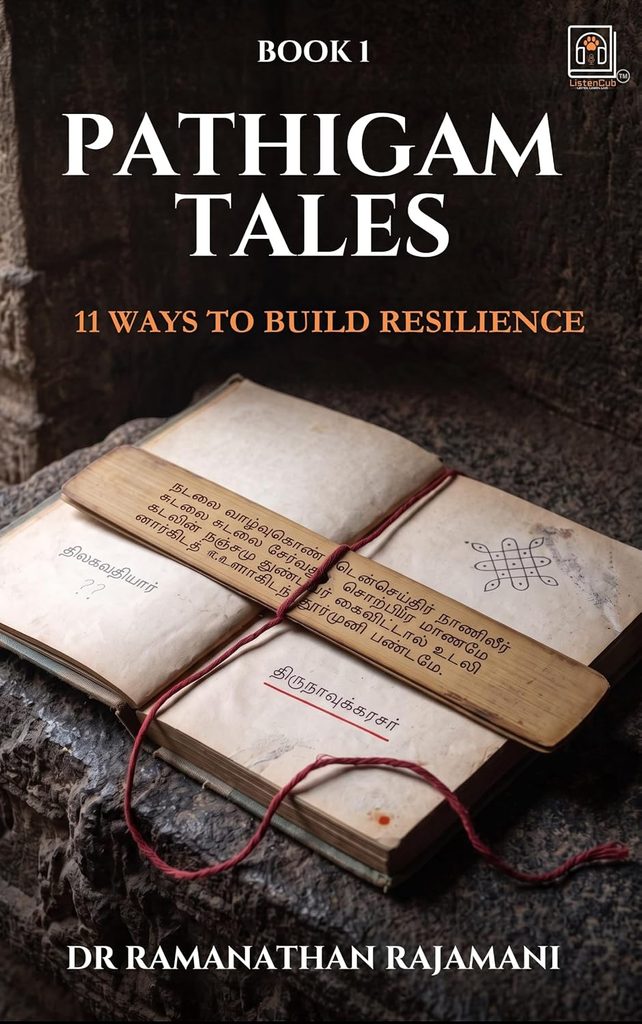
Four Saints, Eleven Defining Moments
At the heart of Pathigam Tales are four figures from the Tamil devotional tradition: Appar, Sambandar, Sundarar, and Manikkavasagar.
The book follows eleven moments from their stories, focusing on situations where they faced extraordinary pressure, uncertainty, loss, or difficult choices.
These are not presented simply as distant religious legends. Instead, the book brings the reader into the circumstances surrounding each moment and then connects those experiences to the hymns associated with them.
This creates a structure in which scene and song come first, followed by reflection.
Resilience Through Story and Song
The concept of resilience in Pathigam Tales is not presented as an abstract motivational principle.
It emerges from situations where the protagonists have very real reasons to surrender, compromise, or lose hope.
One of the book’s most striking examples is the story of a man who is sealed alive in a kiln for seven days. Yet what emerges from that experience is not simply survival. It becomes a hymn describing an evening beside a river.
The contrast between extreme suffering and devotional expression captures one of the book’s central ideas: resilience can involve finding the ability to continue expressing meaning even when circumstances appear unbearable.
Eleven Ways to Face Adversity
The book’s eleven stories explore different forms of pressure and adversity.
Among them is the story of a minister who spends an enormous fortune on a temple instead of horses. When jackals are discovered loose in the stable yard the following morning, he must answer for his decision.
Another story involves a three-year-old child who points toward the sky and sings an answer to a question his father actually asked him.
There is also the story of a stranger who interrupts a wedding ceremony by claiming an unverifiable debt. The bridegroom dismisses him as a madman, only for his entire understanding of his life to change shortly afterward.
Another particularly striking account follows a man who loses his sight after knowingly breaking a promise. His sight eventually returns one eye at a time, years apart, at two different temples.
These stories demonstrate that resilience does not always look the same. Sometimes it involves endurance. Sometimes it involves accepting consequences. Sometimes it requires faith when circumstances provide little certainty.
The Stories Behind the Hymns
One of the distinctive elements of Pathigam Tales is its treatment of devotional poetry.
The book does not simply reproduce hymns as isolated religious texts. Instead, the hymns are placed within the stories and circumstances associated with them.
The result allows readers to consider the poetry as an expression emerging from lived experience.
The hymns become responses to fear, conflict, uncertainty, suffering, faith, and transformation.
This approach can make the devotional tradition accessible even to readers who may be approaching these stories for the first time.
A Personal Connection to the Stories
The book’s storytelling is also connected to the author’s own memories.
Ramanathan Rajamani describes these stories as having been told to him by his grandfather on railway platforms while waiting between cities, long before he understood what had actually been passed on to him.
That detail gives the book a personal dimension.
The stories are not merely presented as material from an ancient tradition. They are also part of a chain of memory, storytelling, family, and cultural transmission.
Appar, Sambandar, Sundarar and Manikkavasagar
The four poet-saints at the center of the book represent different personalities and experiences within the Tamil devotional tradition.
Through their stories, the book explores how individuals respond when their convictions are tested.
Appar, Sambandar, Sundarar, and Manikkavasagar are therefore not simply names within a historical account. In Pathigam Tales, their experiences become vehicles for examining endurance, devotion, difficult choices, and the ability to continue despite adversity.
Why the Book’s Approach Stands Out
Pathigam Tales does not describe itself as a history of a movement. Instead, it focuses on four people and eleven moments.
That narrower approach gives the stories room to become personal.
Each chapter begins with the experience and the song before moving toward reflection. This structure avoids turning the book into a conventional collection of lessons. Instead, readers encounter the story first and are then invited to consider what it might mean.
The result is a literary and reflective approach to resilience rather than a conventional self-help framework.
The Central Question
Ultimately, Pathigam Tales revolves around one powerful question:
What kind of person keeps singing when every reasonable option is to stop?
That question gives the eleven stories a common thread.
Whether the challenge involves imprisonment, uncertainty, broken promises, social pressure, or circumstances that seem impossible to overcome, the book repeatedly returns to the idea of continuing when stopping would appear easier.
Its lessons about resilience therefore emerge through narrative rather than instruction.
Final Thoughts
Pathigam Tales: 11 Ways to Build Resilience offers a distinctive exploration of resilience through the stories and hymns associated with four Tamil poet-saints.
Its eleven episodes move through moments of danger, uncertainty, loss, difficult decisions, and spiritual testing. Rather than presenting resilience as a formula, the book allows readers to witness it through people who continued to sing, believe, and move forward when circumstances gave them compelling reasons to stop.
For readers interested in Tamil devotional literature, spiritual storytelling, Indian cultural traditions, resilience, poetry, and reflective narratives, Pathigam Tales offers a meaningful journey through stories that have continued to be remembered across generations.
Read More : Life Where It All Began: The Prequel Part 2 by Aditya Nair