
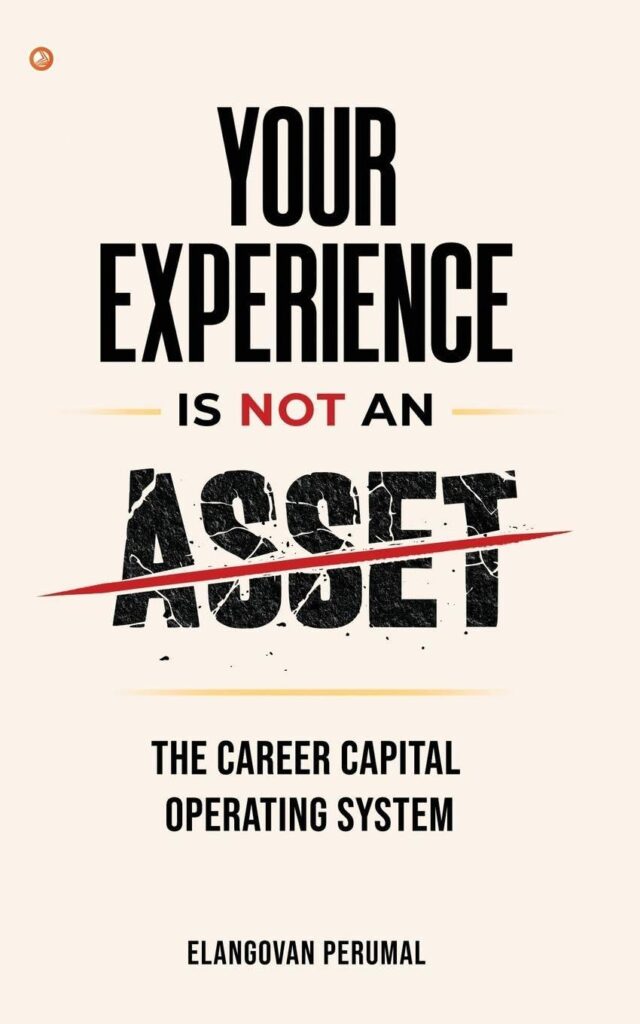
In today’s rapidly evolving professional landscape, experience alone is no longer enough to guarantee career growth. Many professionals spend years building expertise, taking on greater responsibilities, and working harder than ever, only to discover that their careers have plateaued. Your Experience Is Not An Asset: The Career Capital Operating System by Elangovan Perumal challenges one of the most deeply rooted assumptions about professional success. It argues that experience has little inherent value until it is deliberately transformed into career capital.
Rather than offering conventional career advice, the book presents a structured framework for converting accumulated experience into long-term professional leverage. Through practical insights, strategic thinking, and a systems-based approach, the author helps readers rethink how careers grow, why they stagnate, and what it takes to create lasting professional value.
Whether you are an early-career professional, a mid-level manager, or a senior executive preparing for the future of work, this book provides a fresh perspective on building careers that compound rather than simply progress.
Book Details
| Detail | Information |
|---|---|
| Book Title | Your Experience Is Not An Asset: The Career Capital Operating System |
| Author | Elangovan Perumal |
| Publisher | Orangebooks Publication |
| Publication Date | 18 June 2026 |
| Print Length | 202 Pages |
| Language | English |
| Genre | Career Development, Leadership, Professional Growth, Business |
| Best For | Professionals, Managers, Executives, Entrepreneurs, Career Coaches, Students |
| Book Link | https://www.amazon.in/dp/937426594X |
Challenging a Common Career Myth
One of the book’s strongest contributions is its willingness to question a belief that many professionals rarely examine.
Most people assume that years of experience naturally increase their professional value. Elangovan Perumal argues that this assumption is misleading. Experience accumulates over time, but unless it is intentionally analyzed, structured, and communicated, it remains little more than a record of past work.
The distinction between accumulated experience and career capital becomes the foundation of the book’s philosophy.
This shift in thinking encourages readers to evaluate not how long they have worked, but how effectively they have converted their experiences into lasting professional assets.
Understanding Career Capital
The central concept introduced in the book is career capital.
According to the author, career capital consists of the knowledge, decision-making ability, credibility, reputation, and transferable insights that create long-term professional leverage.
Instead of measuring success through job titles or years of service, the book encourages readers to build assets that continue generating opportunities throughout their careers.
These assets include:
- Strategic decision-making
- Professional credibility
- Industry reputation
- Communication skills
- Leadership capability
- Transferable expertise
- Problem-solving frameworks
This broader definition of professional value offers readers a more sustainable approach to career growth.
Why Careers Plateau
A particularly insightful section examines why many talented professionals reach a point where their careers stop accelerating.
The author suggests that the problem is rarely a lack of intelligence or effort. Instead, careers plateau because professionals continue operating at the same level of value creation despite accumulating additional experience.
The book explains that performing more work does not automatically increase professional leverage.
To create meaningful career progression, individuals must continually transform experience into reusable knowledge and visible expertise.
This perspective helps explain why some professionals advance rapidly while others remain in similar roles despite comparable experience.
Making Experience Visible
The book emphasizes that valuable experience must also be visible.
Professional capability is often judged through signals such as communication, decision-making, leadership presence, and reputation.
Elangovan Perumal explains that organizations rarely evaluate experience in isolation. They interpret capability through observable behaviors and demonstrated impact.
Readers are encouraged to improve how they communicate their expertise, articulate their thinking, and demonstrate the value they create.
This discussion is particularly relevant in today’s highly competitive professional environment.
Building Career Optionality
One of the book’s most valuable ideas is the concept of career optionality.
Rather than pursuing a single predetermined path, successful professionals create multiple opportunities by continuously developing valuable assets.
The author argues that optionality is not achieved by keeping every possibility open. Instead, it results from building capabilities that make multiple career paths genuinely available.
This mindset encourages long-term thinking while increasing resilience in changing job markets.
Professionals who develop strong career capital gain greater freedom to adapt, pivot, and pursue meaningful opportunities.
The Role of Artificial Intelligence
Recognizing the growing influence of artificial intelligence, the book explores how emerging technologies are reshaping professional value.
Rather than viewing AI as a replacement for human expertise, the author presents it as an amplifier.
Professionals with structured thinking, clear communication, and well-developed career capital are likely to benefit significantly from AI. Those lacking these foundations may simply experience greater information overload without corresponding career growth.
This balanced discussion positions AI as an opportunity for professionals who invest in developing deeper strategic capabilities.
Career Governance for Long-Term Success
The book concludes by introducing the concept of career governance.
Many careers do not fail because of poor performance. They gradually lose direction through a series of disconnected decisions.
Career governance encourages professionals to make choices that reinforce long-term goals rather than pursuing short-term opportunities without strategic alignment.
This systems-based approach helps readers think about their careers as evolving investments rather than isolated job changes.
The concept provides a valuable framework for sustaining professional growth over decades.
Writing Style and Reader Experience
Elangovan Perumal writes with clarity, logic, and strategic insight.
Although the subject matter involves career systems and professional development, the writing remains accessible and practical. Complex concepts are explained through structured reasoning rather than unnecessary jargon, making the book suitable for readers across industries.
Each chapter builds logically upon the previous one, allowing readers to gradually develop a new way of thinking about career progression.
The author’s emphasis on systems rather than motivational slogans makes the book particularly valuable for professionals seeking practical, long-term strategies.
Who Should Read This Book
This book is highly recommended for:
- Early and mid-career professionals
- Senior managers and executives
- Entrepreneurs and consultants
- Career coaches
- MBA and management students
- Professionals preparing for AI-driven workplaces
- Individuals seeking long-term career growth
- Anyone experiencing career stagnation
Final Review
Your Experience Is Not An Asset: The Career Capital Operating System offers a refreshing and intellectually engaging perspective on professional development.
Elangovan Perumal successfully challenges conventional career advice by demonstrating that experience alone does not create value. Instead, sustained career growth depends on converting experience into transferable assets that increase influence, credibility, and opportunity over time.
The book’s systems-based approach, combined with its discussions on career capital, optionality, AI, and career governance, makes it highly relevant for today’s rapidly changing workplace.
Its greatest strength lies in encouraging readers to move beyond measuring experience by years and begin evaluating it by the lasting value it creates.
For professionals who want to build careers that continue to grow in influence and opportunity, Your Experience Is Not An Asset is an insightful and highly worthwhile read.