
A detailed review of Posthumous Nirvana of Tojo’s Father By Soyum Potom, a literary novel exploring legacy, loss, Northeast Indian history, and the search for purpose.
Introduction
Some stories are not driven by action alone, but by questions that linger long after loss. Posthumous Nirvana of Tojo’s Father is one such novel—a reflective, layered narrative that explores grief, inheritance, identity, and the unfinished conversations between generations.
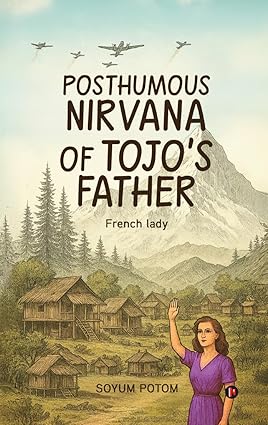
Set against the rarely explored landscapes and histories of Arunachal Pradesh and beyond, the novel follows Tojo, a privileged yet unprepared man forced to confront the weight of legacy after the sudden death of his father. What begins as a personal reckoning unfolds into a sweeping journey across time, geography, and memory.
Book Details
| Detail | Information |
|---|---|
| Title | Posthumous Nirvana of Tojo’s Father |
| Author | Soyum Potom |
| Print Length | 324 pages |
| Language | English |
| Publication Date | 27 November 2025 |
| Buy Link | https://amzn.in/d/bYMxffh |
| Genre | Literary Fiction, Historical Fiction |
Detailed Book Review
A Son, a Father, and Unfinished Business
At the heart of the novel lies Tojo’s unresolved relationship with his father, Noto—an accomplished chieftain in a remote community of Arunachal Pradesh. When Tojo returns from city life to confront long-standing differences, he is met instead with death. His father has passed away while Tojo was away, leaving behind silence where answers should have been.
This absence becomes the novel’s emotional engine. Stripped of privilege and guidance, Tojo must face the realities of leadership, responsibility, and purpose without preparation—questioning not only his father’s life, but his own reason for being.
Personal Loss Meets Collective History
What distinguishes Posthumous Nirvana of Tojo’s Father is its ambitious narrative scope. The novel weaves personal grief with rare historical threads, spanning:
- the 1855 diary of French anthropologist A. B. Krick’s visit to the North East Frontier Tract
- the turbulence of pre-independence India
- the World War II China-India-Burma (CBI) Theatre
- and the turn of the millennium, marked by Tojo’s relationship with a French woman who ultimately returns to France
These timelines do not feel ornamental. Instead, they contextualize Tojo’s struggle—showing how individual lives are shaped by histories far larger than themselves.
A Rare Cultural and Geographical Lens
Set in regions seldom explored in mainstream Indian fiction, the novel offers readers a glimpse into the social, cultural, and emotional landscapes of Arunachal Pradesh. The portrayal of indigenous leadership, generational authority, and the clash between tradition and modernity adds depth to Tojo’s internal conflict.
The author treats these settings not as exotic backdrops, but as living forces that influence identity, values, and destiny.
Purpose, Love, and the Weight of Memory
Interwoven with history is Tojo’s relationship with a French woman—a love shaped by cultural distance and impermanence. Her eventual departure mirrors the central theme of the book: nothing remains unfinished without consequence.
Through love, loss, and memory, the novel suggests that purpose is not inherited—it is earned through understanding, responsibility, and acceptance of one’s past.
Summary
Posthumous Nirvana of Tojo’s Father is a layered literary novel that blends personal introspection with historical depth. It explores how unresolved relationships, cultural legacy, and forgotten histories shape individual purpose.
The book offers:
- a moving exploration of father-son dynamics
- rare historical and cultural narratives from Northeast India
- a reflective meditation on loss, identity, and meaning
- a fusion of personal fiction and historical storytelling
Conclusion
Quietly powerful and intellectually ambitious, Posthumous Nirvana of Tojo’s Father is not a novel that rushes its readers. It invites patience, reflection, and emotional engagement. Through Tojo’s journey, the book asks enduring questions: What do we owe those who came before us? And how do we live when answers arrive too late?
For readers who appreciate literary fiction grounded in history, culture, and philosophical inquiry, this novel offers a deeply rewarding experience—one that lingers long after the final page.
Read More : Review : Whispers of the Soul By Yogesh Arvind Puranik