
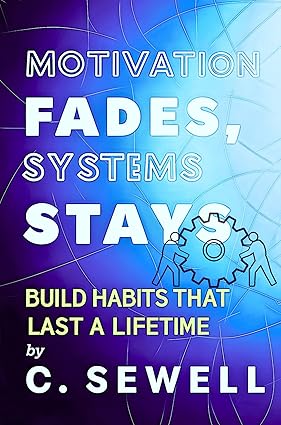
Motivation Fades Systems Stay is a practical self help book that shows how to build lasting habits through systems, structure, and identity based routines rather than relying on motivation alone.
Book Details
| Detail | Information |
|---|---|
| Title | Motivation Fades Systems Stay: Build Habits That Last a Lifetime |
| Author | C. Sewell |
| Language | English |
| Print Length | 298 pages |
| Publication Date | 14 December 2025 |
| Genre | Self Help, Habit Building, Personal Development |
| Buy Link | https://a.co/d/86bA5CG |
Introduction
Most people believe success begins with motivation. They wait to feel inspired before taking action, only to find that inspiration fades far faster than expected. Motivation Fades Systems Stay: Build Habits That Last a Lifetime challenges this widely held belief with a clear and practical truth. Motivation is unreliable. Systems are what endure.
This book is written for readers who are tired of starting strong and falling back into old patterns. It reframes success as a matter of structure rather than emotion, offering a sustainable approach to growth that works even on days when motivation is nowhere to be found.
Why Motivation Is Not Enough
One of the book’s central ideas is that motivation is an emotional state, not a strategy. It fluctuates with mood, stress, energy, and circumstances. Relying on it places progress at the mercy of how one feels in a given moment.
C. Sewell explains that most failures are not due to lack of desire or ambition. They stem from a lack of systems. When habits depend solely on willpower, they collapse under pressure. Systems remove that burden by making progress automatic rather than effort driven.
The Power of Systems and Structure
The book introduces systems as repeatable processes that guide behavior regardless of motivation. Instead of focusing on goals alone, readers are encouraged to design routines, environments, and workflows that naturally support the outcomes they want.
By shifting attention from what to achieve to how daily life is structured, the book shows how consistency becomes a byproduct of design rather than discipline. Progress is no longer forced. It unfolds through rhythm and repetition.
Turning Goals Into Identity Based Habits
A major strength of the book lies in its focus on identity. Rather than chasing outcomes, readers are guided to build habits that reinforce who they are becoming. When actions align with identity, habits stick because they feel natural rather than imposed.
The book explains how small, consistent behaviors compound quietly over time. These behaviors are supported by systems that reduce friction, making the right choices easier than the wrong ones.
Designing an Environment That Supports Success
Another key theme is environmental design. Motivation fades, but environment constantly influences behavior. The book teaches readers how to shape their surroundings so that desired habits require less effort.
By removing obstacles and adding cues that encourage positive action, systems do much of the work in the background. This approach replaces emotional struggle with intentional design.
A Practical Guide Without Hype
Unlike many self help books that rely on inspiration and urgency, Motivation Fades Systems Stay maintains a grounded and practical tone. The guidance is actionable and realistic, focusing on long term sustainability rather than quick wins.
The book draws inspiration from psychology, timeless success principles, and real world application. It avoids complexity and jargon, making it accessible to readers at any stage of personal development.
Who This Book Is For
This book is ideal for readers who have tried to change habits repeatedly and grown frustrated with inconsistency. It will resonate with those who enjoyed Atomic Habits but want a deeper systems focused framework.
Professionals, entrepreneurs, students, and anyone seeking sustainable growth without burnout will find this approach especially valuable.
Conclusion
Motivation Fades Systems Stay is a clear and compelling blueprint for lasting change. It shifts the conversation from emotional effort to intentional structure, showing that success does not require constant inspiration.
By building systems that support identity, environment, and routine, readers can create momentum that compounds quietly and consistently. This book reminds us that lasting success is not about trying harder, but about designing life better.