
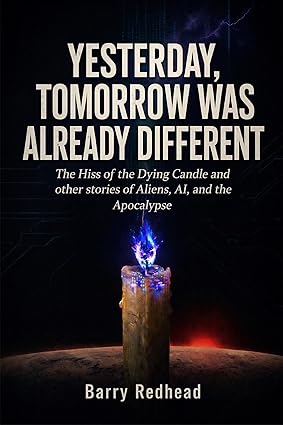
Science fiction often promises dazzling futures, technological wonder, and sleek visions of human progress. YESTERDAY, TOMORROW WAS ALREADY DIFFERENT by Barry Redhead takes a sharply different path. Instead of celebrating polished futures, it dismantles them.
This anthology peers beneath the chrome surface of tomorrow to reveal decay, absurdity, corporate illusion, and humanity’s stubborn refusal to disappear.
A Future That Glows but Does Not Shine
The book opens with a compelling premise. The future is not bright. It is merely well lit.
That single idea shapes the emotional architecture of this collection. Across twenty stories, Barry Redhead constructs a world where technological advancement has not solved human problems. It has merely digitized, commercialized, and amplified them.
From abandoned server farms to post human landscapes, the collection paints futures that feel eerily plausible rather than fantastically distant.
A Science Fiction Anthology with Personality
This is not a uniform collection built around a single formula. Instead, the anthology blends multiple science fiction subgenres into a dynamic reading experience.
Readers can expect:
Hard boiled noir atmospheres
Sharp social satire
High concept speculative fiction
Corporate dystopian absurdity
Temporal paradoxes and existential speculation
The tonal range appears deliberately expansive, allowing the collection to remain intellectually engaging while emotionally unpredictable.
Strange Worlds, Familiar Human Problems
The stories may feature advanced AI, futuristic cities, and surreal technological environments, but their emotional core remains unmistakably human.
Among the worlds described are:
Scavengers dealing in fragments of collapsed civilizations
AI professionals confronting the biological chaos of human life
Architects of deception shaping manufactured realities
Corporate spaces where absurdity becomes ordinary routine
Temporal anomalies that blur memory, history, and identity
Even in radically altered futures, the familiar human struggles remain ambition, fear, survival, ego, loneliness, and hope.
Themes Running Through the Collection
Humanity Beneath Technology
The book repeatedly suggests that technological sophistication does not erase emotional vulnerability.
Satire of Systems and Institutions
Corporate structures, artificial intelligence, and engineered realities are approached with biting irony.
Collapse and Continuity
Civilizational decay forms a major backdrop, yet the persistence of human existence gives the collection its emotional resilience.
Time, Memory, and Identity
Several concepts suggest deeper philosophical engagement with how history and future shape personal meaning.
Literary Style and Tone
Barry Redhead appears to write with stylistic confidence, blending cinematic imagery with dark wit and speculative intelligence.
The language suggested by the premise feels immersive, melancholic, occasionally absurd, and sharply observant. The anthology seems particularly suited for readers who enjoy science fiction that challenges rather than comforts.
Book Details
| Detail | Information |
|---|---|
| Title | YESTERDAY, TOMORROW WAS ALREADY DIFFERENT |
| Author | Barry Redhead |
| Genre | Science Fiction Anthology, Dystopian Fiction |
| Print Length | 220 pages |
| Language | English |
| Publication Date | 15 April 2026 |
| Book Link | https://www.amazon.de/dp/B0GX2ZQ2RS |
Who Should Read This Book
This anthology is ideal for readers who enjoy dystopian science fiction, cyberpunk atmospheres, speculative satire, and philosophical futuristic storytelling.
Fans of intelligent anthology fiction that mixes dark humor with existential questions will likely find strong appeal here.
Final Reflection
YESTERDAY, TOMORROW WAS ALREADY DIFFERENT is not interested in presenting a comforting future. It offers something more provocative.
A world where technology evolves faster than wisdom. Where progress and decay coexist. Where machines dream, systems fail, and humanity persists in imperfect, stubborn form.
Barry Redhead’s anthology appears to be both a warning and a strangely hopeful meditation on what survives when everything else changes.