
The Dystopian Mind by Shrikar Nag is an intellectually ambitious nonfiction work that examines how human civilization has been repeatedly reshaped by technological revolutions—not just externally, but psychologically, socially, and morally. Rather than viewing innovation as simple progress, the book investigates the invisible trade-offs humanity gradually accepts without fully recognizing their long-term consequences.
It asks not what technology gives us, but what it quietly changes within us.
Book Details
| Detail | Information |
|---|---|
| Book Title | The Dystopian Mind |
| Author | Shrikar Nag |
| Genre | Nonfiction, Technology, Social Philosophy, Cultural Analysis |
| Pages | 298 |
| Language | English |
| Publication Date | 1 May 2026 |
| Theme | Technology, human behavior, civilization, autonomy, societal evolution |
| Ideal Readers | Technology readers, philosophy enthusiasts, cultural critics, AI and future-focused readers |
| Book Link | https://www.amazon.in/dp/B0GWJ5JS9L |
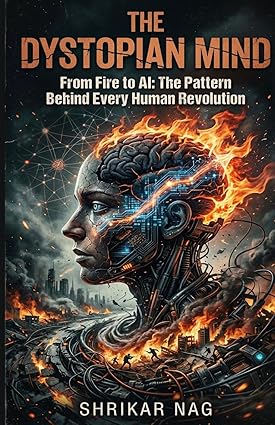
A Bold Reframing of Human Progress
The book challenges conventional narratives of progress by examining how major innovations—from fire to AI—reshaped human behavior, dependence, expectations, and social systems.
This makes it thought provoking.
Seventeen Civilizational Revolutions Examined
The narrative traces multiple historical turning points, analyzing how each innovation moved from disruption to normalization and eventually became invisible within ordinary life.
This creates structural depth.
Technology as Psychological Conditioning
A central idea is that technology does not simply improve capability—it changes perception, desire, emotional responses, and definitions of normalcy.
This adds intellectual relevance.
Strong Interdisciplinary Perspective
The book draws from archaeology, neuroscience, economic history, philosophy, and media theory to build a broad analytical framework.
This strengthens credibility.
Particularly Relevant in the AI Era
Its examination of how technological systems shape autonomy feels especially timely in the context of artificial intelligence, algorithmic dependence, and digital life.
This increases contemporary appeal.
A Blend of Big Ideas and Narrative Accessibility
By combining sweeping civilizational thinking with accessible storytelling, the book aims to appeal beyond purely academic audiences.
This broadens readership.
Philosophical Yet Practical Questions
The core question is not whether change happens, but whether humans notice the compromises embedded in the systems they normalize.
This creates lasting reflection.
For Readers Who Enjoy Challenging Nonfiction
Readers who appreciate books like broad social analysis, technology critique, and philosophical explorations of modern life may find strong appeal here.
This defines its audience.
Final Thoughts
The Dystopian Mind is a compelling exploration of how innovation reshapes civilization in ways far deeper than convenience or productivity. By examining hidden psychological and societal costs across history, it offers readers a provocative lens for understanding modern technological dependence.
For readers interested in technology, culture, AI, human behavior, and the unseen consequences of progress, this book offers a deeply engaging read.