
Artificial intelligence is no longer just a technology discussed by engineers and researchers. It is becoming part of everyday decisions, workplaces, education, businesses, public policy, and even the way people understand the world. But knowing how to use AI tools is not the same as understanding how they work, whose interests they serve, or what risks they may bring. In The Minds That Bend the Machine, Basil C. Puglisi explores these bigger questions and offers readers a way to develop a more thoughtful understanding of artificial intelligence.
Rather than expecting readers to have a technical background, the book approaches AI through the people, ideas, debates, and decisions that have shaped its development. It encourages readers to look beyond the excitement surrounding new technology and consider its wider consequences for society and humanity.
Book Details
| Detail | Information |
|---|---|
| Book Title | The Minds That Bend the Machine |
| Subtitle | How to Learn About AI, Its Bias, Its Power, Its Cost to Humanity, and How I Use It |
| Author | Basil C. Puglisi |
| Publisher | Digital Ethos |
| Language | English |
| Print Length | 400 pages |
| Publication Date | October 30, 2026 |
| Buy the Book | Amazon |
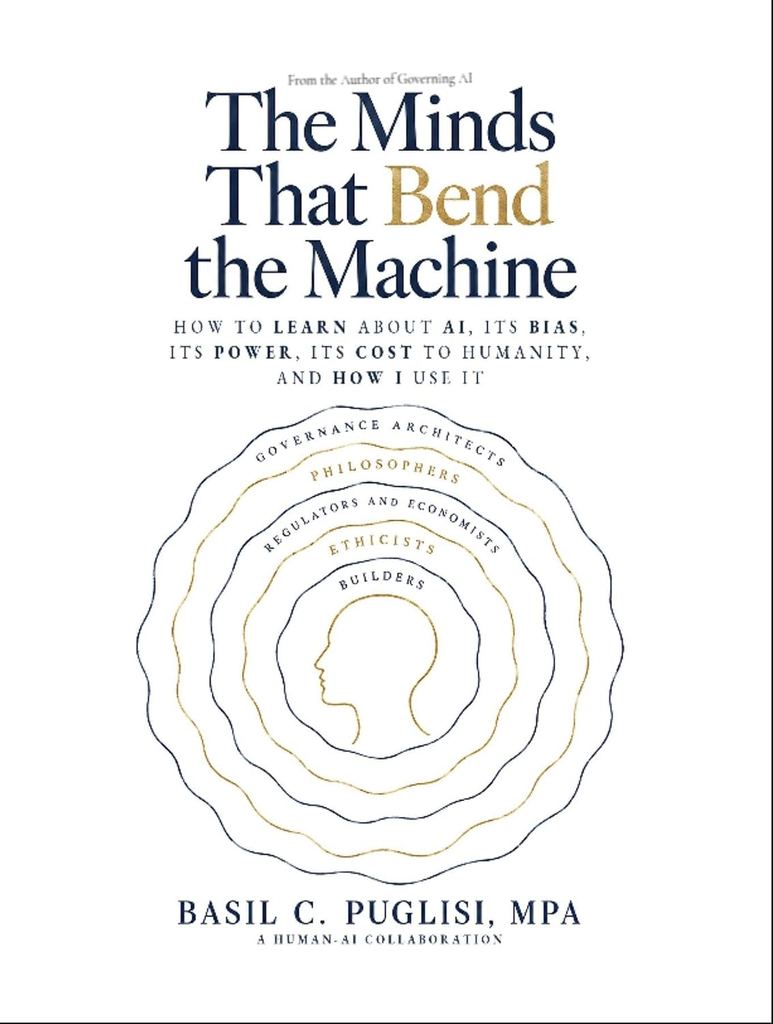
Review of The Minds That Bend the Machine
One of the book’s most interesting ideas is that understanding artificial intelligence does not require becoming an engineer. Instead, it requires curiosity, critical thinking, and a willingness to examine the people and systems behind the technology. This makes the subject more approachable for readers who want to understand AI’s influence without getting lost in technical explanations.
The book brings together perspectives from some of the most influential figures in artificial intelligence and its surrounding debates. Researchers such as Geoffrey Hinton, Yoshua Bengio, Andrew Ng, Fei-Fei Li, and Demis Hassabis represent different contributions to the development of modern AI. Meanwhile, voices such as Timnit Gebru, Joy Buolamwini, Kate Crawford, and Meredith Whittaker draw attention to questions of bias, labor, accountability, and power. Economists, regulators, and philosophers add further dimensions to the discussion.
Importantly, these individuals do not share the same opinions. Their disagreements are part of what makes the subject worth exploring. Instead of presenting AI as either a miracle or a threat, the book encourages readers to understand the competing arguments and recognize that its impact is more complicated than simple labels can explain.
Another valuable aspect is its focus on AI literacy. The ability to use a chatbot or generate content is only one small part of understanding this technology. Readers are encouraged to question what an AI system knows, identify what it might overlook, examine the assumptions behind its responses, and recognize when human judgment is necessary. These skills are increasingly relevant to business owners, educators, policymakers, professionals, parents, and anyone interacting with AI-powered systems.
The practical dimension also adds depth to the book. The author’s experience with multi-AI workflows, human checkpoints, verification, preserved disagreement, and documented decision-making connects broader research with real-world application. This approach highlights an important distinction: using AI effectively does not mean accepting every output it produces. It means knowing when to question, verify, and take responsibility for the final decision.
At 400 pages, the book offers room to explore a wide range of perspectives and concerns. Its central question, “What do I not know?”, is particularly meaningful because it encourages intellectual humility in a field where technology often advances faster than public understanding.
Final Thoughts
The Minds That Bend the Machine by Basil C. Puglisi offers a thoughtful starting point for anyone who wants to understand artificial intelligence beyond its everyday applications. Its focus on influential thinkers, ethical concerns, competing perspectives, governance, and practical AI use makes it relevant to a broad audience.
Rather than telling readers what to think about AI, the book encourages them to ask better questions. That may be its most important contribution. As artificial intelligence becomes more deeply involved in human decisions, the ability to examine its limitations, understand its influence, and preserve human responsibility will become increasingly valuable.