
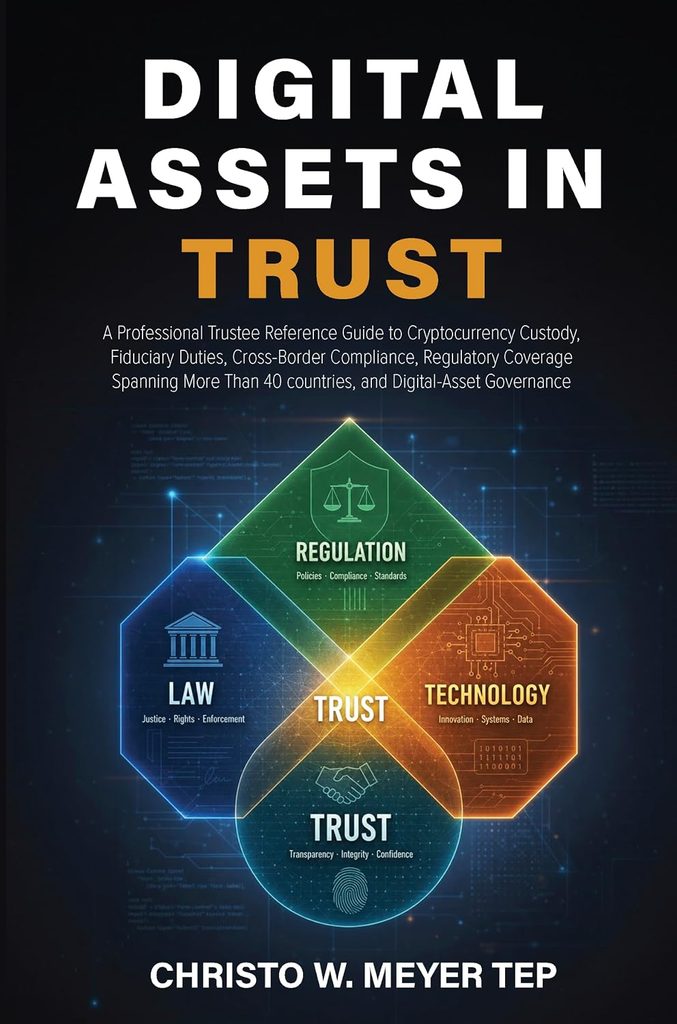
As cryptocurrency and other digital assets become increasingly relevant to wealth planning, trustees face a new set of responsibilities around custody, control, regulation, reporting, and fiduciary administration. Digital Assets in Trust: A Professional Trustee Reference Guide to Cryptocurrency Custody, Fiduciary Duties, Cross-Border Compliance and Digital-Asset Governance by Christo W. Meyer TEP addresses these challenges from a professional fiduciary perspective.
Book Details
| Book Details | Information |
|---|---|
| Title | Digital Assets in Trust: A Professional Trustee Reference Guide to Cryptocurrency Custody, Fiduciary Duties, Cross-Border Compliance and Digital-Asset Governance |
| Author | Christo W. Meyer TEP |
| Genre | Trust Administration, Digital Assets, Cryptocurrency, Compliance |
| Language | English |
| Print Length | 373 pages |
| Publication Date | September 7, 2026 |
| Book Link | Read on Amazon |
Review
Digital Assets in Trust addresses an increasingly important question for professional trustees: how can digital assets be administered within trust structures while maintaining appropriate fiduciary standards?
Christo W. Meyer TEP approaches the subject as a professional operating guide rather than a technical blockchain manual. The book emphasizes that cryptocurrency and other digital assets cannot simply be treated like conventional portfolio assets. Private keys, exchange balances, stablecoins, and trust authority each present distinct custody, control, legal, and regulatory considerations.
The book covers a broad range of issues relevant to professional fiduciaries, including cryptocurrency custody, key-control governance, trustee powers, prudent administration, licensing risk, AML/CFT and sanctions controls, source-of-wealth procedures, tax reporting, valuation, staking, lending, DeFi, stablecoins, tokenised securities, insolvency, tracing, privacy, and beneficiary distributions.
Cross-border compliance is another major focus. The guide provides comparative jurisdictional coverage across numerous major onshore and offshore trust and digital-asset centres, including the United States, United Kingdom, European Union, Singapore, Hong Kong, Australia, South Africa, Mauritius, Seychelles, United Arab Emirates, Jersey, Guernsey, Isle of Man, Switzerland, Cayman Islands, British Virgin Islands, and Panama.
Its practical orientation is reinforced through tools such as trustee intake protocols, custody due-diligence tables, risk matrices, decision trees, model trust clauses, board resolutions, incident-response templates, beneficiary disclosure language, and implementation roadmaps.
At 373 pages, the book provides an extensive professional reference for trustees, family offices, protectors, fiduciary providers, trust lawyers, tax advisers, compliance professionals, and wealth-planning specialists working with digital assets.
Final Thoughts
Christo W. Meyer TEP’s Digital Assets in Trust brings cryptocurrency custody and digital-asset governance into the broader framework of fiduciary responsibility. Its focus on custody, control, regulation, taxation, transparency, privacy, and insolvency provides a structured professional perspective on administering digital assets within modern trust arrangements.