
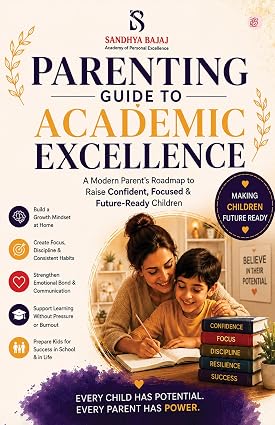
Every parent wants their child to succeed academically, but helping children achieve their potential can sometimes become a source of stress for the entire family. Constant reminders, struggles with focus, resistance to studying, and pressure to achieve better marks can create frustration and distance between parents and children. Parenting Guide to Academic Excellence by Sandhya Bajaj explores a different approach, one that focuses on understanding how children learn rather than simply pushing them to perform.
The book encourages parents to look beyond grades and consider the habits, mindset, and learning skills that support academic growth. By creating a supportive home environment and helping children develop focus, memory, discipline, and confidence, parents can play a more constructive role in their educational journey.
Book Details
| Detail | Information |
|---|---|
| Book Title | Parenting Guide to Academic Excellence |
| Author | Sandhya Bajaj |
| Genre | Parenting, Education, Child Development |
| Language | English |
| Publication Date | October 13, 2026 |
| Buy the Book | Amazon India |
Review of Parenting Guide to Academic Excellence
One of the most meaningful ideas in this book is that academic struggles are not necessarily a reflection of a child’s intelligence. Children may need help developing the skills required to concentrate, retain information, study consistently, and believe in their own abilities. This perspective encourages parents to move away from blame and frustration and toward a more supportive approach to learning.
A central feature of the book is its framework of the Three Pillars of Academic Excellence: Mindset, Math, and Memory. These pillars bring attention to different aspects of academic development, from a child’s attitude toward learning to the practical skills needed to understand and remember information. The framework offers parents a way to think about academic progress beyond examination results alone.
The discussion of focus and discipline is particularly relevant to families who find themselves caught in a cycle of reminders and arguments about studying. Rather than relying on shouting or force, the book emphasizes building discipline in a way that encourages children to become more responsible for their own learning. This approach supports the long-term goal of raising children who can manage their studies with greater independence.
Another important theme is the difference between reacting and responding. When academic performance becomes a source of tension, a parent’s immediate reaction can sometimes increase pressure instead of solving the problem. Learning to respond more thoughtfully may help parents communicate more effectively, understand their child’s difficulties, and create a healthier learning environment.
The book also explores smart revision techniques and memory retention. These topics are valuable because studying is not simply about spending more hours with textbooks. Children also need effective ways to revisit information, strengthen understanding, and develop consistent learning habits.
Beyond academic techniques, Sandhya Bajaj places importance on confidence and emotional well-being. A child who feels supported and capable may be better positioned to approach challenges with persistence. The book’s emphasis on creating a home that naturally supports success reinforces the idea that learning habits develop through everyday routines, encouragement, and family interactions.
Overall, the book’s practical, parent-focused approach may appeal to families seeking alternatives to constant pressure and additional tuition. Its emphasis on mindset, learning strategies, and independence provides a useful starting point for parents who want to support both academic progress and personal development.
Final Thoughts
Parenting Guide to Academic Excellence by Sandhya Bajaj presents an encouraging perspective on parenting and education. It shifts attention from marks alone toward the habits, mindset, memory skills, and emotional support that contribute to a child’s development.
For parents who want to reduce study-related conflict and help their children become more confident, disciplined, and independent learners, this book offers practical themes worth exploring. Its central message is simple: supporting a child’s success begins with understanding how they learn and creating the right conditions for growth.