
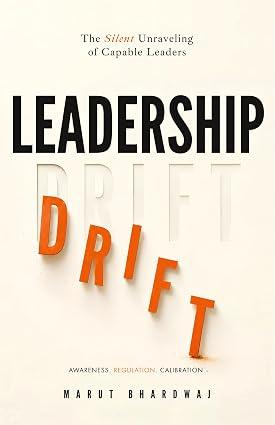
What happens when a capable leader continues to deliver results but gradually moves away from the kind of leader they want to be? Leadership Drift: The Silent Unraveling of Capable Leaders by Marut Bhardwaj explores this important question, examining how sustained pressure can quietly change leadership behaviour, decision-making, and relationships.
Leaders often face competing demands, difficult decisions, and expectations that leave little room for reflection. Over time, these pressures can turn patience into impatience, trust into control, curiosity into defensiveness, and strategic thinking into excessive involvement in daily operations. The changes may be subtle, but they can influence team morale, organisational culture, and leadership effectiveness.
Through its practical framework, the book encourages leaders to recognise these patterns early, understand their responses to pressure, and regain a more conscious and balanced approach to leadership.
Book Details
| Detail | Information |
|---|---|
| Book Title | Leadership Drift: The Silent Unraveling of Capable Leaders |
| Author | Marut Bhardwaj |
| Publisher | StoryMirror Infotech Pvt. Ltd. |
| Publication Date | September 23, 2026 |
| Language | English |
| Print Length | 420 pages |
| Reading Age | 12 years and up |
| Amazon Link | View on Amazon |
Review of Leadership Drift
One of the most compelling ideas in Leadership Drift is that leadership challenges do not always begin with poor performance or a lack of competence. Sometimes, capable leaders continue achieving their goals while their behaviour gradually changes under pressure. This distinction makes the book particularly relevant to experienced managers, executives, entrepreneurs, and professionals who carry significant responsibility.
Marut Bhardwaj introduces the Window of Equilibrium, a framework designed to help leaders understand how they operate under pressure, recognise when their behaviour begins to drift, and identify ways to return to a more conscious state. Instead of treating leadership as a fixed collection of qualities, the book presents it as an ongoing process of awareness, adjustment, and recovery.
The framework is supported by five operating states, six leadership drift archetypes, and twelve leadership tensions. Topics such as control and trust, confidence and humility encourage readers to examine the competing demands that shape leadership decisions. These tensions are especially relevant in situations where a leader must remain decisive without becoming controlling or confident without dismissing other perspectives.
Another valuable concept is recovery velocity, which focuses on how quickly leaders can recognise and interrupt unhelpful patterns. This shifts attention from expecting leaders to remain perfectly composed at all times to developing the ability to notice mistakes, respond thoughtfully, and regain balance.
The inclusion of the Window of Equilibrium Index, recovery practices, and a Personal Leadership Operating System gives the book an action-oriented direction. These elements are intended to help readers move beyond recognising their weaknesses and toward building practical habits for more deliberate leadership.
Bhardwaj’s approach will appeal to readers interested in organisational behaviour, emotional maturity, self-awareness, and leadership development. The book’s central strength is its focus on the subtle changes that can affect even experienced leaders, encouraging reflection before those changes become deeply established habits.
Final Thoughts
Leadership Drift by Marut Bhardwaj offers a thoughtful framework for understanding how pressure can influence leadership behaviour without immediately affecting visible performance. By combining leadership tensions, drift archetypes, and recovery practices, it encourages leaders to become more aware of their patterns and take responsibility for how they respond to challenging situations.
For executives, managers, business owners, team leaders, and aspiring professionals, this book provides a useful perspective on the importance of self-awareness and behavioural adjustment. Its central message is clear: effective leadership is not just about maintaining performance, but also about recognising when you are drifting away from your values and developing the capacity to return.