
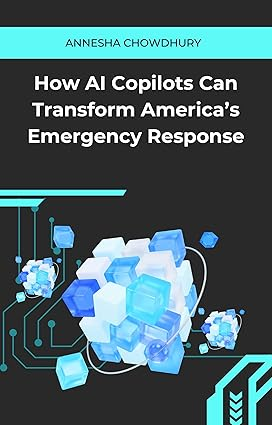
Natural disasters are becoming more frequent, more destructive, and far more costly. Yet the systems responsible for responding to them often remain outdated. How AI Copilots Can Transform America’s Emergency Response examines this growing gap and proposes a powerful solution: the integration of artificial intelligence into emergency management.
Rather than presenting a distant futuristic concept, the book focuses on practical frameworks that can reshape how governments, emergency managers, and responders prepare for and handle disasters.
A Crisis That Is Growing Faster Than the Response
The United States has seen a dramatic rise in billion dollar disasters. In 2024 alone, 27 such events caused nearly $182.7 billion in damage and resulted in hundreds of lives lost.
From devastating hurricanes and wildfires to extreme winter storms, disasters are no longer rare events. They are recurring realities. Yet many response systems still rely on traditional tools such as paper maps, manual reports, and reactive strategies.
This book highlights the urgent need to shift from reactive response to predictive resilience.
The Role of AI Copilots in Crisis Management
The central concept of the book is the idea of AI copilots. These systems are not meant to replace human leadership. Instead, they serve as decision support systems that assist emergency managers during high pressure situations.
Imagine an incident commander facing a major hurricane in the middle of the night. Hundreds of thousands of people may need evacuation, but available transportation and resources are limited. Human judgment remains essential, but AI can rapidly analyze vast data sets, simulate evacuation scenarios, and present actionable options with probability based outcomes.
This kind of intelligent support can dramatically improve decision making during critical moments.
Key Innovations Explored in the Book
The book introduces several advanced tools and frameworks that could redefine disaster response.
Predictive GIS Mapping
Real time geographic intelligence can forecast where disasters are likely to strike rather than simply tracking damage after it occurs.
AI Driven Evacuation Simulations
Artificial intelligence can run thousands of evacuation models in seconds, allowing officials to evaluate different strategies before acting.
Infrastructure Risk Scoring
The InfraIQ system described in the book analyzes vulnerabilities in infrastructure to identify potential failures before they cause cascading crises.
Explainable AI Systems
The book stresses the importance of transparency. Decision makers must understand how AI arrives at recommendations so that human oversight remains central.
Integrated Crisis Platforms
The Crisisense platform demonstrates how predictive analytics, infrastructure monitoring, and operational coordination can function in a unified system.
Real World Case Studies
To illustrate the need for transformation, the book examines major disasters such as Hurricane Katrina, Hurricane Harvey, the Texas power grid freeze, and the Maui wildfires.
Each case reveals systemic weaknesses in planning, coordination, and response. By analyzing these failures, the author outlines how AI enabled systems could have improved outcomes and potentially saved lives.
Who Should Read This Book
This work is designed for a wide audience involved in disaster preparedness and response.
Emergency managers seeking modern tools
Government policymakers responsible for disaster funding
Technology leaders building crisis response platforms
First responders exploring emerging technologies
Researchers studying resilience and risk management
Citizens interested in how disaster response systems function
Book Details
| Detail | Information |
|---|---|
| Title | How AI Copilots Can Transform America’s Emergency Response |
| Genre | Technology, Public Policy, Disaster Management |
| Language | English |
| Reading Age | 10 to 18 years |
| Publication Date | January 28, 2026 |
| Book Link | https://a.co/d/05T3HoCV |
Final Reflection
How AI Copilots Can Transform America’s Emergency Response argues that the scale of modern disasters demands a new generation of tools. Artificial intelligence, predictive modeling, and real time data analysis can dramatically improve the speed and effectiveness of emergency decisions.
The book makes a compelling case that the goal is not simply faster response. The real objective is smarter prevention and stronger resilience.
As disasters become more complex, the systems designed to protect communities must evolve just as rapidly.