
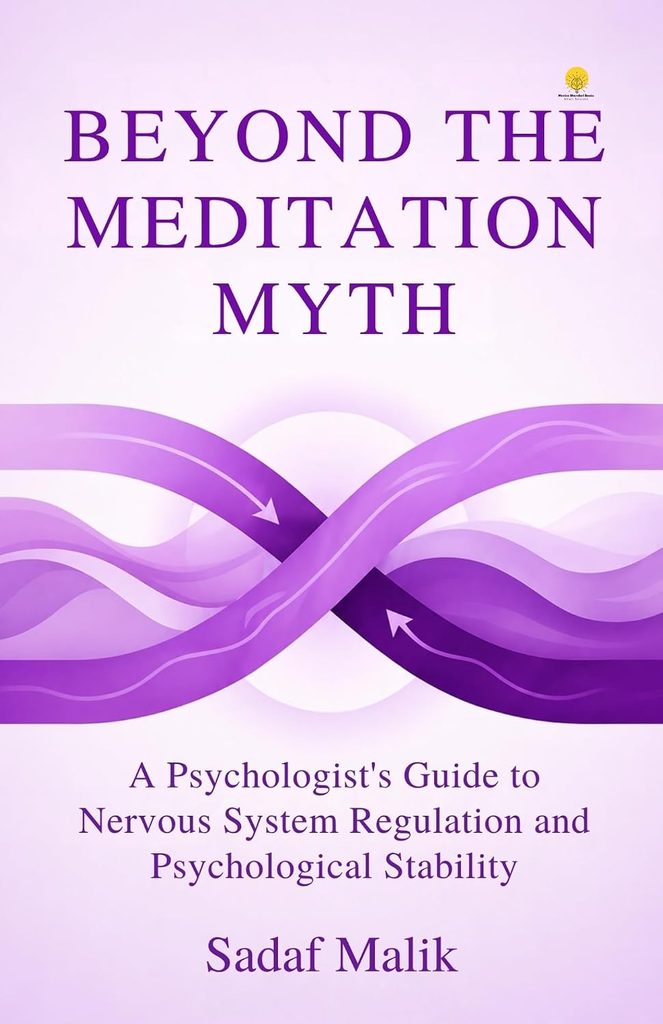
In a world where meditation, mindfulness, and relaxation are often presented as straightforward solutions to stress, Beyond the Meditation Myth: A Psychologist’s Guide to Nervous System Regulation and Psychological Stability offers a thoughtful and accessible exploration of a deeper question: What if the difficulty in relaxing is not simply a matter of the mind, but a reflection of what the nervous system has learned to expect?
Written by Sadaf Malik, RCI-Licensed Psychologist, the book brings together psychological principles, nervous system education, and practical guided relaxation techniques to create a resource for readers who want to understand calm not as something to force, but as a capacity that can gradually be developed.
At the heart of the book is a compassionate reframing of relaxation. Rather than suggesting that people simply need to think positively, meditate harder, or become better at switching off, Sadaf Malik explores how prolonged stress, emotional overload, mental fatigue, and sustained states of alertness can make stillness feel unfamiliar. The book emphasizes that many people are not failing at relaxation; they may simply be working with a nervous system that has become accustomed to remaining activated.
Understanding Why Relaxation Can Feel Difficult
One of the book’s defining ideas is that relaxation is not a switch but a skill and a capacity that can be strengthened.
The book begins by examining the modern tendency to associate resilience with constant functioning. Productivity, problem-solving, analysis, and continuous mental engagement can become so normalized that genuine rest begins to feel unfamiliar. Against this backdrop, the book introduces nervous system regulation as an important foundation for emotional balance and psychological stability.
Its approach is particularly reassuring because it removes the idea of performance from relaxation. Readers are not asked to achieve a perfect state of stillness. Instead, they are encouraged to create repeated opportunities for the body to experience safety and steadiness.
This philosophy gives the book a warm and practical character. Its emphasis is not on dramatic transformation, but on small, intentional practices that can gradually become more familiar.
When the Body Comes Before the Mind
A central principle running throughout the book is the relationship between physiological regulation and psychological clarity.
The book presents the idea that when the nervous system is highly activated, simply trying to reason one’s way into calm can be difficult. Instead, the body can provide an important starting point. Once the body begins to settle, attention, emotional flexibility, and mental clarity can become more accessible.
This is why the book moves progressively from physiological practices toward more focused forms of relaxation. Breathing awareness forms the initial foundation, followed by Progressive Muscle Relaxation, induction techniques, deepening exercises, and visualization.
The progression creates a sense of structure while still allowing readers to choose practices according to their needs and comfort.
Breathing Awareness: Beginning With Rhythm
The first major practice introduced is breathing awareness.
Breathing is presented as an especially accessible entry point because it connects conscious attention with an automatic physiological process. Rather than attempting to control every thought, readers are encouraged to notice the breath, its rhythm, movement, pauses, and physical sensations.
The guided exercise gradually moves through intentional breathing before returning to natural breathing and observation. Readers are also reminded that distraction is normal. Returning attention to the breath is itself part of developing attentional control and regulation.
The approach is deliberately practical. The book recognizes that readers may not always have the time or capacity for lengthy exercises and therefore emphasizes that shorter practices can also have a place in everyday routines. Consistency is repeatedly presented as more important than intensity.
Progressive Muscle Relaxation: Discovering Tension Through the Body
The book then turns toward Progressive Muscle Relaxation (PMR), a body-focused technique designed to help readers identify and release physical tension.
The practice takes readers gradually through different parts of the body, encouraging awareness of sensations and the contrast between muscular tension and release. Feet, calves, thighs, hips, lower back, abdomen, chest, shoulders, arms, hands, neck, and face are brought into awareness.
This section reinforces the book’s broader body-mind perspective. Stress can manifest physically, sometimes through subtle or unconscious muscular holding. By learning to recognize these sensations, readers can become more aware of their physical state and begin responding to tension earlier.
The book also presents PMR as something that can eventually move beyond a formal exercise. Awareness of tightening shoulders, a clenched jaw, or other signs of tension can become part of everyday self-regulation.
Exploring Induction and Focused Attention
Another section introduces readers to induction techniques, which are used to guide attention inward and reduce external distraction.
The book explains induction in an accessible way, presenting it as a structured shift in attention rather than something associated with losing awareness or control. Predictable sequences, sensory focus, gentle repetition, and physical awareness are used to help create a more settled state.
The exercises include techniques such as:
- Finger spreading
- Eye fixation
- Hand levitation
- Magnetic hands
- Arm drop
- Free-fall imagery
What makes this section particularly practical is the freedom it gives readers. The techniques are presented as options rather than requirements. Readers can work with one method consistently, rotate between approaches, or combine them with breathing and Progressive Muscle Relaxation.
This reinforces one of the book’s recurring messages: there is no single experience of relaxation that every person must reproduce.
Deepening Relaxation Through Rhythm and Imagery
Once readers have explored foundational relaxation techniques, the book introduces deepeners designed to help stabilize an emerging relaxed state.
These exercises use repetition, counting, gradual progression, and imagery. The Countdown Deepener and Staircase Deepener, for example, guide readers through progressively deeper states of physical and mental settling.
The emphasis remains on stability rather than intensity. Deep relaxation is not presented as losing consciousness or escaping awareness. Instead, the exercises are designed to help the body and mind remain comfortably settled.
This gradual approach is consistent with the book’s larger philosophy that regulation develops through familiarity and repetition.
Visualization as a Path Toward Safety
The book’s visualization practices add another dimension to its exploration of relaxation.
Readers are invited to imagine or recall a place associated with safety and comfort, paying attention to sensory details such as surroundings, textures, sounds, temperature, and physical support. The exercises recognize that visualization does not look identical for everyone. Some readers may experience vivid mental pictures, while others may experience sensations, concepts, colors, or simply an emotional impression.
This inclusive treatment makes visualization approachable even for readers who do not naturally form detailed mental images.
The purpose is not to create a perfect imaginary environment, but to explore an internal experience of steadiness and safety.
A Flexible Resource Rather Than a Strict Programme
One of the book’s most appealing qualities is its flexible structure.
Readers are not expected to complete every exercise in sequence or finish the book in a single sitting. Instead, the book is designed as something that can be returned to according to one’s circumstances. On one day, breathing awareness may feel appropriate; on another, a longer relaxation or visualization exercise may be more suitable.
This flexibility also extends to duration. The book encourages readers to work with practices that fit their current capacity rather than treating length as a measure of success.
In this sense, the book functions not only as something to read but also as a practical companion for repeated use.
Making Psychological Concepts Accessible
Although the book is grounded in psychological concepts and references relevant research, its presentation remains accessible.
The discussion of the autonomic nervous system, sympathetic and parasympathetic responses, the freeze response, the window of tolerance, attention, physiological regulation, and the relationship between body and mind is connected directly to practical exercises.
The references include research and established works addressing breathing, attention, mindfulness, stress management, progressive muscle relaxation, imagery, and psychological regulation.
This combination of explanation and practice gives the book an educational dimension without turning it into a purely academic text.
Who Can Benefit From the Book?
Beyond the Meditation Myth is designed to be approachable for readers with different levels of experience.
It speaks to individuals dealing with stress, mental fatigue, or emotional overload, as well as students and professionals looking for greater grounding and focus. Mental health practitioners and trainees may also find the structured relaxation scripts useful as a resource for personal or professional exploration. Importantly, the book does not require previous experience with meditation, relaxation, breathwork, or visualization.
Its broad accessibility reflects the author’s larger aim of translating psychological knowledge into practices that people can understand and incorporate into everyday life.
A Compassionate Philosophy of Regulation
Perhaps the most distinctive quality of Beyond the Meditation Myth is its compassionate treatment of the reader.
The book repeatedly moves away from pressure and toward patience. Readers are reminded that regulation is gradual, that stillness can initially feel unfamiliar, and that there is no requirement to achieve a particular level of relaxation.
The practices are presented as invitations rather than demands. A reader can pause, shorten an exercise, modify an image, keep their eyes open, or return to simple breathing whenever necessary.
That philosophy makes the book feel less like another productivity-oriented wellness programme and more like an invitation to develop a kinder relationship with one’s own internal state.
About the Author: Sadaf Malik
Sadaf Malik is an RCI-Licensed Psychologist with more than a decade of experience in psychological assessment, counselling, psychotherapy, and mental health education. She is the Founder of Sadaf Blooming Souls & Psyche Pvt. Ltd., where her work has extended across clinical, educational, and corporate settings.
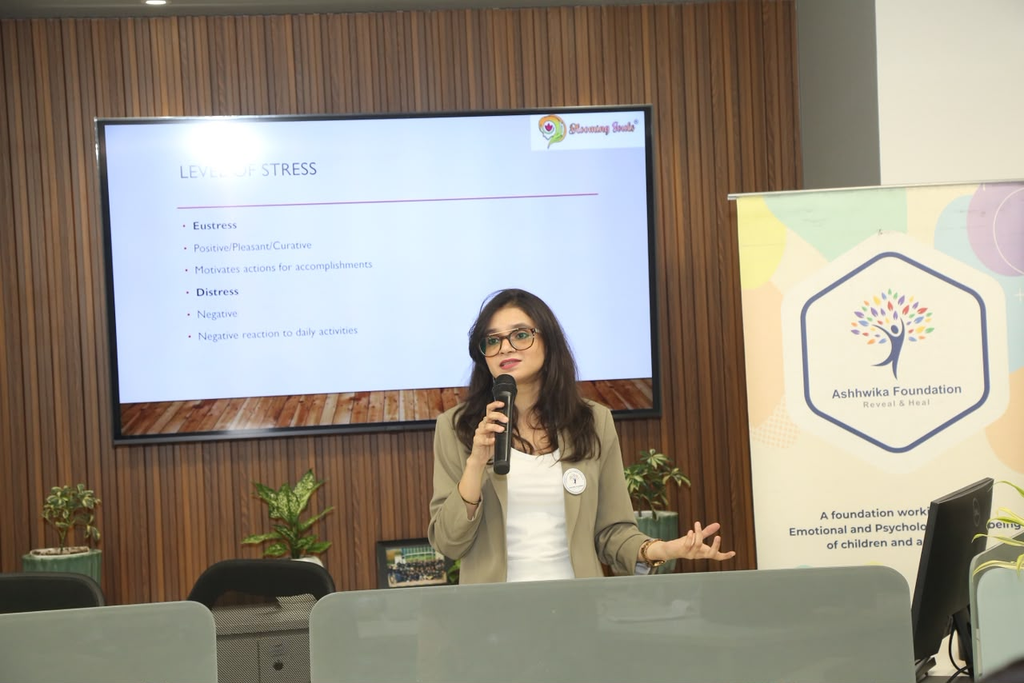
Her professional journey includes early clinical exposure at Rashtrapati Bhavan and advanced mentorship under Padma Shri awardee Dr. Mohsin Wali. Over the years, she has worked with thousands of individuals experiencing stress, anxiety, burnout, trauma, and other emotional challenges, developing an approach that combines psychological knowledge with compassion and practical application.
Sadaf Malik is also the Founder of Calmora Foundation, a non-profit initiative focused on mental health awareness, psychological literacy, education, training, and community outreach. Her work reflects a continuing commitment to making psychological knowledge more accessible and applicable to everyday well-being.
Beyond the Meditation Myth reflects this professional orientation by bringing psychological concepts into a practical format that readers can revisit and apply at their own pace.
Connect With Sadaf Malik
Readers interested in learning more about Sadaf Malik and her professional work can visit her organization and professional profile:
Blooming Souls & Psyche – Official Website
Final Editorial Perspective
Beyond the Meditation Myth offers readers a refreshing way to think about relaxation, moving the conversation beyond the familiar instruction to simply “calm the mind.”
Its central message is that the path toward calm can begin with understanding the body.
Through breathing awareness, Progressive Muscle Relaxation, induction techniques, deepeners, and visualization, the book gradually builds a practical vocabulary for nervous system regulation. At the same time, its explanations of stress, attention, physiological activation, and internal safety give readers a framework for understanding why these practices may matter.
The book’s greatest appeal lies in its combination of psychological education and practical experience. It does not present relaxation as a performance or promise an instant transformation. Instead, it encourages readers to approach regulation through repetition, patience, curiosity, and self-kindness.
For anyone interested in stress management, nervous system regulation, relaxation techniques, emotional well-being, psychological stability, mindfulness, breathing practices, or practical psychology, Beyond the Meditation Myth offers a thoughtful and accessible place to begin exploring how calm can be cultivated from within.
Ultimately, the book invites readers to reconsider what relaxation really means. It is not necessarily about eliminating thoughts, escaping responsibilities, or achieving perfect stillness. It is about creating the conditions in which the body can gradually feel safe enough to settle and from that steadier ground, allowing greater clarity and balance to emerge.
Book Details
| Details | Information |
|---|---|
| Title | Beyond the Meditation Myth |
| Author | Sadaf Malik |
| Print Length | 66 pages |
| Publisher | Monica Bhandari Books |
| Publication Date | 5 August 2026 |
Read More : Descriptive Review: Where Silence Learned My Name: Poems of Survival, Hope & Becoming By Khushi Gupta