
Land Acquisition Saga Of Bengal Historical Divide And Thereafter by Raja Mukherjee explores Bengal’s land conflicts through colonial history, partition, agrarian reform, and political movements, offering deep insight into the roots of contemporary land acquisition debates.
Book Details
| Field | Information |
|---|---|
| Title | Land Acquisition Saga Of Bengal Historical Divide And Thereafter |
| Author | Raja Mukherjee |
| Publisher | Adhyyan Books |
| Publication Date | 27 July 2025 |
| Print Length | 370 pages |
| Language | English |
| Amazon Link | https://amzn.in/d/eXcjVh1 |
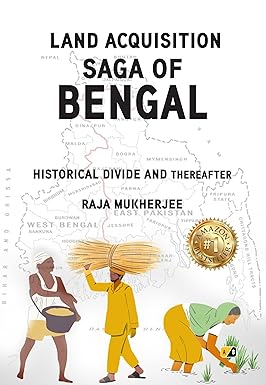
Introduction
Land Acquisition Saga Of Bengal Historical Divide And Thereafter is a meticulously researched and deeply analytical work that examines one of the most complex socio political regions in Indian history. Authored by Raja Mukherjee, the book explores how land ownership, agrarian structures, colonial policies, and political ideologies collectively shaped Bengal’s past and continue to influence its present.
Rather than treating land acquisition as an isolated policy issue, the book positions it as a historical process rooted in class conflict, communal tension, and structural inequality. Through careful examination of Bengal’s rural landscape, Mukherjee reveals how land became both an economic resource and a political weapon.
Historical Foundations of the Bengal Land Question
The book traces the origins of Bengal’s land conflicts to the colonial era, particularly under the zamindari system. Mukherjee explains how land ownership patterns created deep divisions between landlords and peasants, embedding economic exploitation into everyday rural life.
By linking agrarian distress to broader political developments, the author demonstrates how land control shaped identities, loyalties, and resistance movements. These structural imbalances did not disappear with independence but instead carried forward into post colonial governance and reform efforts.
Partition, Refugees, and Agrarian Transformation
A major strength of the book lies in its treatment of the Partition of Bengal and its long term consequences. Mukherjee explores how displacement, refugee resettlement, and demographic change intensified land scarcity and competition.
The book shows how refugees, peasants, and political actors became entangled in struggles over land access, ownership, and legitimacy. These pressures reshaped rural Bengal and contributed to enduring socio economic tensions that continue to influence policy debates today.
Political Movements and Land Reform
Mukherjee critically assesses the role of political movements in addressing Bengal’s land question. From Congress era reforms to Left led agrarian restructuring, the book examines how ideology translated into policy and where it fell short.
Rather than presenting a single narrative, the author highlights contradictions within political approaches, showing how reforms sometimes alleviated inequality while at other times reinforced new hierarchies. The analysis remains grounded in evidence, drawing from archival records and historical documentation.
Voices from the Countryside
One of the book’s most valuable contributions is its focus on lived experience. Peasants, refugees, and grassroots political actors are not treated as abstract categories but as historical agents whose voices shaped events on the ground.
By incorporating lesser known perspectives, the book challenges dominant narratives and adds depth to the understanding of Bengal’s agrarian history. This human dimension strengthens the book’s relevance for readers seeking more than policy analysis.
Academic and Contemporary Relevance
Land Acquisition Saga Of Bengal Historical Divide And Thereafter is a significant contribution to South Asian studies, political history, and agrarian studies. Its multidisciplinary approach makes it especially useful for scholars and students examining land reform, colonial legacies, and post independence political development.
At the same time, the book offers valuable context for contemporary debates around land acquisition, development projects, and rural displacement in Bengal and across India.
Conclusion
Land Acquisition Saga Of Bengal Historical Divide And Thereafter is not just a historical account but a comprehensive examination of how land, power, and memory intersect in Bengal’s past and present. Raja Mukherjee’s work offers readers a deeper understanding of why land acquisition remains such a contested issue and how historical patterns continue to influence modern policy and politics.
This book is essential reading for anyone seeking to understand the roots of agrarian conflict in Bengal and the broader Indian subcontinent.
Read More : Book Review: Doing Poetic Justice by Vishwas Anand