
What if some of the ideas widely associated with Sanatana Dharma developed differently from the earliest spiritual traditions that preceded them? The Distortions in Sanatana Dharma: New Revelations by Mukundan P.R. takes up this question through an examination of ancient scriptures, cosmological concepts, spiritual traditions, and the evolution of Hindu religious thought.
The book presents a distinctive inquiry into what it describes as distortions that have gradually become embedded in traditional understanding. At the center of this exploration is a fundamental question: was the original foundation of Sanatana Dharma based on the familiar Trimurti of Brahma, Vishnu, and Shiva, or did an earlier spiritual framework center on Manu-Purusha and a singular Cosmic Being?
Drawing upon references to the Rigveda, Chandogya Upanishad, Brihadaranyaka Upanishad, Vishnu Purana, Bhagavata Purana, and the teachings of Navajyoti Sri Karunakara Guru, Mukundan P.R. develops an alternative perspective on the origins and evolution of Sanatana Dharma.
Book Details
| Book Details | Information |
|---|---|
| Title | The Distortions in Sanatana Dharma: New Revelations |
| Author | Mukundan P.R. |
| Genre | Hindu Philosophy, Spirituality, Religious Studies, Sanatana Dharma |
| Language | English |
| Print Length | 245 pages |
| Publication Date | 2 October 2025 |
| Book Link | Read on Amazon India |
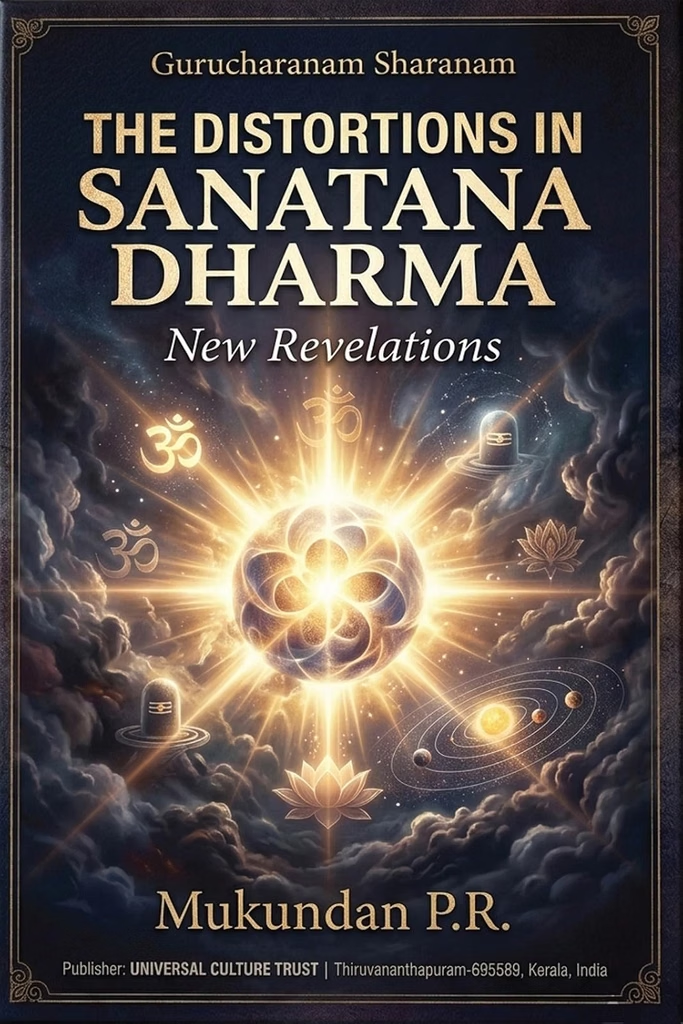
Review: A Search for the Foundations of Sanatana Dharma
The Distortions in Sanatana Dharma: New Revelations approaches Sanatana Dharma through a question of origins. Rather than accepting the most familiar formulations of Hindu religious thought as the complete picture, the book looks toward Vedic and Upanishadic sources to explore whether an older and different foundation can be identified.
Its central investigation concerns the relationship between Manu, Purusha, the Trimurti, and the broader evolution of Hindu spirituality. This makes the book particularly oriented toward readers interested in the historical, scriptural, philosophical, and theological dimensions of Sanatana Dharma.
Questioning the Familiar Trimurti Framework
One of the book’s principal areas of inquiry is the Trimurti doctrine, in which Brahma, Vishnu, and Shiva are associated with creation, preservation, and dissolution.
The book does not simply treat this framework as the starting point of its discussion. Instead, it asks whether the Trimurti represents the original foundation of Sanatana Dharma or whether it emerged through later developments in Hindu religious thought.
This question gives the book its investigative character. The discussion moves beyond commonly understood representations and turns toward earlier scriptural traditions in an attempt to reconsider how concepts of creation and cosmic governance may have been understood.
Manu and the Concept of Purusha
At the heart of the book is the figure of Manu, described within its framework as the primordial progenitor of humanity and an administrator of cosmic cycles known as Manvantaras.
The book explores the possibility that Manu-Purusha represents an older foundation of Sanatana Dharma. In this interpretation, Manu is considered in relation to the Vedic concept of Purusha, the singular Cosmic Being from whom existence emerges.
This creates an alternative paradigm to the later popular emphasis on three principal deities. The relationship between Manu, Purusha, humanity, and cosmic order becomes an important part of the book’s broader investigation.
Returning to Vedic and Upanishadic Sources
A significant feature of the work is its emphasis on scriptural references. The book draws from several important texts, including the Rigveda and major Upanishadic and Puranic sources.
The references to the Chandogya Upanishad and Brihadaranyaka Upanishad, alongside the Vishnu Purana and Bhagavata Purana, provide the textual foundation for its exploration.
Through these sources, the book examines the distinction between earlier Vedic and Upanishadic concepts and later developments in religious interpretation. Its approach encourages readers to look beyond familiar popular formulations and engage with the textual traditions themselves.
Guru-Centric Monotheism and Priest-Centric Ritualism
Another important theme is the distinction the book makes between Guru-centric monotheism and priest-centric ritualism.
According to the book’s perspective, epochal Gurus played a significant role in preserving Sanatana Dharma across different ages. The work examines whether this Guru-centered spiritual approach was gradually overshadowed by forms of deity-centered ritualism during the Puranic period.
This discussion introduces another layer to the book’s central argument. The question is not only about which divine figures occupy the center of religious understanding, but also about how spiritual knowledge is transmitted, preserved, interpreted, and practiced.
The Role of Sectarian Development
The book proposes that the elevation of the Trimurti framework was connected to sectarian developments during the Puranic period.
Within this perspective, the evolution of religious traditions is viewed as an important factor in understanding how particular theological ideas became prominent. The book therefore examines Sanatana Dharma not as a static system, but as a spiritual tradition whose interpretations and practices developed over different historical periods.
This approach gives the work a strong focus on religious evolution and the relationship between foundational teachings and later interpretations.
Recovering the Manu Parampara
The concept of Manu Parampara becomes particularly important in the book’s proposed alternative framework.
The work presents the recovery of Manu Parampara as a way of understanding what it describes as the original universal and monotheistic foundations of Hindu spirituality. This places Manu at the center of an exploration that connects humanity, cosmic cycles, spiritual authority, and the transmission of ancient wisdom.
For readers interested in alternative interpretations of Hindu philosophical history, this provides a distinctive lens through which familiar concepts can be reconsidered.
A Dialogue Between Scripture, Tradition, and Interpretation
One of the defining characteristics of The Distortions in Sanatana Dharma: New Revelations is its attempt to bring different layers of Hindu thought into conversation with one another.
Vedic literature, Upanishadic philosophy, Puranic traditions, concepts of Manu and Purusha, Guru traditions, and later religious practices all form part of the book’s examination.
Rather than focusing exclusively on ritual or theology, the book asks broader questions about how spiritual knowledge changes over time and how certain interpretations become established as conventional understanding.
This makes the work particularly relevant to readers who enjoy exploring the relationship between ancient scriptures and contemporary interpretations of Sanatana Dharma.
Why This Book Matters
The question of how Sanatana Dharma should be understood, and what constitutes its earliest foundations, is deeply significant for anyone interested in Hindu philosophy and religious history.
The Distortions in Sanatana Dharma: New Revelations contributes to this conversation by presenting a specific thesis centered on Manu-Purusha, Guru-centered spirituality, and the distinction between Vedic foundations and later sectarian developments.
Its emphasis on returning to scriptural sources also encourages readers to engage with ancient texts as part of their own exploration of spiritual history.
The book can therefore appeal to readers interested in:
- Sanatana Dharma and its origins
- Vedic and Upanishadic traditions
- Manu and Manvantara concepts
- Purusha and cosmic creation
- Hindu philosophical thought
- The historical development of Hindu traditions
- Guru-centered spiritual traditions
- Monotheistic interpretations of Hindu spirituality
- The relationship between Vedic and Puranic thought
- Alternative perspectives on the Trimurti
A Different Lens on Ancient Spiritual Knowledge
At a broader level, the book is an invitation to reconsider assumptions. Its approach is based on the belief that traditions can accumulate interpretations over time and that returning to foundational sources can offer another perspective.
The title, The Distortions in Sanatana Dharma: New Revelations, reflects this purpose. The work seeks to identify what it regards as deviations from an earlier spiritual understanding and proposes a framework through which readers can reconsider the foundations of Sanatana Dharma.
Its emphasis on clarity, scriptural exploration, and spiritual transformation gives the discussion both an intellectual and spiritual dimension.
Final Thoughts
The Distortions in Sanatana Dharma: New Revelations by Mukundan P.R. is an exploration of Hindu spiritual foundations that asks readers to look again at concepts they may already consider familiar.
Through its discussion of Manu-Purusha, the Trimurti, Vedic and Upanishadic literature, Puranic developments, Guru traditions, and the Manu Parampara, the book presents a distinctive interpretation of the evolution of Sanatana Dharma.
Its central inquiry is both straightforward and substantial: what was the original foundation of Sanatana Dharma, and how did later interpretations shape the way it is understood today?
For readers interested in Vedic traditions, Hindu philosophy, spiritual history, and alternative interpretations of Sanatana Dharma, this book offers a thought-provoking journey into the relationship between ancient knowledge, religious tradition, and contemporary understanding.
Read More : Book Review: Beyond Emoticons by Dr. Niharika